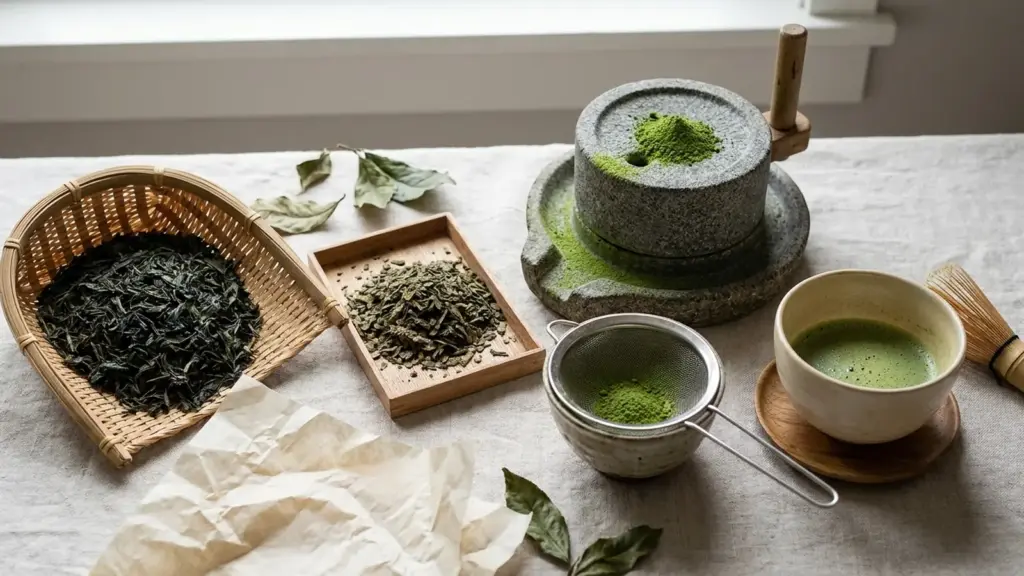
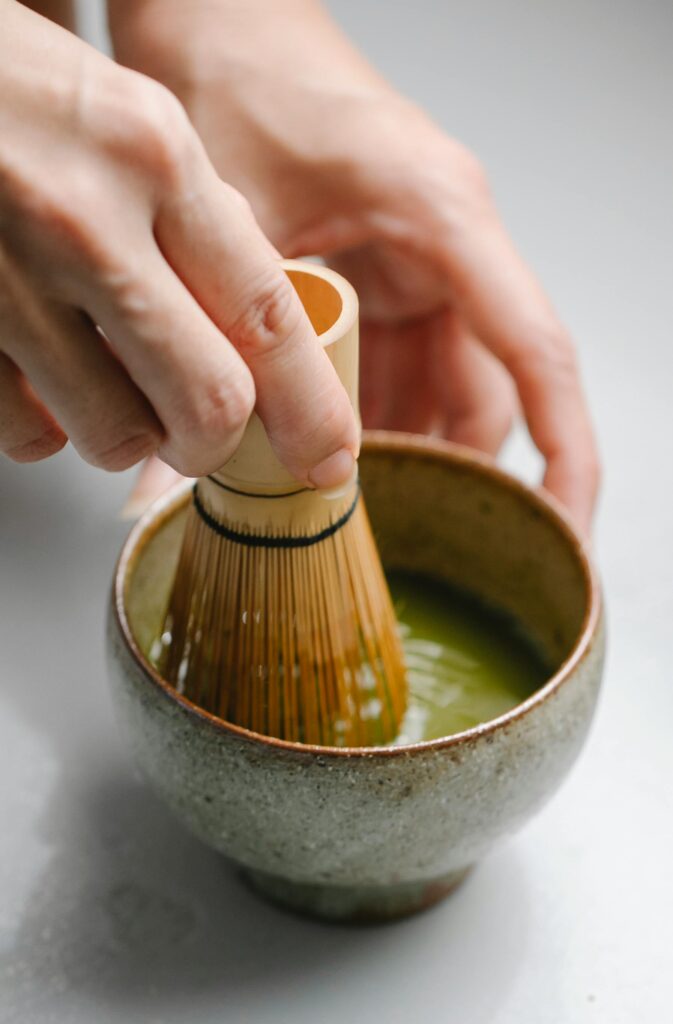
Matcha Authenticity concerns whether the contents match what the seller claims. The questions are distinct: Is the powder made from tencha? Where were the leaves grown and processed? Is the product pure tea or a formulated mix? Does evidence support a named regional origin or milling method?
A production definition, not a nationality test
The Japan Tea Central Association’s Green Tea Labelling Standards define matcha as finely powdered tencha. In the cited standard, tencha comes from covered cultivation and is dried without rolling. This separates the matcha route from simply pulverizing rolled sencha.
The standard’s explanatory note allows equipment with functions equivalent to a stone mill; it does not limit the definition to one mill material or a hand-powered mechanism. Its cultivation note describes approximately two to three weeks of covering, not an exact universal acceptance window. These are the terms of a named Japanese industry standard, not a claim that this glossary establishes worldwide law.
Country of origin is a separate claim. A product advertised as Japanese must support Japanese origin. That does not turn the production word “matcha” itself into proof that every qualifying tea powder worldwide must have been grown in Japan. Ask which definition the supplier follows and where each production stage occurred.
Read the ingredient and origin information together
A sweetened latte mix containing matcha is not the same product as pure matcha powder. Added sugar, other tea powders or coloring ingredients should be assessed against the product’s ingredient declaration and presentation. A clearly described blend is different from undisclosed substitution.
The association’s standard treats raw-material origin, finished-product origin and responsible business details separately. A seller’s Japanese address is therefore not a substitute for leaf-origin information. Likewise, a famous region named in branding should lead to a clear explanation of the source and applicable regional designation, not an assumption based on packaging.
What appearance and taste can establish
Color, aroma and texture are useful observations, but they cannot independently prove geography or the entire manufacturing chain. Yamamasa Koyamaen explains that some food-processing powders contain coloring ingredients and that manufacturers draw their own product-use boundaries. A very green appearance or a premium-sounding grade name is not a complete authentication test.
Nor does mechanical milling by itself establish that a tea is counterfeit. Compare the claimed method with the cited definition and supplier records. Taste can help you choose a tea you enjoy, but documentation is needed for factual claims about its origin and manufacture.
A practical verification checklist
- Identify the product as pure powder or a formulated blend.
- Ask whether its raw material is shaded, unrolled tencha.
- Distinguish growing, refining, milling and packing locations.
- Request support for specific region, harvest or milling claims.
- Read any certificate for its exact scope rather than treating it as an all-purpose endorsement.