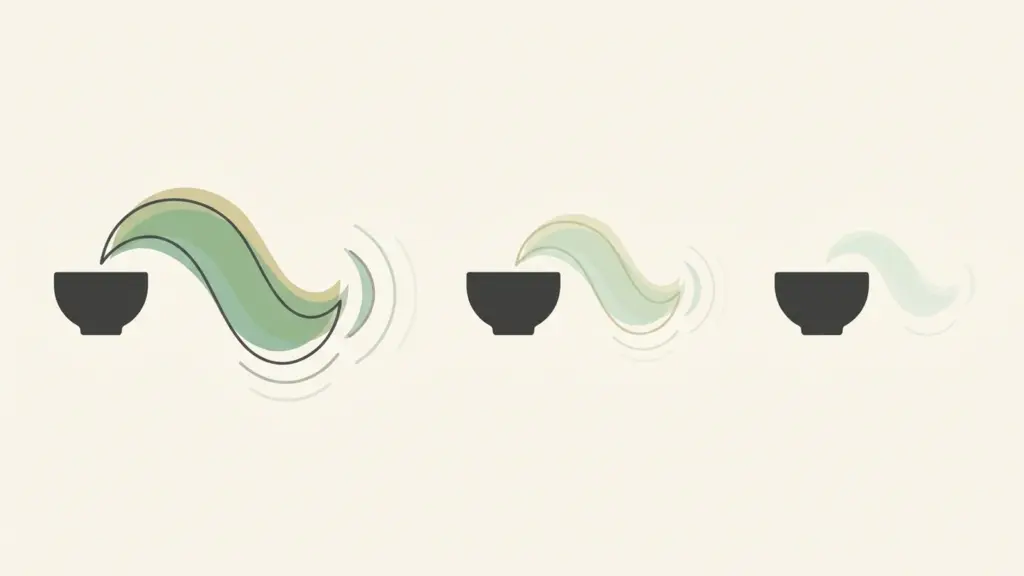
Finish: Matcha’s Lingering Flavor and Mouthfeel
Finish describes what lingers after swallowing matcha. Separate flavor, dryness, and duration without treating a long aftertaste as proof of grade.Definition of Finish
Finish is the lingering taste, aroma, and mouthfeel noticed after swallowing matcha. It describes both how long sensations remain and how they change. A finish may seem sweet, savory, bitter, drying, or clean; its duration alone does not establish the tea’s grade, freshness, or amino acid content.
Learn more
What remains after a sip
Finish refers to the aftertaste and lingering sensations noticed after swallowing matcha. It is distinct from the first impression of a sip. Some notes fade quickly; others become more apparent as stronger sensations diminish. Describing that change is more informative than simply calling the finish good or bad.
Keep duration separate from character. A long bitter impression is still a long finish. A brief, clean impression can be enjoyable. There is no universal number of seconds that turns a matcha into a higher grade, and persistence is not a measurement of its amino acid concentration.
A vocabulary for tasting
- Short or lingering: how quickly the impression fades.
- Sweet or savory: the taste you notice, rather than a claim about sugar or nutrient content.
- Vegetal, nutty, or floral: aroma associations that can remain part of the overall flavor.
- Drying or rough: mouthfeel, which should be recorded separately from bitter taste.
- Clean: a personal description for an ending without unwanted lingering notes.
These terms are descriptive tools, not mandatory qualities of a cultivar or price category. “Creamy” can describe a coating impression without meaning that the tea contains dairy. Similarly, a seaweed-like aroma does not mean that seaweed has been added.
Taste, aroma, and astringency are different
Matcha research distinguishes taste-active components from aroma-active volatiles. A study comparing three milling processes evaluated astringent, sweet, bitter, and umami attributes and examined their interactions. It also related selected volatile compounds to perceived aromas. That supports separating these observations rather than assigning the entire finish to theanine.
A 2013 study developed a taste-sensor method for matcha using EGCg as an astringency reference and monosodium glutamate as an umami reference. The researchers describe a tool for characterizing matcha for different uses. The abstract does not establish a human aftertaste-duration scale or prove that a long finish certifies high quality.
What cultivation can and cannot explain
Shading is applied to growing plants before the leaves are picked. Kyoto Prefecture describes covering tea gardens while new shoots develop, followed by production of shaded teas including tencha, matcha’s raw material. Leaves are not picked and then subjected to a preharvest shading period.
Growing and processing conditions influence the material in the bowl, but a tasting note cannot reconstruct those conditions on its own. Bitterness or dryness is not enough to diagnose oxidation, poor workmanship, or older leaves. Nor does a “ceremonial” label ensure a smooth, extended finish in every preparation.
A repeatable comparison at home
For a useful comparison, prepare the teas with the same water, powder amount, water amount, and mixing method. Take a small sip, swallow, and notice what remains without immediately drinking again. Record the main taste, the drying or coating sensation, and whether an aroma seems to return. This is a practical tasting exercise, not a standardized laboratory protocol.
If timing the finish, use the same observation intervals for every tea and describe the sensation that persists. “A drying sensation remained longer than the savory taste” is clearer than “long finish.” Rinse and allow your mouth to settle between samples so that the previous tea does not dominate the next comparison.
Using the result
A finish note helps communicate preference: you may enjoy a refreshing ending, persistent umami, or some astringency. Keep that preference separate from claims about harvest age, safety, nutrition, and market grade. Changing the preparation and tasting again is more useful than assuming a single bowl proves the leaf is inferior.
Sources and references
Objective Evaluation of Astringent and Umami Taste Intensities of Matcha using a Taste Sensor System
Accessed: 2026-09-08
Language: en
2013 abstract: matcha taste-sensor evaluation using EGCg for astringency and MSG for umami; characterization for different uses. No human aftertaste-duration threshold established.
Accessed: 2026-09-08
Language: en
Matched Okumidori harvest batch; laser diffraction in MCT reporting relative particle volume and microscopy; physical properties associated with chemical release/stability and sensory differences. Linalool/beta-ionone correlated with floral aroma and 2,3-diethyl-5-methylpyrazine with roasty aroma. Does not establish universal particle-size grades.
Accessed: 2026-09-08
Language: ja
Covering during shoot growth; kabusecha, gyokuro and tencha as covered teas; overhead versus direct-cover arrangements; black cloth, silver-surfaced direct-cover materials, and traditional reed/straw honzu. Does not guarantee hand-harvest or grade.

Emilie Schol
Founder of Best MatchaFrequently asked questions
Here are some frequently asked questions and answers.Does a long finish prove better matcha?
Does a long finish prove better matcha?
No. Duration and pleasantness are separate observations. A long finish can be bitter or drying and does not establish grade or chemical composition.
Is astringency the same as bitterness?
Is astringency the same as bitterness?
No. Record the drying or rough sensation separately from bitter taste, even when both are present in the finish.
Are leaves shaded after picking?
Are leaves shaded after picking?
No. Preharvest shading covers growing tea plants while the shoots develop; the leaves are harvested afterward.