What matcha accessories do
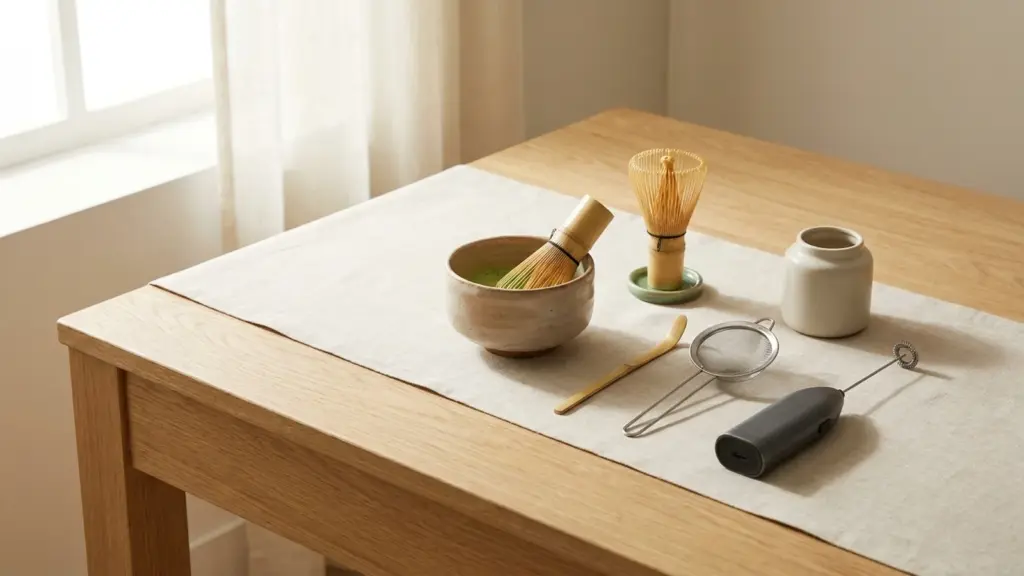
Matcha accessories are tools and vessels used to measure, whisk, prepare, and serve matcha. Traditional sets commonly center on a bamboo whisk, tea bowl, and bamboo scoop. Urasenke procedure resources identify those utensils within broader chanoyu practice, while Japanese government sources describe the chasen as the whisk used to stir matcha and produce froth.
Core tools and optional additions
A simple setup needs matcha, water, a bowl, and a suitable mixing tool. Ippodo’s starter-kit description presents a tea bowl, bamboo whisk, and portioned matcha as the minimal included items, with water added separately. A scoop, sifter, whisk stand, tray, storage container, or electric tool may be useful, but each serves a separate function and should be selected according to the drink and the manufacturer’s instructions.
A chasen is the traditional bamboo whisk. A chashaku is a narrow bamboo scoop used to transfer powdered tea, and a tea bowl provides space for preparation and serving. A sifter may help break apart compacted powder, but it is an optional preparation aid rather than a requirement established by the ceremonial sources.
How chasen differ
Japan Government reporting on Takayama chasen describes bamboo selection, boiling, drying, splitting, shaving, curling, and binding as distinct craft stages. It also notes that tea schools use whisks that differ in bamboo color, length, thickness, tine size, and tine count. Those differences reflect designs and traditions; the sources do not establish one universal quality ranking based on tine count or appearance.
Inspect a bamboo whisk before use and handle its fine tips gently. Ippodo advises replacing a chasen when its tips are broken. Cracks in the handle may develop naturally, so condition should be evaluated according to the maker’s instructions rather than through a blanket rule about every visible mark.
Cleaning and drying a bamboo whisk
Ippodo recommends dipping a chasen in water briefly before use to make the tips less brittle, then rinsing it with water without soap soon after whisking. Any stuck powder should be removed gently. The whisk should dry in the open air because leaving it in its case while damp can lead to mold.
A whisk stand can help the chasen retain its flared shape while drying. It is an optional care accessory, not a substitute for rinsing and airflow. Ippodo also recommends using the bamboo whisk with water and matcha; for a latte, milk or an alternative is added after the matcha has been whisked.
Modern tools and substitutes
Electric frothers and small kitchen whisks can be sold or used as mixing tools, but their care, vessel compatibility, and operating limits depend on the specific product. Follow the manufacturer’s food-contact, cleaning, charging, and water-exposure instructions. The retained sources do not support universal claims about bubble size, splash behavior, battery safety, or comparative performance.
Choose a tool by its stated function, the vessel being used, the preparation method, available storage, and care requirements. A starter kit can be convenient when its contents match those needs, but a bundled item is not automatically essential or superior. See matcha whisk and tools for practical setup guidance.
Bowls, stands, and other materials
Tea bowls, whisk stands, scoops, and sifters are available in different materials and shapes. Product-specific instructions should govern washing, heat exposure, dishwasher use, and replacement. The ceremonial and craft sources establish utensil identity and chasen manufacture, but they do not justify universal claims about cracked-bowl hygiene, repairs, rust, glaze safety, or every material used in modern accessories.
Accessories whose main function is unrelated to preparation or serving fall outside this category. Keeping consumable matcha products, preparation tools, and general merchandise separate makes comparison clearer.