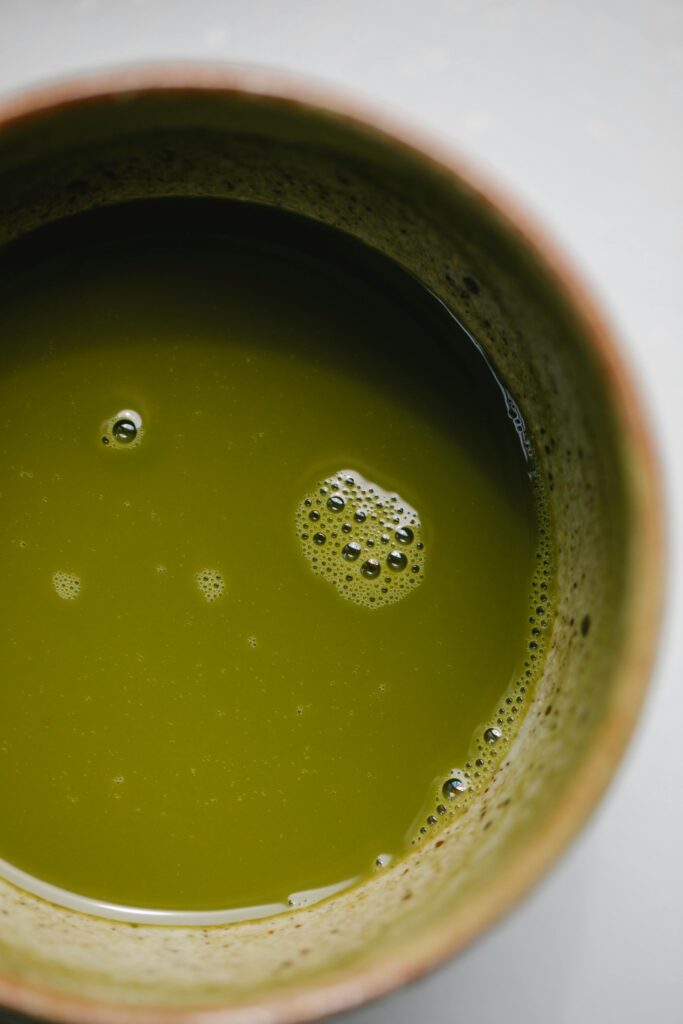
Defining Body in Matcha Terminology
Body in Matcha means the weight, fullness and substance of the tea as it moves over the tongue and coats the mouth. It is a texture description, distinct from flavor or aroma. Light-bodied, medium-bodied and full-bodied are useful tasting words, not formal product grades.
A light bowl can be enjoyable and well made. A full bowl can be smooth or rough. The aim is to describe what you perceive rather than assume that more thickness always means more quality.
What Creates Body in Matcha?
Matcha contains finely ground leaf material mixed into water. Not all of the powder simply dissolves. Research on matcha’s water solubility and water-holding capacity treats these as separate physical properties. Those measurements help explain why “dissolved tea” is an incomplete description, but they are not direct scores of how full a bowl will feel in the mouth.
Particle properties also matter. A study comparing cyclone-, bead- and stone-milled matcha found differences in particle size and surface morphology, alongside chemical and sensory differences. This supports considering the actual powder and milling process. It does not prove that every stone-milled product has the fullest body or that one particle size guarantees creaminess.
Preparation Changes the Comparison
How much powder is mixed with how much water is a practical starting point. Adding more water changes the concentration, so two bowls made from the same tin can feel different. Mixing also affects the distribution of powder and the amount of visible foam.
Traditional thin tea, usucha, and thick tea, koicha, show why preparation cannot be ignored. Omotesenke describes thin tea as whisked and thick tea as kneaded. Comparing their textures without noting the method would confuse the tea preparation with the identity of the powder.
Body, Foam, Grit and Astringency Are Different
- Body: how light or substantial the liquid feels.
- Foam: the bubbles at the surface and their contribution to the sip.
- Grittiness: a particulate or rough sensation, which can coexist with either light or dense tea.
- Astringency: the drying sensation, not a synonym for thickness.
- Bitterness and umami: taste descriptions, not measurements of body.
Keep these observations separate. A large cap of foam is not proof of a full-bodied liquid underneath. Likewise, a strong flavor can make an impression without the tea feeling especially weighty.
Evaluating Body: A Fair Home Comparison
The following is a practical tasting exercise, not a standardized professional test. Use the same water, measured powder and water amounts, bowl style and preparation temperature for each sample. Mix in the same way and taste after a similar interval.
- Take a small sip and notice how the tea moves across your tongue.
- Describe its weight with a simple word such as light, rounded or dense.
- Note smoothness or grit separately, then note drying sensations and flavor.
- Record whether the sip included mostly foam or the liquid below it.
- Repeat before deciding that one product consistently feels fuller.
If you want to explore concentration, use the same powder and deliberately change only the water amount. Label those samples as different recipes rather than evidence that the powder itself has changed quality.
Body Differences Across Matcha Grades
A ceremonial or culinary label is not a measured body result. The cited milling study does not establish a universal hierarchy between those retail labels. Nor can a tasting note reveal an amino-acid concentration or an antioxidant benefit.
Choose a preparation and texture that fit your use. For drinking with water, assess the powder in that setting. A latte introduces other ingredients, so its creamy texture cannot be attributed to matcha alone. When buying, a clear preparation recommendation and a small trial are more useful than a promise that a grade must always feel fuller.
Sources
Effect of three milling processes (cyclone-, bead- and stone-millings) on the quality of matcha: Physical properties, taste and aroma; The Content of Bioactive Compounds and Technological Properties of Matcha Green Tea and Its Application in the Design of Functional Beverages; Omotesenke Fushin’an : Chanoyu Glossary.