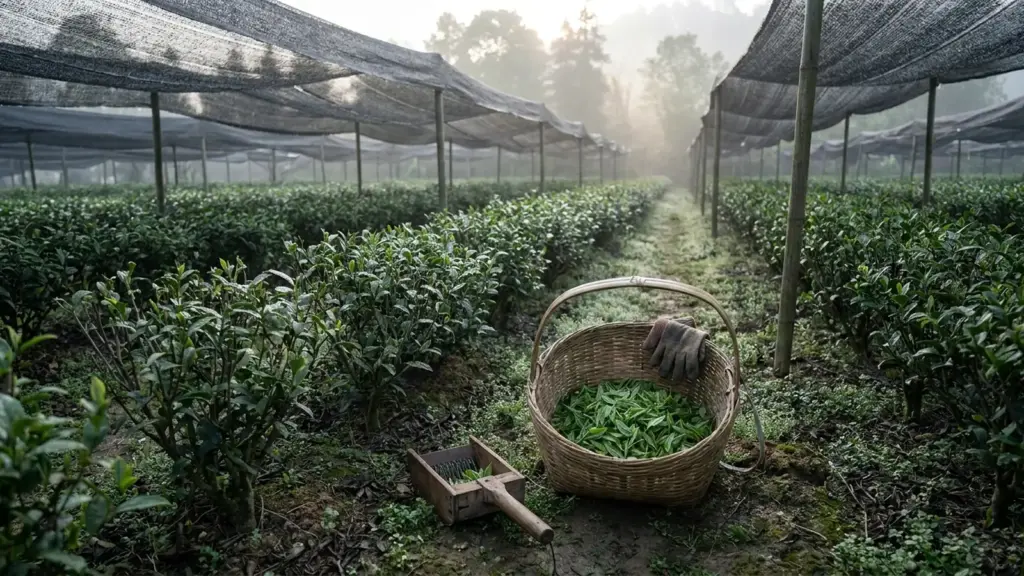
What Houshun identifies
Houshun is a Kyoto-bred tea cultivar selected from naturally crossed seedlings of Samidori. Its former line name was 53-7. Kyoto’s Tea Research Institute began selection in 1977 and registered the cultivar in 2006 after comparative and field evaluation.
The cultivar was developed for gyokuro and is distinguished most clearly by timing. This page does not convert that gyokuro purpose into an automatic matcha claim, even though both gyokuro and tencha belong to covered-tea production.
An extremely early gyokuro cultivar
Kyoto’s official guide classifies Houshun as extremely early. Its budding and harvest are reported approximately seven days earlier than Samidori and ten days earlier than Yabukita in the cited comparisons. The breeding page explains that combining it with other cultivars could broaden the harvest period and reduce concentration of work.
Those relative intervals belong to the breeding authority’s test context. They do not mean every Houshun garden is harvested on a fixed date. Elevation, seasonal weather, management, covering, and farm decisions affect the actual schedule.
Lineage and growth
Houshun came from naturally crossed Samidori seedlings. Kyoto describes it as somewhat upright, with vigor and plant spread at a medium level in the concise cultivar guide. The more detailed breeding page reports stronger vigor and greater spread than Samidori during its comparison.
New leaves are long-elliptical, relatively large, green, slightly glossy, and somewhat soft. The first-harvest yield is reported as high and approximately equal to Samidori, with a shoot-number-oriented yield composition. These are breeding observations rather than guarantees for every farm.
Official processed-tea evaluation
Kyoto reports Houshun’s gyokuro quality as approximately equal to the highly regarded Samidori comparison. Its internal qualities include a strong aroma and freshness in the official assessment. The statement is tied to the gyokuro processing evaluated by the institute.
Kyoto’s cultivar and breeding pages define Houshun as an extremely early gyokuro cultivar. Their gyokuro evaluations do not establish a universal tencha or matcha taste, or fixed umami and bitterness levels. If a producer makes Houshun tencha or matcha, that is a product-specific use requiring direct evidence.
Covered tea does not mean one process
Gyokuro and tencha may both use covered cultivation, but their manufacture differs. Gyokuro leaves are rolled and dried for infusion. Tencha is dried without rolling and later refined and milled into matcha. A cultivar’s performance in one route cannot simply be copied into the other.
Readers can use gyokuro and matcha processing terms to compare the categories. Houshun’s official purpose remains gyokuro, while any matcha use belongs to a named producer and documented lot.
Houshun within the Uji cultivar timeline
Houshun is much newer than Ujihikari, Komakage, and the other locally named cultivars adopted by Kyoto in the 1950s. It also differs from Ujimidori, named in 1983. Its 2006 registration reflects a long breeding program aimed at a specific production problem: adding a very early option to the covered-tea harvest calendar.
The Uji Tea Cultivars page provides the group context. This page stays with Houshun’s Samidori seedling origin, selection dates, extremely early timing, gyokuro purpose, and official comparative traits.
How to read a Houshun product claim
A Houshun label identifies cultivar only when traceability supports the plant material. It does not establish Kyoto origin by itself, because plant material can potentially be cultivated elsewhere. It also does not establish hand picking, shade duration, grade, organic status, or a fixed taste.
For a product sold as Houshun matcha, verify leaf origin, processor, covered cultivation, tencha manufacture, milling, and cultivar composition. The matcha authenticity guide explains why cultivar, origin, and processing are separate claims. Houshun’s glossary identity should remain precise enough to make those checks possible.