What Kanayamidori identifies
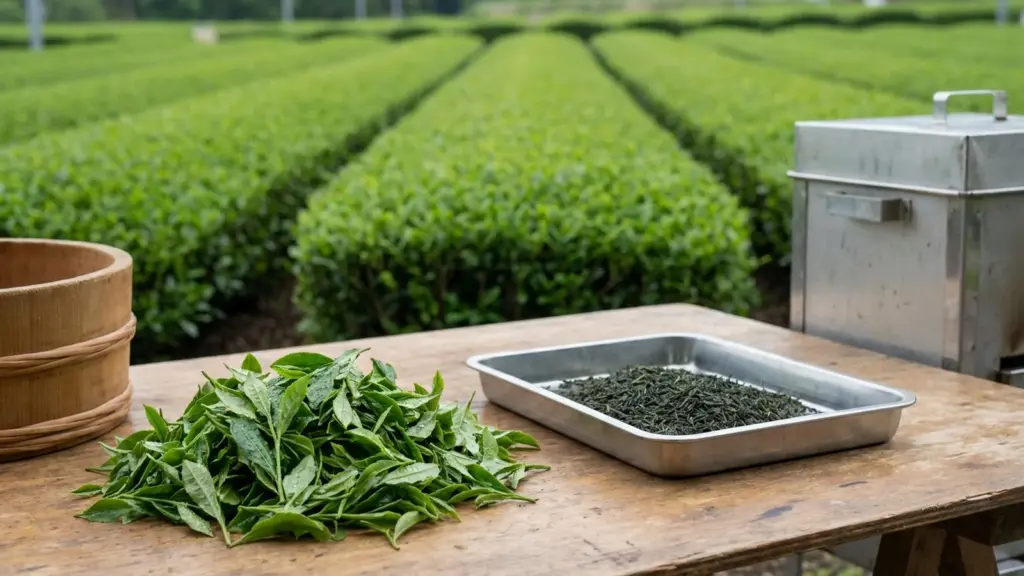
Kanayamidori is a Japanese tea cultivar bred by the national tea research program at Kanaya. The original cultivar paper records its parents as Shizuoka local line S6 and Yabukita. It was named and registered in 1970 as Tea Norin No. 30.
The cultivar’s official category is sencha. This matters on a matcha glossary because cultivar names are sometimes presented as if they automatically describe matcha. Kanayamidori is a plant variety with a documented primary use; a Kanayamidori matcha requires separate processing evidence.
Why the cultivar was developed
The breeding paper explains that Japanese tea production needed cultivars with broader regional adaptation and different harvest timing from Yabukita. Kanayamidori was selected as a mid-late option that could extend the harvesting period while providing useful yield, quality, and cold tolerance.
Its name reflects the Kanaya tea-research location associated with its development. The naming origin is geographic history of the breeding program, not proof that every current planting or finished product comes from Kanaya or Shizuoka.
Parentage and registration
The breeding program crossed the Shizuoka local selection S6 as the seed parent with Yabukita as the pollen parent. Following selection and multi-location adaptation trials, the cultivar was approved on 24 April 1970 as a registered cultivar for sencha.
This corrects a reversal in the former page, which described Yabukita as one parent without preserving the documented direction. Parentage is a breeding fact; it does not allow the characteristics of Yabukita or an unnamed “native plant” to be transferred wholesale to Kanayamidori.
A mid-late sencha cultivar
The original paper describes Kanayamidori as a mid-late sencha cultivar. It was evaluated as equal to or somewhat better than Yabukita in quality and substantially higher in yield in the reported trials. Its intermediate plant form made training manageable, and the researchers reported strong cold tolerance and broad suitability across sencha regions from Tokai and Kinki to Kyushu.
Those findings belong to the historical multi-location trials and should be read with their period and methods. They do not establish a current nationwide rank, a guaranteed yield on every farm, or suitability for every climate under present conditions.
Flavor claims and their limits
A municipal cultivar page from Minamikyushu describes a distinctive aroma likened to milk and notes that the cultivar has attracted renewed interest as consumer preferences diversify. This is useful regional communication about sencha character, but aroma descriptions are perceptual and depend on cultivation, processing, storage, and preparation.
The glossary therefore does not promise a mild milky aroma, balanced sweetness, or full body for every Kanayamidori product. The primary identity remains the registered sencha cultivar; sensory language should be attributed to a defined source or a specific lot.
Kanayamidori and matcha
The reviewed cultivar paper does not define Kanayamidori as a tencha or matcha cultivar. A producer can choose to cover and process a cultivar differently, but the finished powder is not authenticated by cultivar name alone. A matcha claim needs evidence of covered cultivation, suitable leaf handling, tencha production or the stated regional process, and milling.
This makes Kanayamidori distinct from Kyoto cultivars for which official pages directly document tencha. It also differs from Sayamakaori, an early sencha cultivar bred in Saitama. The matcha authenticity guide explains the product-level checks beyond cultivar identity.
How to read a Kanayamidori label
Look for the cultivar proportion, leaf origin, grower, harvest, processing category, and producer. A single-cultivar sencha, a blended leaf tea, a covered powdered tea, and a matcha can all use cultivar language while representing different products.
Kanayamidori’s page therefore answers a specific question: what is this cultivar according to its breeding record? It is Tea Norin No. 30, registered in 1970, bred from S6 and Yabukita, and developed as a mid-late sencha option with historically documented productivity and cold tolerance.