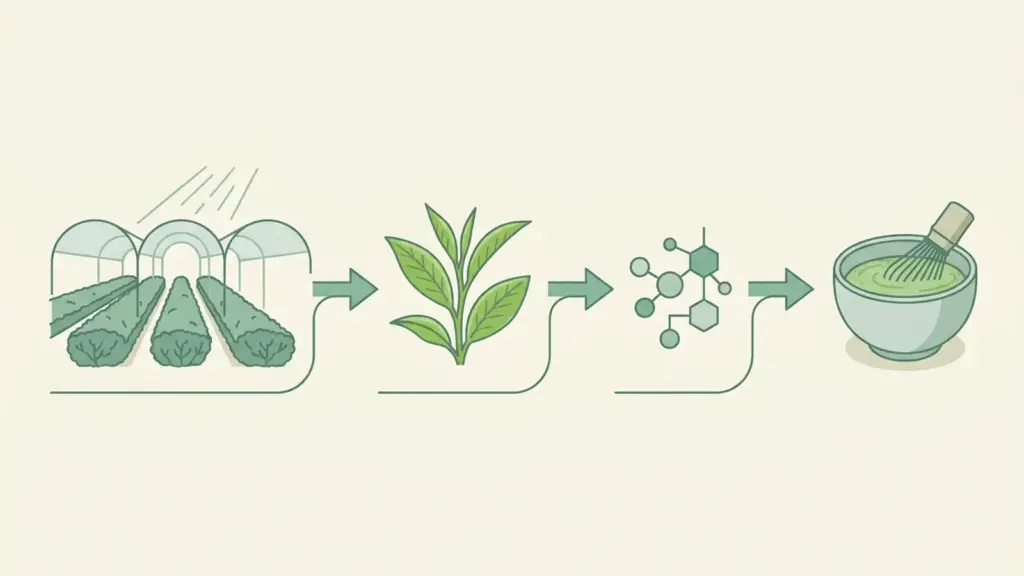
The savory taste in the bowl
Umami is one of the five basic tastes, alongside sweet, sour, salty and bitter. In matcha, savory or brothy describes the taste more precisely than creamy. Creaminess, foam and the weight of the suspended powder belong to the texture of the drink.
Umami can occur alongside sweetness, bitterness and dry astringency. A lingering flavor can be useful to describe, but no fixed aftertaste duration defines umami or proves a particular grade.
Amino acids and receptor evidence
Glutamate and L-theanine are relevant to tea’s umami character. A study of L-theanine used cells engineered to express T1R1 + T1R3 receptors. The cells responded to L-theanine, and the nucleotide IMP enhanced the response under the tested conditions.
This is evidence about a taste mechanism. It does not show that every matcha contains enough of each substance for the same interaction, that theanine alone determines the flavor, or that a savory cup has a calming effect.
How cultivation relates to taste
Preharvest shading can change amino acid and catechin levels. In a study of Fuding white tea plants, shading increased theanine while decreasing EC and EGC. That result supports an explanation for differences in flavor chemistry, not an absolute ranking of origins or harvests.
Neither a ceremonial label nor an origin name guarantees a specific umami intensity. Green color measures a different aspect of the tea: pigment-related appearance cannot directly quantify its amino acids.
Separating taste from mouthfeel when comparing teas
Compare teas using the same amount of powder and water. First consider whether the flavor is savory or brothy; then describe thickness, foam, dryness and how long the flavor remains. Keeping these observations separate makes the comparison more useful.
Kokumi describes mouthfulness, continuity and enhancement of existing tastes, rather than another name for umami. A thick or creamy preparation does not on its own demonstrate kokumi-active peptides.
Preparation and health claims
Choose water temperature for the flavor you prefer. The cited receptor and cultivation studies do not establish a household temperature at which L-theanine is destroyed or a universal preparation that maximizes umami.
Strong umami is a sensory observation, not a measure of likely cognitive benefit. Human studies of whole matcha cannot assign effects to taste intensity or to L-theanine alone, and they do not guarantee freedom from caffeine jitters.
What receptor synergy means
IMP stands for inosine 5′-monophosphate. In the cited cell experiment, adding it enhanced the response to L-theanine. The researchers also altered receptor sites to investigate where theanine binds, identifying the amino acid binding site in T1R1. This explains why a receptor study can illuminate savory taste while still leaving open the composition and sensory balance of a finished tea.