What Komakage identifies
Komakage is a Kyoto-developed tea cultivar recorded under the former line name Hirano 55. Kyoto Prefecture’s research history says it was one of eight promising local lines named as cultivars in 1953 and selected as a prefectural recommended cultivar in 1954.
The cultivar belongs to the history of Uji-area plant selection, but that fact should not be expanded into unsupported product claims. Komakage is a plant variety, not a protected grade, a single preparation method, or proof that a finished powder is matcha.
What the official history establishes
Kyoto’s postwar research history lists Komakage with Asahi, Samidori, Ujihikari, Gokou, Oguramidori, Asagiri, and Kyomidori. The record explains that the prefecture evaluated locally selected lines and adopted cultivars considered useful for tea production and farm management. Komakage remained in the later list of Kyoto-recommended cultivars.
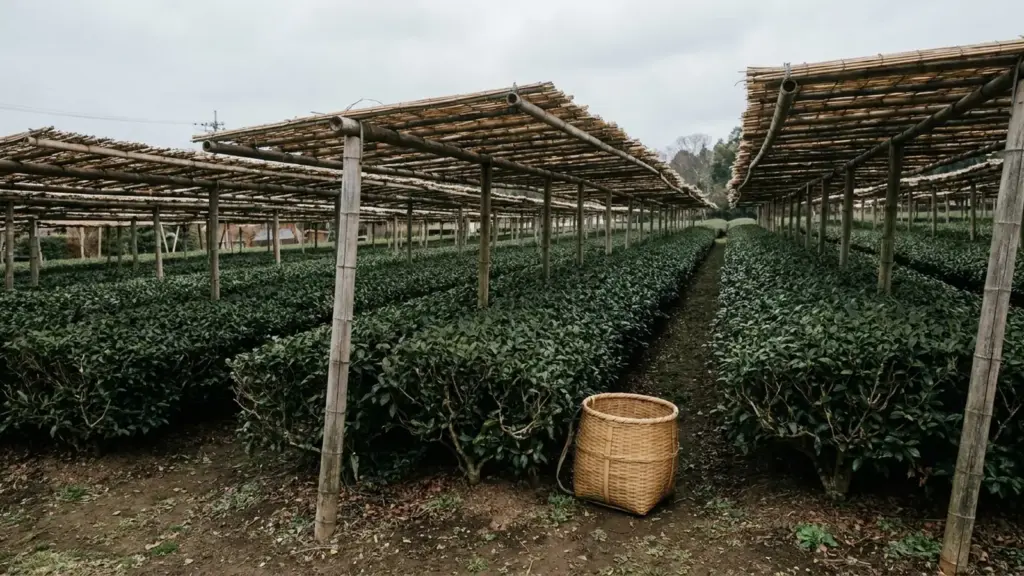
A current Kyoto tea-promotion plan also includes Komakage in the defined “Uji cultivar” group. The plan discusses the group’s value in covered teas such as tencha and gyokuro. That is legitimate regional and policy context, but it does not say that every Komakage planting is shaded or that every Komakage harvest becomes matcha.
Covered tea and matcha relevance
Komakage’s matcha relevance must be expressed through documented use, not assumed from the word Kyoto. Kyoto’s planning material identifies Uji cultivars as important in tencha and gyokuro production. Tencha can become matcha after refinement and milling, whereas gyokuro remains a rolled infusion tea.
The reviewed official sources do not provide a cultivar-specific rule stating that Komakage must be processed as tencha. They support its membership in a covered-tea cultivar group. A particular Komakage matcha therefore needs product-level traceability showing that the leaves were made into tencha and milled.
What the historical records do not establish
The Kyoto history establishes Komakage’s identity and place in cultivar selection. It should not be used as evidence for a fixed leaf appearance, yield rating, cold-resistance rating, or signature matcha flavor without a cultivar-specific trial and processing context.
A named field trial would be needed to support a specific cold-resistance or bud-timing comparison. A cultivar’s historical inclusion in a regional selection programme is not itself such a trial. Similarly, an evaluation of sencha would not prove a fixed sensory profile for tencha or matcha.
Komakage’s distinct role among these pages
Komakage is different from Ujihikari, for which Kyoto publishes detailed tencha and gyokuro characteristics. It is also different from Ujimidori, named later in 1983, and from Houshun, registered in 2006 as an extremely early gyokuro cultivar. Komakage’s strongest evidence is historical: a locally developed line named in 1953, recommended in 1954, and retained in the Uji cultivar group.
This boundary gives the page a useful purpose without inventing precision. Readers looking for the collective history can follow Uji Tea Cultivars; readers evaluating a specific product should seek the producer, leaf origin, harvest, processing route, and whether the powder is single-cultivar or blended.
How to evaluate a Komakage product
A Komakage label should be read as a cultivar claim. Verify where the plants were grown, who processed the leaf, which tea category was made, and what proportion of the product is Komakage. If the product is sold as matcha, look for a tencha-to-milling account rather than relying on Kyoto association alone.
Neither recommended-cultivar status nor regional prestige guarantees grade, shade duration, hand picking, color, flavor, or authenticity. The matcha authenticity page explains those product checks. Komakage’s documented identity remains a durable and narrower one: it is a historic Kyoto-developed Uji cultivar still recognized in prefectural tea planning.