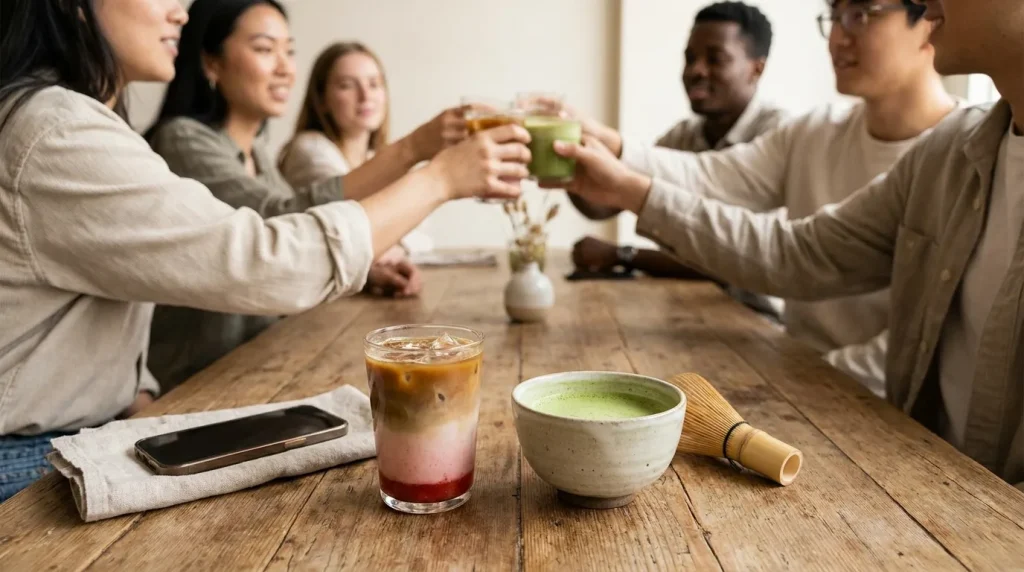
Why is matcha so popular? Its vivid colour, café versatility, preparation ritual, and appeal as an alternative to coffee made it easy to discover and share. That popularity now has consequences. Japan’s green tea exports, including matcha, rose 25% in value in 2024, while the average price at Kyoto’s May 2025 tencha auction was 170% higher than a year earlier.[1]
The matcha trend is therefore more than a collection of photogenic drinks. It connects social attention to real changes in demand, supply, prices, and product quality. This guide explains that chain without treating every viral recipe as evidence or every out-of-stock tin as proof of a worldwide shortage.
Why Matcha Is So Popular
Matcha did not become popular for one reason. Four forces reinforced one another.
It works unusually well on a visual feed
Matcha’s colour reads instantly on a small screen. Whisking creates motion, foam rewards close-up filming, and an iced latte produces a clean contrast between green tea and milk. A short preparation sequence can become a tutorial, an ASMR clip, a café review, or a recipe reveal without changing the basic drink.
That visual advantage helps explain why matcha repeatedly returns in new forms. Strawberry, coconut, vanilla, citrus, sparkling water, cold foam, and espresso can each create a recognisable variation. Cafés are not promoting one fixed recipe. They are working with a format that can be remixed.
People use it as an alternative to coffee
Matcha contains caffeine and L-theanine, which is one reason some drinkers describe the experience differently from coffee. Small studies reviewed in the medical literature suggest that caffeine combined with L-theanine may modestly improve some measures of attention and alertness. The evidence does not prove that matcha prevents a caffeine crash or provides all-day energy, and serving size varies substantially.[3]
The careful conclusion is simple: matcha is a caffeinated drink that many people prefer to coffee, not a guaranteed solution for focus, anxiety, or fatigue. Our matcha versus coffee guide compares the two without turning a personal preference into a medical promise.
The preparation feels like part of the product
A scoop, bowl, whisk, and visible layer of foam give matcha a ritual that instant drinks do not have. Some people enjoy the pause as much as the flavour. The tools also make the drink easy to demonstrate, which turns preparation into content and content into product discovery.
Modern café preparation should not be confused with chanoyu, the Japanese tea practice commonly called the tea ceremony. An iced fruit latte can be enjoyable without being described as traditional. Accurate language makes room for innovation while still crediting matcha’s Japanese origins.
It moved from novelty to habit
A trend becomes more durable when people can adapt it to different routines. Matcha can be whisked with water, poured over milk, used in desserts, or ordered from a café. This flexibility gives it more ways to remain useful after the first wave of attention passes.
Japan’s agricultural policy reflects the scale of the opportunity. The Ministry of Agriculture, Forestry and Fisheries reported tea exports worth ¥36.4 billion in 2024 and set an ¥81 billion target for 2030. Its plan specifically calls for expanded production and processing of tencha, the leaf material used to make matcha.[2]
What a Matcha Trend Can and Cannot Tell You
A trend measures attention. It can show that people are repeating a format, searching for an ingredient, or responding to a visual idea. It cannot establish flavour, quality, safety, historical accuracy, or a health effect.
Three questions are often collapsed into one:
- Is it popular? Views, searches, saves, and remakes can help answer this.
- Is it accurate? That requires sources and a claim that can actually be checked.
- Is it useful to me? That depends on taste, budget, caffeine sensitivity, and how the matcha will be prepared.
A strawberry matcha can be a good café drink even when its caption makes a weak claim about metabolism. Rejecting the claim does not require rejecting the recipe.
| Popular format | What it may show | What it cannot prove | Best check |
|---|---|---|---|
| Layered latte | Assembly, texture, and visual contrast | Matcha quality from colour alone | Ask about dose, origin, sweetness, and harvest information |
| Taste review | One person’s response to one preparation | A universal ranking | Look for a consistent method and commercial disclosure |
| Wellness routine | Habit and serving context | A guaranteed health outcome | Check qualified health sources and the actual dose |
| Recipe tutorial | Reproducible steps when quantities are given | That a jump-cut result will work at home | Require a complete written recipe |
| Traditional preparation | Tools and technique | That every styled video represents formal tea practice | Compare with recognised Japanese tea sources |
The same principle applies to creator recommendations. Payment, free products, affiliate commissions, employment, and discount codes are material relationships. The US Federal Trade Commission advises creators to make such disclosures clear and conspicuous rather than hiding them after a long caption or behind a vague hashtag.[5]
Is There a Matcha Shortage in 2026?
There is a real supply squeeze, but it is not a uniform absence of matcha everywhere. In 2026, the phrase “matcha shortage” is best understood as tight and uneven availability, particularly for sought-after Japanese tencha and products from established producers.
The strongest available figures show why the market feels constrained:
| Supply signal | Reported figure | What it means |
|---|---|---|
| Japanese tencha production in 2024 | 5,336 tonnes | Production was almost 2.7 times its level ten years earlier, yet demand still pressured supply |
| Japanese green tea exports in 2024 | ¥36.4 billion | Export value rose 25%, while volume rose 16% |
| Kyoto tencha auction price, May 2025 | ¥8,235 per kg | The average was 170% higher than a year earlier |
| Time before a new tea field can be harvested | About five years | New supply cannot appear as quickly as a viral demand spike |
These figures were reported by Reuters using data from Japan’s agriculture ministry, the Japanese Tea Production Association, and the Global Japanese Tea Association.[1] Auction prices are not retail prices, and green tea export data includes more than matcha. They still show a clear imbalance between fast demand growth and slow agricultural expansion.
Where is the matcha shortage felt?
The shortage is most visible in the supply of Japanese matcha from recognised growing areas and popular producers, especially where buyers want first-harvest material or a specific cultivar. Some producers limit quantities, some products sell out more often, and some retailers replace a familiar product with a different harvest or origin. Our guide to matcha production beyond Japan explains how other origins fit into the wider market.
That does not mean every country or every grade has run out. Culinary matcha, blends, and matcha produced outside Japan may remain available. Availability can also differ from one seller to another because they hold different contracts and inventory. A single full shelf does not disprove the shortage, just as one empty shelf does not define the entire market.
Why Is There a Matcha Shortage?
Four constraints explain most of the pressure.
Demand grew faster than production
Japan produced more tencha in 2024 than it did a decade earlier, but production growth did not fully absorb the rise in international demand. The increase in export value was also faster than the increase in export volume, consistent with a market in which buyers were paying more for limited supply.[1]
Tea fields take years to expand
Tencha is not a factory input that can be ordered for the next quarter. New tea fields need years before their first harvest, and converting an existing field requires investment, equipment, knowledge, and confidence that demand will last. Reuters reported an estimate of about five years before a newly planted field can be harvested.[1]
Weather can reduce an already limited harvest
Tea output depends on a short agricultural calendar. Heat, frost, and poor growing conditions can reduce yield or quality in a way that cannot be corrected later in the year. Reuters reported that record heat damaged tea bushes in Kyoto ahead of the 2025 harvest. That does not mean every Japanese farm suffered the same loss, but it shows how weather can tighten a market that already has little spare capacity.[1]
Farming and processing capacity cannot change overnight
Expanding tencha production requires growers, suitable land, shading systems, processing equipment, and grinding capacity. Japan’s decision to support expanded tencha production and smart agricultural technology confirms that the response is structural rather than immediate.[2] Our guide to how matcha is grown, shaded, processed, and milled explains why each stage matters.
Why Is Matcha So Expensive Right Now?
The shortage is one factor, but it is not the whole retail price.
Raw material prices rose sharply. The May 2025 Kyoto tencha auction average of ¥8,235 per kilogram was 170% above the previous year.[1] Retailers may have bought at different times and under private contracts, so this figure should not be used as a direct markup calculator. It does show that pressure began before the powder reached a consumer tin.
Matcha involves specialised production. Tea intended for matcha is shaded before harvest, processed into tencha, sorted, and ground. Quality-focused products may also be selected by harvest, region, cultivar, and sensory profile. See first flush versus later harvests for the trade-offs behind those labels.
Currency, packaging, freight, and retail margins still apply. A Japanese auction price is only one part of what a buyer ultimately pays in dollars, euros, or pounds.
Grade language is inconsistent. ISO/TR 21380:2022 defines matcha through its plant material, cultivation, manufacture, grinding, and sensory characteristics. It does not create universal “ceremonial” and “culinary” quality tiers.[4] Those terms can be useful descriptions, but they are not a substitute for origin, harvest, ingredients, freshness, or preparation guidance. Our matcha grade guide and marketing red flags guide explain what to inspect instead.
What the Shortage Changes About How You Buy
The practical response is not to panic-buy. It is to ask better questions.
Match the product to the drink. Milk, fruit, syrup, and cold foam can cover the fine differences that make a delicate matcha expensive. A robust latte matcha may be a better purchase for mixed drinks, while a subtler product makes more sense when whisked with water. Use our water temperature and ratio guide to give each product a fair preparation.
Check the information behind the grade name. Look for a stated country and region, ingredients, package size, storage guidance, and any harvest or lot information the seller provides. A named region gives you more to evaluate than “premium” or “ceremonial” alone. Our guide to Japanese matcha regions explains what regional information can and cannot tell you.
Use colour as one clue, not a verdict. A lively green can indicate well-shaded leaf and careful storage, while dullness can reflect harvest, oxidation, age, photography, or lighting. Colour should be read alongside aroma, taste, origin, and freshness.
Buy a size you can finish. Matcha changes after opening as it is exposed to air, heat, light, and moisture. A smaller package used while fresh may offer better value than a large tin bought only because supply feels uncertain.
Compare price per gram. Package sizes vary enough to make tin prices misleading. Then compare products intended for the same use rather than treating a latte powder and a first-harvest matcha as interchangeable.
Do not assume a low price is fraudulent or a high price proves quality. A seller may have older inventory, a direct contract, different packaging, a blend, or a lower-cost origin. Use our price versus quality guide to identify what the price is actually paying for.
Has the Matcha Craze Peaked?
No single search curve can answer that question. Online interest can rise and fall quickly, while repeat purchases, café menus, exports, and farming investment move on different timelines.
The strongest evidence points to a transition rather than a simple ending. Matcha still benefits from visual culture, but it is also embedded in everyday café and home routines. At the same time, Japan is planning for higher tea exports and expanded tencha production through 2030.[2]
The novelty may cool without the category disappearing. The more useful question is no longer whether matcha is trending. It is whether buyers can distinguish an attractive post from a reproducible recipe, and a persuasive label from useful product information.
How We Researched This Article
This article was updated on August 10, 2026. We reviewed Japanese government policy documents, Reuters reporting based on Japanese industry data, the international matcha standard, US consumer-disclosure guidance, and a systematic review of caffeine combined with L-theanine.
Best Matcha did not conduct a blind taste test for this article. No brand paid for inclusion, and no product ranking is presented here. Availability and prices can change, so current seller information should be checked before purchase.