What Ujihikari identifies
Ujihikari is a tea cultivar developed by the Kyoto Prefectural Tea Research Institute from material selected in the Uji area. Kyoto’s official cultivar guide records its former line name as Kyoken 170 and a breeding year of 1954. Kyoto’s detailed research history separately records the naming of Ujihikari in 1953, followed by prefectural recommendation in 1954. These are different milestones, not evidence that naming and registration are interchangeable. It belongs to the group of Kyoto-developed cultivars used to maintain a distinct regional tea identity.
This page is about the plant variety and the uses documented for it. It is not a claim that every tea sold with an Uji or Kyoto origin uses Ujihikari, and it does not imply that cultivar name alone determines grade, harvest method, flavor, or authenticity.
Official use for tencha and gyokuro
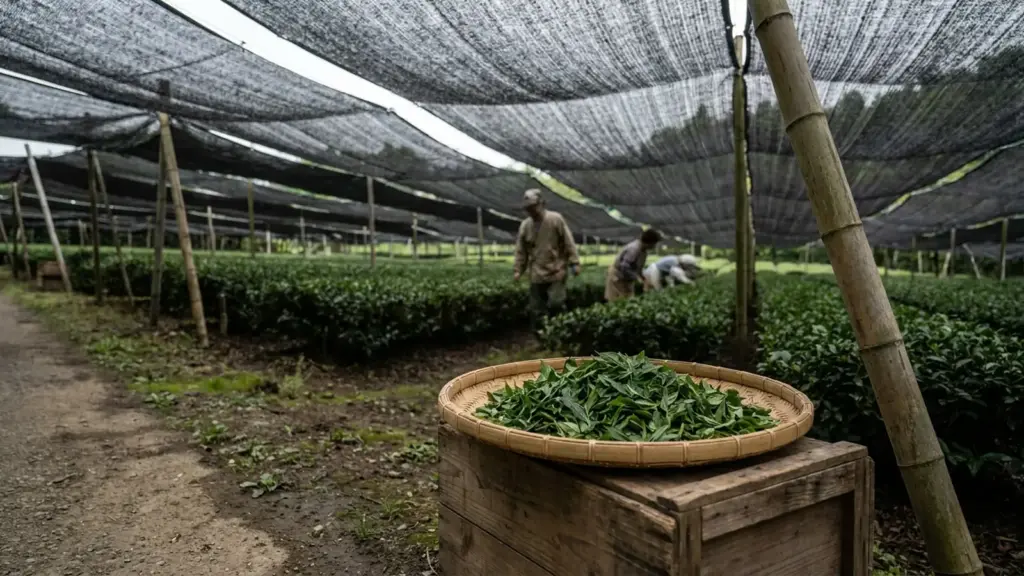
Kyoto Prefecture places Ujihikari in its section on cultivars for tencha. Tencha is the covered, steamed, unrolled leaf material that may be refined and milled into matcha. The same guide also says Ujihikari is grown among the cultivars used for gyokuro. These are related covered-tea uses, but the processing outcomes are different: tencha is prepared for later milling, while gyokuro is rolled and brewed as leaf tea.
That distinction prevents a common shortcut. Evidence that a cultivar performs well as gyokuro does not automatically prove how a finished matcha made from it will taste. Ujihikari’s direct matcha relevance comes from its documented tencha use, not merely from its place in the wider Uji tea tradition.
Growth and harvest characteristics
The Kyoto guide classifies Ujihikari as mid-season, with harvest timing approximately the same as Yabukita or up to two days later in the documented comparison. It describes a somewhat upright plant form, medium vigor, and a moderately broad spread. Yield is rated medium and below Yabukita in that reference.
Its new shoots are described as relatively small and thin, pale green, and delicately shaped. These observations are cultivar traits recorded by the breeding authority. They are not a promise that every farm will produce identical leaves, because site, weather, pruning, covering, harvest timing, and processing also affect the harvested material.
What Kyoto reports about finished tea
For tencha, Kyoto describes Ujihikari as producing an even, soft shape with a bright, clear appearance and good color development. For gyokuro, the guide notes a fine, tightly twisted appearance and clarity. Those are official evaluation notes for defined tea processing, not a universal consumer tasting note for every Ujihikari product.
The page therefore avoids unsupported claims of fixed umami, sweetness, low bitterness, or a single signature aroma. A producer may publish sensory or analytical results for a specific lot, but the cultivar record should keep those product-level claims separate from the official cultivar description.
Ujihikari within the Uji cultivar group
Kyoto’s research history records Ujihikari among the locally developed and selected cultivars that became prefectural recommended varieties. The wider group includes cultivars with different intended tea uses and harvest schedules. The Uji Tea Cultivars page explains that shared regional group; Ujihikari has its own narrower cultivar identity.
It also differs from Ujimidori, which Kyoto’s guide presents primarily in its gyokuro section, and from Houshun, a much later, extremely early cultivar developed from naturally crossed Samidori seedlings. Keeping lineage, year, timing, and intended use separate prevents the cultivar pages from becoming interchangeable.
How to read a Ujihikari matcha label
A product described as Ujihikari matcha should ideally identify leaf origin, producer or processor, harvest, whether it is single-cultivar or blended, and the tencha and milling route. The cultivar name identifies plant material only when the product’s traceability supports that statement. It does not by itself establish ceremonial use, stone milling, organic certification, or geographic origin.
For broader context, the Japan page explains national and regional origin language, while matcha authenticity covers the evidence readers can seek. Ujihikari’s precise role is simpler: it is a Kyoto-developed cultivar with official tencha and gyokuro uses and a documented set of agronomic and processed-tea characteristics.