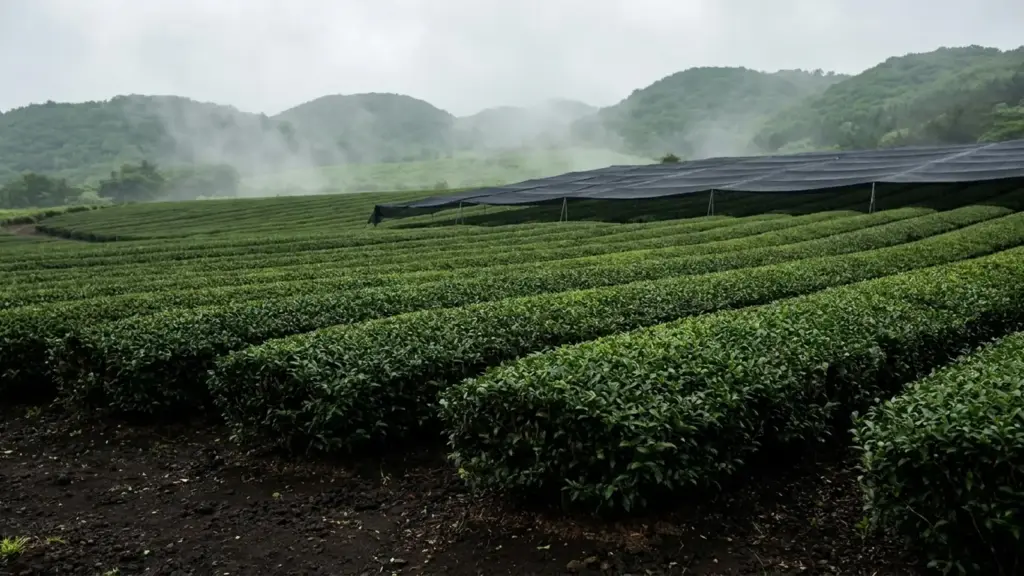
Miyazaki: Tea Traditions and Tencha Processing
Miyazaki combines sencha and kamairicha with documented tencha processing. Explore the local factory evidence without fixed flavor claims.Definition of Miyazaki
Miyazaki is a Japanese tea-producing prefecture with sencha and kamairicha traditions and documented investment in tencha processing. A reported factory in Miyazaki City supplies a concrete matcha connection, but its existence does not establish one harvest season, cultivar mix or flavor for the entire prefecture.
Learn more
A diverse prefectural tea sector
Miyazaki’s Tea Branch Station researches sencha and kamairicha as well as other teas, organic cultivation and export-oriented techniques. The official research program covers a tea sector broader than matcha. Research into organic farming is not proof that every producer is certified, and information about ordinary leaf tea is not automatically evidence of tencha manufacture.
A dated tencha facility
Miyazaki Nichinichi Shimbun reported on April 18, 2026 that Miyazaki Hajime Chaen’s tencha processing factory had been completed at Uranomyo in Takaoka, Miyazaki City. The report describes a company involving tea producers from Miyazaki, Miyakonojo and Saito, among other places. This is a concrete connection to the raw material for matcha, rather than an inference from southern climate or fertile soil.
City and prefecture are not interchangeable
The factory location is Miyazaki City, while the participating producers come from multiple municipalities. A prefectural entry can describe this project without assigning every participating field to the city. The report does not establish a prefecture-wide production total, a shared shade duration or first-flush-only harvesting. Such information needs an appropriately scoped statistical or producer source.
Cultivar research is not a matcha formula
The prefectural station names はると34 and 暖心37 among its breeding results and discusses disease and pest resistance and tea manufacture. This demonstrates agricultural research, not a declaration that those cultivars dominate Miyazaki matcha. Avoid fixed cultivar flavor lists and claims that volcanic minerals create every powder’s color. For the actual tea, ask the maker for the cultivar or blend, harvest and processing details.
What makes a powder matcha
The Japan Matcha Association describes matcha as powdered tencha. Tea leaves are cultivated under shade, steamed and dried without rolling before milling. This distinguishes the manufacturing route from simply grinding an ordinary leaf tea. It is a general processing reference, not evidence that every farm in the place named here uses that method. The local sources above must establish their own production claims; the process definition cannot fill gaps in a regional report.
Reading the origin on a package
Separate the place where leaves were grown from the locations of processing, milling, packing and sale. Ask for a named producer, the actual leaf origin, the tea category before milling and the harvest or lot information. Where an organic claim is made, request the current certificate and its operator and product scope. A location name, scenic field or retailer address is not a substitute for these records.
Comparing the actual tea
Use product-specific information when comparing taste, color and value. A broad climate description cannot establish a batch’s amino-acid content, sweetness or absence of astringency. Compare named teas prepared in similar ways and keep sensory observations attached to those products. This lets documented regional history remain useful without turning it into an unsupported promise about every powder sold under the place name.
Sources
- 茶業支場 — Miyazaki Prefecture
- てん茶加工機能を集約 みやざき一茶園、宮崎市高岡に工場完成 — Miyazaki Nichinichi Shimbun
- What is MATCHA — Japan Matcha Association
Sources and references

Accessed: 2026-09-08
Language: ja
Research in sencha, kamairicha, organic/export cultivation and other tea manufacture; cultivars はると34 and 暖心37.
Accessed: 2026-09-08
Language: ja
April 18, 2026 report of Miyazaki Hajime Chaen tencha factory in Uranomyo, Takaoka, Miyazaki City; producers from several municipalities.
Accessed: 2026-09-08
Language: en
General processing only: shaded leaves steamed and dried without rolling, then milled; matcha is powdered tencha. Not used for local production, health or historical origin claims.

Emilie Schol
Founder of Best MatchaFrequently asked questions
Here are some frequently asked questions and answers.Is Miyazaki tencha production documented?
Is Miyazaki tencha production documented?
Yes. The April 18, 2026 local report identifies a tencha processing facility for Miyazaki Hajime Chaen in Takaoka, Miyazaki City.
Is all Miyazaki matcha first-flush or organic?
Is all Miyazaki matcha first-flush or organic?
Neither claim is established for the whole prefecture. Check the individual product and certificate.
Does a Miyazaki City factory locate every field in the city?
Does a Miyazaki City factory locate every field in the city?
No. The report names participating producers from several municipalities.