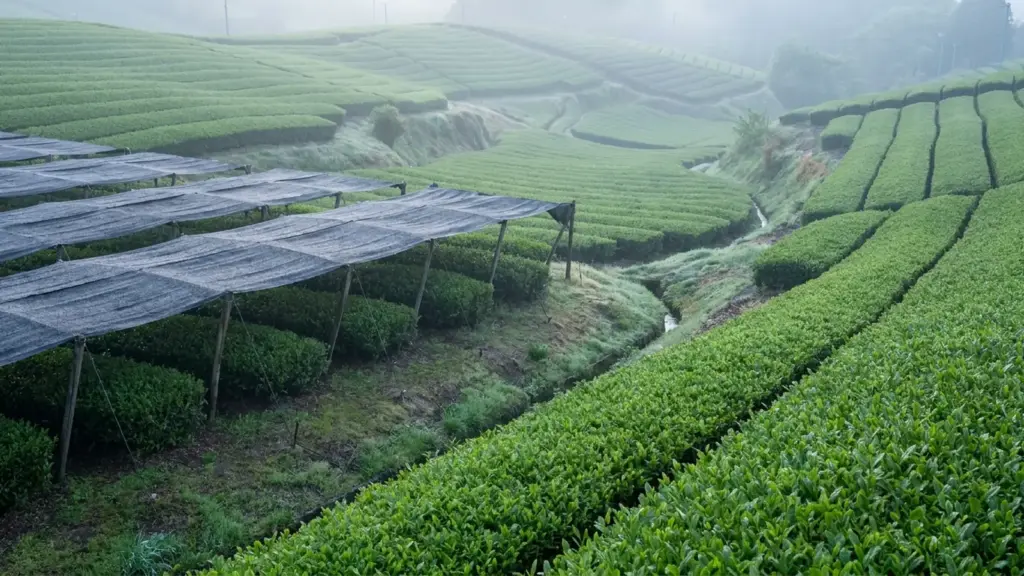
Mie: Tea Origin and Regional Context
Mie is the home of Ise tea, including northern kabusecha and southern deep-steamed sencha; shading alone does not turn tea into matcha.Definition of Mie
Mie is a Japanese prefecture whose teas are collectively called Ise tea. Northern growing areas are associated with kabusecha, while central and southern areas specialize in deep-steamed sencha. These regional leaf-tea traditions explain Mie’s tea identity without making every shaded tea a matcha.
Learn more
Mie and the Ise tea name
Mie is a tea-producing prefecture in Japan, and Ise tea is the collective name for teas produced there. The Ministry of Agriculture, Forestry and Fisheries describes a regional range rather than a single tea style. That distinction matters on a matcha-focused glossary: Ise tea is an origin label, while kabusecha, sencha and matcha describe different products.
The ministry’s account places Mie third nationally for tea cultivation area and production volume as of 2022. This is a dated all-tea comparison, not a current matcha ranking. It does not establish that Mie matcha has one standard flavour or that it is sweeter than tea from Kyoto.
Two useful regional patterns
The Hokusei area reaches into the foothills of the Suzuka mountains and includes Yokkaichi, Suzuka, Kameyama and Inabe. The ministry associates this northern area with kabusecha, a covered-cultivation tea described as green in colour and mellow in taste. These are characteristics of the named leaf-tea style, not automatic descriptions of any powder from the same cities.
Further south, the Chunansei area includes Matsusaka, Watarai, Odai, Tsu and Taki. Here the ministry identifies fukamushi-sencha, or deep-steamed sencha, as the mainstream product. The contrast is useful for shoppers: two teas carrying the same Ise origin name may have different processing methods and preparation needs.
Shading does not make kabusecha into matcha
The ministry describes Hokusei kabusecha as covered for one to two weeks before harvest. It separately explains that fukamushi-sencha is steamed longer than conventional sencha. These local practices should remain attached to their respective tea types. A kabusecha shading period is not evidence that every Mie matcha follows the same schedule.
The Japan Matcha Association identifies matcha as powdered tencha: shaded leaves are steamed, dried without rubbing and milled. The distinction is therefore not simply shaded versus unshaded. A leaf tea can be grown under cover without becoming the material used for matcha. Ask what was dried and milled, not only whether the garden was shaded.
History and buying context
The ministry traces several strands of local tea history, including temple tea in the Suizawa area and later encouragement of the industry by the Komono clan. It also describes tea spreading along the Kushidagawa and Miyagawa river basins. This is a more careful regional history than assigning all Mie tea one foundation date or one founding monk.
When choosing Ise tea, start with the stated tea type and the producing locality. For a matcha-labelled product, look for the maker’s leaf-origin and processing details rather than borrowing the reputation of northern kabusecha or southern sencha. A cultivar name, a prefecture name and a historical production ranking each answer a different question; none alone guarantees a grade or tasting result.
Sources and further reading
- Ise Cha | Traditional Foods in Japan — Ministry of Agriculture, Forestry and Fisheries of Japan
- What is MATCHA — Japan Matcha Association
Sources and references


Accessed: 2026-09-08
Language: en
Ise tea is the umbrella for Mie teas; Hokusei kabusecha versus Chunansei fukamushi-sencha, one-to-two-week kabuse shading, regional history, and the explicitly dated 2022 tea ranking.
Accessed: 2026-09-08
Language: en
Matcha is powdered tencha: shaded leaves are steamed and dried without rubbing before milling. This supports processing distinctions, not regional production or health claims.

Emilie Schol
Founder of Best MatchaFrequently asked questions
Here are some frequently asked questions and answers.Is Ise tea another name for Mie matcha?
Is Ise tea another name for Mie matcha?
No. Ise tea is the collective origin name for teas produced in Mie Prefecture. It includes different tea styles, not only matcha.
Which Mie areas are associated with kabusecha?
Which Mie areas are associated with kabusecha?
The ministry identifies the northern Hokusei area, including Yokkaichi, Suzuka, Kameyama and Inabe, with kabusecha. Chunansei is associated with deep-steamed sencha.
Does Mie’s third-place ranking refer to matcha?
Does Mie’s third-place ranking refer to matcha?
No. The cited ministry account places Mie third for all-tea cultivation area and production volume as of 2022, not for matcha alone.