What Fukuoka matcha identifies
Fukuoka is a prefecture in Japan whose Yame tea sector is associated with several distinct tea products. Official prefectural material now documents “Yame matcha” as a specific promotion subject. That makes the prefecture’s matcha connection direct rather than an inference drawn only from Yame’s better-known gyokuro.
The most careful reading is product-specific. Yame matcha, Yame sencha, and Yame gyokuro belong to the same regional tea economy, but the names do not describe interchangeable products. A fact about the cultivation rules, geographical indication, awards, or taste of gyokuro cannot automatically be transferred to matcha.
The prefecture’s Yame matcha initiative
In 2025, the Fukuoka Prefectural Government ran a public proposal process for a Yame matcha promotion program. The procurement page says that, in light of rapidly expanding matcha demand, the prefecture planned a public-relations event aimed at establishing the Yame matcha brand in addition to sencha and gyokuro. The page was updated on 27 August 2025 and records the selection of a contractor.
This is strong evidence of an active prefectural branding initiative. It does not by itself define a legal geographical indication, specify a production volume, establish a prefecture-wide processing rule, or prove that all matcha made anywhere in Fukuoka is sold as Yame matcha. Those questions require their own regulatory or production evidence.
Direct evidence for tencha in the Yame area
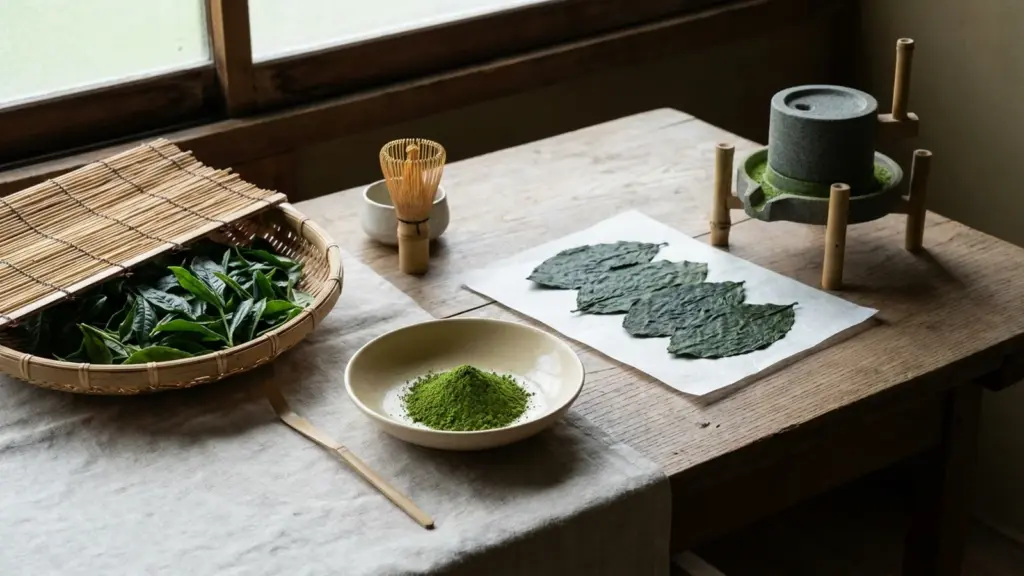
An earlier Fukuoka government agriculture feature provides the missing production link. It describes a Yame producer group building one of the area’s relatively few tencha factories. The prefectural explanation identifies tencha as covered tea leaf that is steamed and dried without being rolled, and says it becomes matcha when ground.
This evidence is directly relevant to matcha because it documents local handling of the intermediate product. It should still be kept in date and scope: the feature appeared in a 2017 summer issue and describes a producer group, not every tea farm or processor in Fukuoka. It supplies a regional process example rather than a current prefecture-wide output total.
Matcha is not gyokuro
Gyokuro and tencha can both begin with covered cultivation, but their leaf processing differs. Tencha is dried without rolling before refinement and grinding into matcha. Gyokuro is rolled and dried as an infusion tea. Sencha follows another route, generally involving open cultivation and rolling. Shared regional origin or some shared cultivation context does not erase these category boundaries.
This distinction changes how evidence should be used. Yame gyokuro’s reputation can explain why the Yame name already has a strong tea identity, but it cannot establish the flavor, grade, shade period, award record, or legal protection of Yame matcha. The Fukuoka matcha page therefore relies on the prefecture’s matcha promotion and tencha evidence for its central claims.
How Yame matcha fits the regional hierarchy
Fukuoka is the prefecture; Yame is the regional tea name; and Yame Matcha is the emerging matcha brand described by the prefectural program. Keeping those levels visible helps readers interpret an origin label. A package that says “Fukuoka” may identify a prefecture, while “Yame matcha” makes a narrower regional and product claim that should be supported by the seller’s traceability information.
Within Japan, Fukuoka should be compared with other documented producing prefectures without assuming a single national style. The national page explains the broader tencha-to-matcha route and origin-label questions. This page stays focused on the prefecture’s direct actions and evidence.
What readers can verify
For a product marketed as Fukuoka or Yame matcha, useful checks include the stated leaf origin, processor location, producer or cooperative, harvest information, and whether the brand provides a tencha and milling account. Product form matters too: matcha powder is not the same thing as brewed gyokuro or sencha, even when all three names appear in a regional promotion.
The supplied official sources do not establish a standard Yame matcha flavor, a universal river-valley effect, a current production total, or a ranking against other Japanese origins. They also do not show that every Fukuoka matcha qualifies for the Yame name. Omitting those claims keeps the page aligned with what the prefecture actually documents.
Why the page is distinct
This Fukuoka reference is not a general guide to matcha products and not a duplicate of the Yame Matcha entry. Its job is to establish the prefecture-level record: Fukuoka has an official Yame matcha brand-building program, and regional government material documents a tencha processing example. More specific producer, product, and certification questions should be answered at their corresponding level.