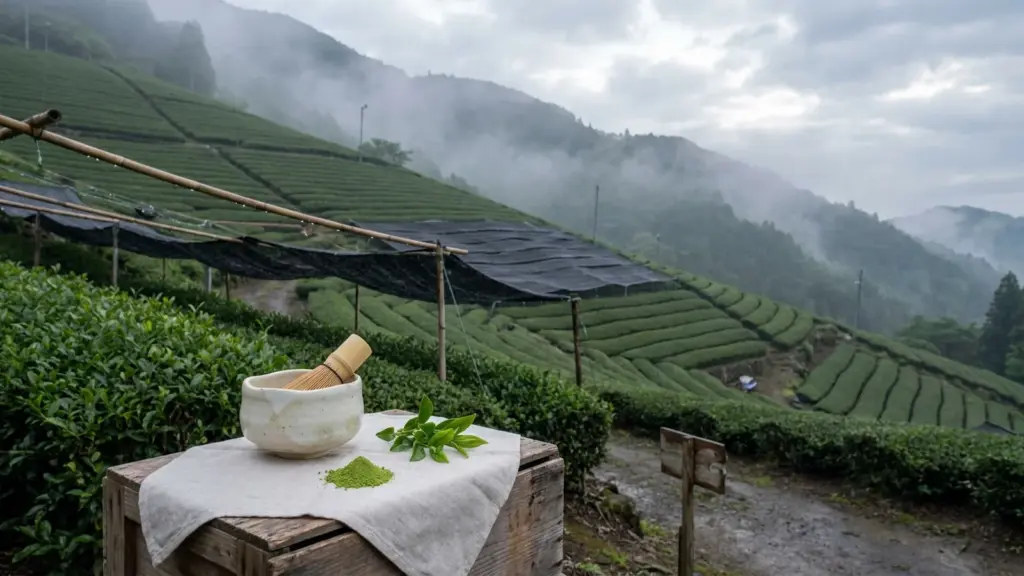
Gokase: Mountain Tea and Kamairicha Heritage
Gokase is a mountain town in Miyazaki known for pan-fired kamairicha. Learn why its tea heritage does not define a regional matcha style.Definition of Gokase
Gokase is a mountain town in Miyazaki Prefecture, Japan, known for kamairicha, a green tea made by pan-firing rather than steaming. Its documented tea heritage includes family farms and organic cultivation, but these facts do not establish a town-wide matcha style or production method.
Learn more
Gokase’s documented tea specialty
Gokase is a town in the mountains of Miyazaki Prefecture on Kyushu. Its tea heritage is real, but the most useful starting point is kamairicha rather than an assumed specialty matcha. The Gokase Tourism Association’s municipal-site guide identifies pan-fired tea as a local product and lists several tea farms, including Miyazaki Sabou. This anchors the place name to actual local production rather than to a neighboring municipality.
Pan-firing is not tencha processing
The tourism guide explains that kamairicha leaves are heated in a pan without steaming, then rolled; heating and rolling are repeated during manufacture. It also notes that machines, production lines and firing choices differ among local farms, so their teas do not all taste alike. That is a more precise explanation of local variation than assigning every Gokase tea a single level of sweetness or umami.
Mountain cultivation at a named farm
A Ministry of Agriculture, Forestry and Fisheries feature profiles Miyazaki Sabou in Gokase and describes its tea fields at 600–750 metres. That elevation belongs to the featured operation, not to every tea garden in the town. The farmer describes paying attention to sunlight, drainage and wind at individual plots. The same account records the family’s decision to begin organic cultivation in 1983 and discusses frost protection. Those are farm-specific practices, not proof that all Gokase tea is certified organic.
How Gokase relates to matcha
The Japan Matcha Association distinguishes matcha made from tencha from powdered sencha. Its processing explanation describes steamed leaves dried without rolling before milling. The documented kamairicha process is therefore a different manufacturing route. A green powder sold by a Gokase farm should be identified from its own raw material and processing description; green colour or mountain origin alone cannot establish that it is tencha-based matcha.
What to look for on a product
For a claimed Gokase matcha, ask for the grower, leaf-growing location and whether the starting material is tencha. A farm may make several tea types, so its reputation for pan-fired tea or black tea cannot substitute for a matcha specification. Check a named cultivar, harvest and shading record if provided, rather than assuming a town-wide twenty-day covering regime or a fixed particle size. Organic status should refer to the relevant product and certification, not simply to a scenic landscape.
Use origin as context, not a tasting score
The useful continuity in Gokase is the relationship between mountain farms, individual processing decisions and tea-making knowledge. It does not justify a blanket claim that its matcha is less bitter than Uji tea, superior to lowland tea or suitable for every ceremonial use. For drinking, compare the actual powder at a consistent dose and preparation. For exploring the local tradition itself, clearly labelled kamairicha is the tea category directly supported by the local evidence.
Sources and scope
釜炒り茶/五ヶ瀬町; The Future of Tea-Making — Google Arts & Culture; What is MATCHA | Japan Matcha Association. Sources checked on 8 September 2026. Producer statements are attributed; they are not independent tests of every product.
Sources and references

Accessed: 2026-09-08
Language: ja
Gokase kamairicha specialty and named local farms including Miyazaki Sabou. Pan-firing without steaming, rolling and variation between producers.
Accessed: 2026-09-08
Language: en
Miyazaki Sabou is in Gokase, Miyazaki. Featured fields at 600–750 metres; organic cultivation decision in 1983; farm-specific drainage, wind, sunlight and frost management.
Accessed: 2026-09-08
Language: en
Matcha uses tencha; fresh leaves steamed, dried without rolling and milled. Powdered sencha is distinguished from matcha. No health or historical claims adopted.

Emilie Schol
Founder of Best MatchaFrequently asked questions
Here are some frequently asked questions and answers.Is Gokase known for matcha or kamairicha?
Is Gokase known for matcha or kamairicha?
The local tourism guide specifically documents kamairicha and local tea farms. It does not establish a uniform Gokase matcha category.
Are all Gokase farms organic?
Are all Gokase farms organic?
No such town-wide claim is supported here. MAFF describes Miyazaki Sabou’s organic cultivation history; certification and farming practices must be checked for each product.
Does Gokase tea grow at one altitude?
Does Gokase tea grow at one altitude?
No. MAFF gives 600–750 metres for the featured Miyazaki Sabou fields, not for every tea field in the municipality.