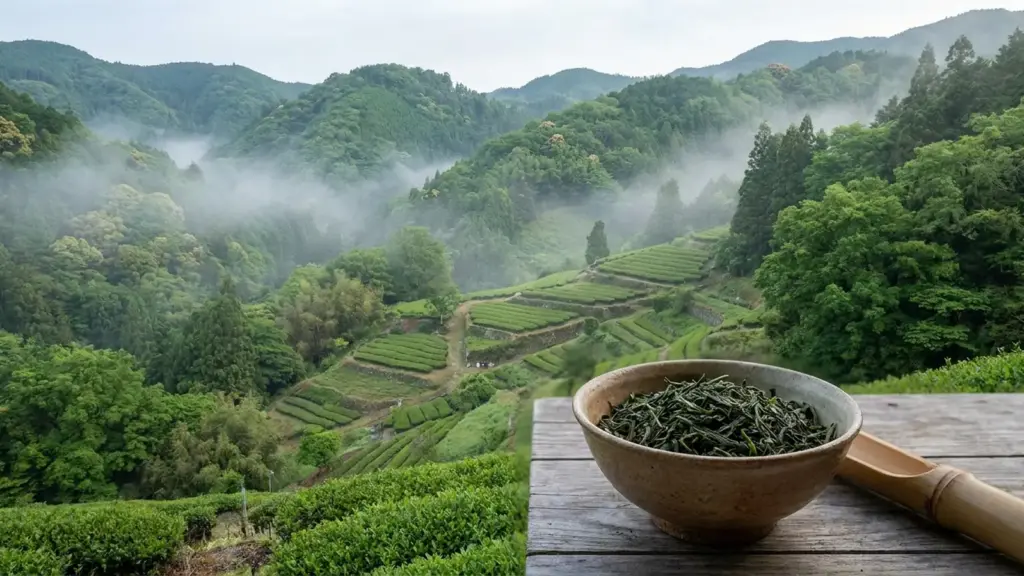
Takachiho and the larger heritage area
Takachiho is in Miyazaki Prefecture, not Kumamoto. It is associated with the Takachihogo-Shiibayama Mountainous Agriculture and Forestry System, recognised by the Food and Agriculture Organization as a Globally Important Agricultural Heritage System in 2015. The designation concerns a broader mountain landscape and its management. It is not a matcha appellation, an organic certificate or an award for every tea made in Takachiho.
Tea within mixed agriculture and forestry
FAO describes a composite livelihood system combining timber production, shiitake cultivation, terraced rice growing, beef cattle raising and tea cultivation. This retains the useful agricultural context of Takachiho’s tea story: fields, forests and farming communities are interdependent. The landscape is not simply a collection of specialist matcha gardens. A forest mosaic includes timber trees, broadleaf trees used for mushroom cultivation and evergreen woodland.
Keep regional infrastructure regional
The heritage site’s own account describes a 500-kilometre canal network serving the mountain landscape. It discusses irrigation, rainwater drainage and protection of communities. The figure should remain attached to the wider heritage site, not to a Takachiho tea-farm irrigation scheme. Rice terraces and mixed farming provide the context; they do not demonstrate how a particular tea is shaded, harvested or processed.
Kamairicha is the relevant processing tradition
The site’s heritage account specifically discusses kamairicha made from mountain tea. Kamairicha refers to pan-fired green tea, a different route from the steamed, unrolled tencha described by the Japan Matcha Association. Preserving pan-firing knowledge is meaningful in its own right. It should not be repackaged as proof that local farmers have always grown modern matcha or followed a single tencha production protocol.
Community practice without misplaced claims
Kagura, ritual Shinto dance, is described by FAO as part of the cultural life sustaining village cooperation. The heritage site also identifies traditional cyclical field burning specifically with Shiiba Village. That distinction matters: a practice within the wider designated landscape cannot automatically be assigned to all Takachiho farms. Nor does heritage recognition mean that all agricultural inputs are organic or that no pesticides are used.
Reading a Takachiho tea label
A useful tea description should identify the actual producer and tea type before making sensory promises. For kamairicha, the pan-firing method is relevant; for a product sold as matcha, ask whether the raw material is tencha and where the leaves were grown and processed. Neither a mountain photograph nor the GIAHS designation proves a fixed altitude, flavour or ceremonial suitability. Takachiho’s strongest documented contribution is its place in a living agricultural and cultural system, not a universal matcha tasting profile.
Sources and scope
Takachihog System| Globally Important Agricultural Heritage Systems | Food and Agriculture Organization of the United Nations; Globally Important Agricultural Heritage System (GIAHS)
The Takachihogo-Shiibayama Site; What is MATCHA | Japan Matcha Association. Sources checked on 8 September 2026. Producer statements are attributed; they are not independent tests of every product.