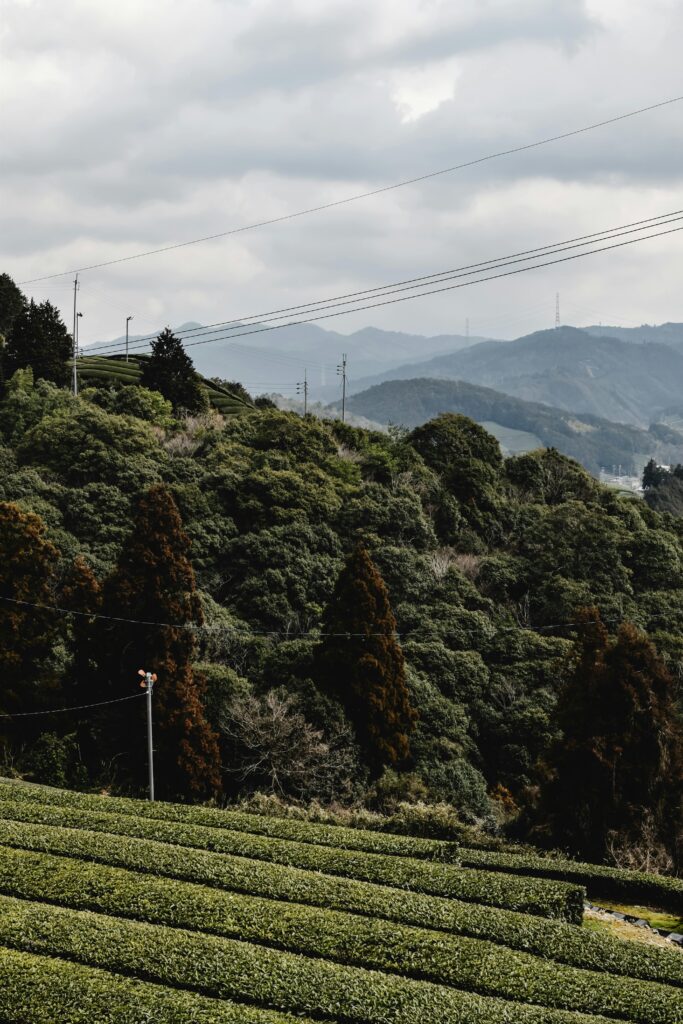
Wazuka is a tea-growing town in southern Kyoto Prefecture, Japan, and an important source of leaves for Uji tea. Its name identifies a farming location, not a single tea style or flavor. Understanding that distinction helps explain why a Wazuka-grown tea may also carry the broader Uji name.
Wazuka within Kyoto tea country
The town’s tourism introduction traces local tea cultivation to the Kamakura period and describes a landscape shaped by centuries of farming. Tea rows cover hillsides around homes and villages rather than forming one continuous estate. Ishitera and Shirasu are named tea-field landscapes in the official Kyoto travel guide.
Wazuka’s tourism site says the town supplies approximately half of the Uji-cha leaves grown in Kyoto Prefecture. That wording matters: it is a claim about Kyoto-grown leaves, not half of every finished Uji-branded product or half of Japan’s matcha. Neighboring Minamiyamashiro is a separate municipality; a reference to tea from that village should not be read as Wazuka origin.
Tea origin and tea processing answer different questions
A geographical name tells you where leaves come from. The manufacturing description tells you what those leaves became. The official Kyoto travel guide documents both sencha and matcha tasting linked to tea grown in d:matcha’s Wazuka plantations. This is specific evidence of local matcha activity, not a reason to call all Wazuka tea matcha.
In the Japan Matcha Association’s explanation, matcha is powdered tencha: leaves are steamed, dried without rolling and then milled. Read the tencha entry alongside sencha versus matcha when comparing products. Powdered sencha and tencha-based matcha should not be treated as interchangeable merely because both came from the same town.
How to check a Wazuka origin claim
For a concrete buying scenario, imagine a packet described as “Uji matcha, grown in Wazuka.” Those statements need not conflict: one is the wider tea identity, the other names the leaf-growing town. But a Kyoto business address alone does not establish either the farm or the contents of a particular blend.
- Ask whether all leaves in the batch were grown in Wazuka or whether the name refers to one component.
- Request the grower or farm name and distinguish it from the milling, finishing and packing businesses.
- For matcha, ask for the tencha production description and harvest information, rather than relying on a photograph of tea fields.
- Check what “single origin” means to that supplier: town, farm, field and cultivar are different levels of detail.
Learning from the landscape without guessing the cup
The official travel guide describes fog, seasonal harvesting and covered tea rows, but these observations cannot establish the taste or shading schedule of an unidentified batch. A cultivar name adds plant information; it is not a substitute for farm traceability. Use the broader Kyoto entry for regional context.
Visitors should also distinguish viewing a landscape from entering a working farm. The Kyoto guide explicitly says plantations are private property and directs visitors who want field access toward guided tours. A producer-led visit can clarify which tea was grown, processed and sold locally without turning scenery into a quality guarantee.