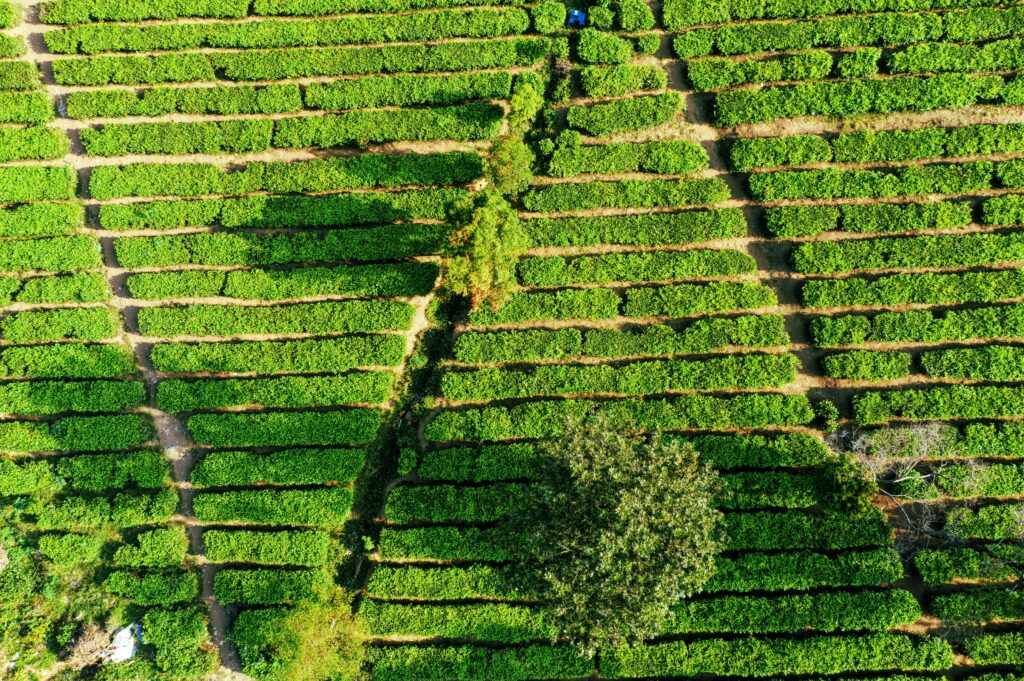
Yawata and the Kizugawa tea landscape
Yawata is a city in Kyoto Prefecture with covered tea gardens along the Kizugawa River. Its connection to matcha is concrete: the Uji tea cultural-landscape programme documents tencha production in the settlements of Kozuya, Nojiri, and Iwata. Tencha is the leaf material refined and ground to make matcha. The place name identifies a growing area, not a cultivar or a guaranteed flavor.
Hamacha describes the riverside setting
The local landscape account calls tea grown on the river’s soft, sandy deposits hamacha, in contrast with yamacha grown in mountain areas. Hamacha is therefore a landscape-related tea name, not the name of a shading technique. Covered cultivation is described separately as oishita cultivation. Keeping these terms apart helps readers distinguish where the plants grow from how farmers manage light before harvest.
The source describes these riverbank teas as having a deep green appearance. That regional description is not a chemical analysis of Yawata matcha and does not establish a fixed level of theanine, chlorophyll, sweetness, or astringency. Garden management, cultivar, harvest, manufacture, and storage need to be considered for an individual tea.
When covered gardens spread to Yawata
The documented local chronology places the spread of covered tea gardens from the Uji area into Yawata from the nineteenth century onward. This should not be confused with the much older history of tea in the wider Yamashiro region. A regional story spanning many centuries does not date every village’s tencha industry to the same starting point.
Kozuya has a counterpart of the same name on the opposite bank in Joyo. The cultural-landscape account explains that the settlements were formerly one community, divided by a change in the river’s course. A ferry once connected them; the Kozuya Bridge, also known as Nagarebashi, later provided the connection. The tea landscape is consequently a story of neighboring river communities as well as cultivation.
From covered leaves to matcha
Japan’s Ministry of Agriculture, Forestry and Fisheries describes tencha as covered-grown shoots that are steamed and dried without rolling. After refinement removes stems and leaf veins, the material is ground into matcha. Gyokuro also uses covered cultivation, but its leaves are rolled and dried for infusion. Shade structures alone cannot tell a visitor which finished tea a garden will produce.
For Yawata, the landscape programme specifically documents tencha, so its matcha relevance does not depend on guessing from the covers. It does not supply a universal shade duration, shade percentage, fertilizer recipe, or cultivar list for every farm. Those details should come from the grower or processor rather than from a general regional description.
A working landscape, not a uniform product
The account describes a continuous stretch of covered gardens on the river’s left bank from Iwata through Nojiri toward Kozuya and its bridge. Around Kozuya’s Hamagaito settlement, tea factories form part of the village setting; buildings formerly used for rolled-tea manufacture also remain. That evidence gives a more useful picture than calling Yawata an area that has always produced tencha exclusively.
These are working gardens and processing sites, not an assurance of public access. When planning a visit, use local visitor information and respect farm boundaries. A view of the fields can explain the riverbank setting, but it cannot independently verify the origin of a packet bought elsewhere.
Reading a Yawata matcha label
Ask whether Yawata identifies the leaf-growing location, a business address, or another connection. Then check the named producer or processor, harvest information, cultivar or blend disclosure where available, and the tencha-to-milling route. A statement that tea was sold or blended in Kyoto is not the same as a statement that its leaves grew in Yawata.
Yawata’s useful distinction is its documented riverbank tencha landscape and the local meaning of hamacha. Neither the place name nor the area’s history guarantees hand picking, organic certification, a particular commercial grade, or a taste superior to other regions. Compare finished products using their own traceability and preparation guidance.