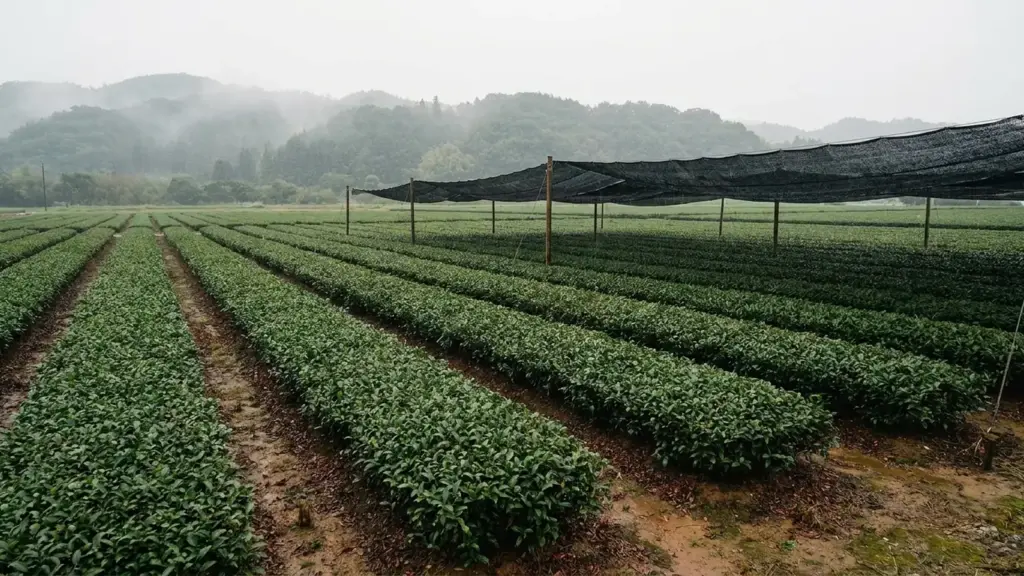
Kumiyama and the Hamacha Landscape
Kumiyama is a town in Kyoto’s Yamashiro tea area with a documented connection to tencha. Its official account identifies the Sayama Hamadai gardens beside the Kizu River, around the landscape of Nagare Bridge. These riverbank teas are known as hamacha.
The municipal description calls the riverside land sandy and fertile and explains how embankments were shaped to leave the gardens on the river side. This is a floodplain tea landscape, not evidence of mountainous tea fields or a distinctive red-soil region. The account also notes surviving seed-grown gardens, a more specific local detail than an unsupported list of supposedly dominant cultivars.
Tea Heritage Is Not the Same as Tencha Chronology
The town’s heritage page connects the local landscape with the broader “800-year history” of Japanese tea in Kyoto and Yamashiro. That regional story should not be turned into 800 years of continuous tencha production in Kumiyama.
For Hamadai itself, the town says gyokuro was formerly the main product and that a gradual change to tencha took place from the early Meiji period. It also reports old tea trees said to be about 300 years old. The age of trees, the history of a tea landscape and the period of production of one tea type are separate claims.
The heritage account further explains that covered gardens spread along the Kizu River when gyokuro was not subject to the same restrictions as matcha or tencha cultivation. This helps explain the local change in tea production without inventing a simple migration of all farming out of urban Uji.
Covered Cultivation and Tencha Processing
The town documents covering the tea gardens before harvest, with preparations responsive to budding and weather, and shows hand picking of new shoots. Its account links this cultivation with the tencha produced there. These are locally described practices, not a claim that every farm follows one identical annual schedule.
For the processing distinction, MAFF explains that tencha leaves are steamed and dried without rolling; stems and veins are removed before milling into matcha. Gyokuro leaves are also shade-grown but are rolled during processing. Steaming and rolling should therefore not be described as the route that makes tencha in Kumiyama.
How Kumiyama Fits Within Uji Tea
The local tencha connection is part of the wider Uji tea landscape. MAFF’s Uji tea account describes a category that can use leaves from Kyoto, Nara, Shiga and Mie processed in Kyoto using Uji-origin methods. Kumiyama’s documented gardens give a more precise leaf-growing location within that broader discussion.
When a product names Kumiyama, ask whether its leaves came from those local fields, whether it is a single-origin product or a blend, and who processed and milled it. A business address and a leaf-origin statement are not interchangeable. The place name is useful provenance, not an automatic grade or authenticity test based on sweetness.
What the Local Evidence Does Not Promise
No fixed comparison with Uji City or Nishio follows from the heritage record. Claims that Kumiyama powder must be thicker, sweeter, more floral or less astringent need evidence about particular teas. Nor does recognition of a cultural landscape certify every local product as organic or establish a universal ceremonial grading system.
Appreciate the documented river setting, seed-grown gardens and change from gyokuro to tencha. Then assess flavor and preparation suitability at the product level. That preserves what is distinctive about Kumiyama without attributing a guaranteed sensory signature to an unsupported red-soil theory.