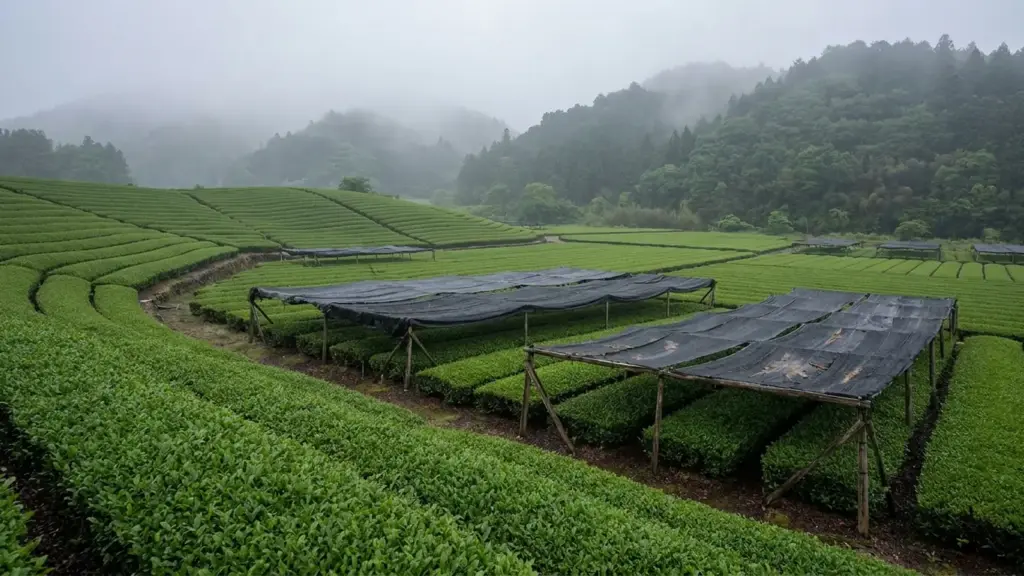
A village within Kyoto’s tea landscape
Minami Yamashiro, commonly written Minamiyamashiro, is a village in southern Kyoto and part of the Uji tea-growing landscape. It is not Uji City. The distinction matters when a broad regional tea label is used alongside a specific farm or village origin. One identifies a wider tea context; the other can locate cultivation more precisely.
The official Kyoto tourism account of Tayama Tsurugi Tea Plantation describes Minamiyamashiro as a major Uji tea production area. Its mountain setting supports tea cultivation on slopes. This documented landscape is worth explaining without attaching an undated percentage of Kyoto’s tea output or a national tencha ranking.
Vertical rows and actual frost protection
At Tayama Tsurugi, tate-une, or vertical ridges, give the fields their distinctive appearance. The tourism account explains their practical role: the layout allows harvesting with powered clippers or riding-type tea pickers and helps airflow from fans installed for frost protection. This connects the visible landscape with actual farm work.
The plantation is near Takayama Dam, but proximity to a dam does not demonstrate that its mist protects every field from frost. The cited account specifically identifies fans. Nor should mountain mist be treated as the equivalent of a controlled shading regime or as a guarantee of high amino-acid content.
A documented connection with local matcha
Another Kyoto’s official rest-area listing describes Muracha-ya serving soft ice cream made with the village’s matcha, as well as matcha syrup. It also mentions local tea for sale and dishes incorporating tea. This is a concrete official example of local matcha use; it is not a village-wide production or quality survey.
The example does not establish that every local tea farm now specializes in tencha, that all farms share one processing plant or that the village makes only ceremonial-grade powder. Tea tourism and local food uses are valuable evidence of a living tea economy without requiring those broader claims.
Understanding the process and the label
The Japan Matcha Association describes matcha as powdered tencha: shaded leaves are steamed and dried without rolling before milling. Rolling or kneading belongs to other tea processes and should not be added to the tencha sequence. When buying a village-origin powder, ask which farm grew the leaves and where finishing and milling occurred.
For statistics, keep village tea output, Kyoto tencha output and national matcha output separate. They have different geographical scopes and may use different product categories. For taste, compare the actual harvest and blend rather than assigning a universal creamy or low-bitterness profile to the village. A local sample and a clear lot specification tell you more than an assumed hierarchy between Kyoto villages and other Japanese regions. The tea fields themselves are private working land; the official guide asks visitors not to enter them.