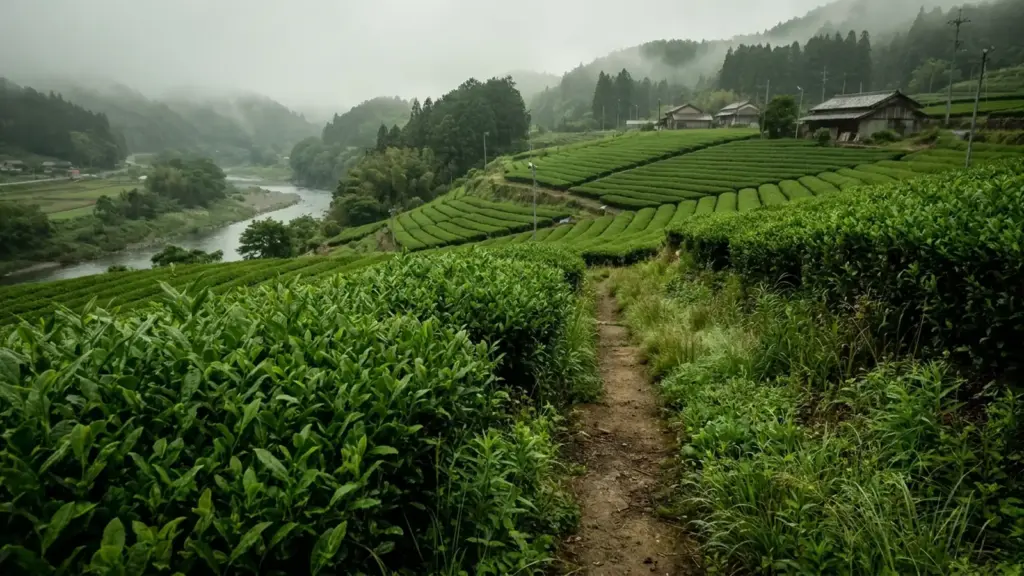
Ide’s documented tea landscape
Ide is a town in southern Kyoto Prefecture. It belongs in a discussion of Kyoto tea culture, but its most clearly documented local feature is more specific than a generic luxury-matcha label. Kyoto’s official travel guide identifies surviving tea plantations in the forests of the Taga area as part of the Japan Heritage story “Japanese Tea: Eight Centuries of Tradition”. This gives the entry a named locality and a verifiable cultural connection.
Why Taga is worth distinguishing
The official account explains that many old tea plantations in the area returned to forest, while some survived within the wooded landscape. The point is the relationship between tea cultivation and the surrounding environment. It is not evidence that every garden uses modern tencha covering equipment, or that all Ide tea comes from one cultivar. A heritage landscape records the history of land use; it does not function as a current municipal crop survey.
Part of Kyoto tea culture, not simply an Uji suburb
The wider Kyoto tea story includes multiple towns, tea-growing landscapes and trading centres. Ide should retain its own municipal identity rather than being treated as a district of Uji City. A reference to the Uji tea tradition can explain context, but it cannot establish that all products sold by an Ide business use leaves from the town. Growing areas, company addresses and regional tea branding must be distinguished in a useful origin description.
The limits of an exclusive-tencha claim
The official Taga account does not say that Ide cultivates only tencha. Without a dated municipal crop breakdown, it is not justified to call the town an exclusively tencha-growing zone or to assign it a specific share of matcha output. Equally, the absence of such data does not prove that tencha is absent. The careful conclusion is that Ide’s tea heritage is documented, while claims about the current crop mix require separate agricultural evidence.
What a matcha specification would add
For an Ide-grown matcha, useful evidence would name the garden and identify tencha as the raw material, with a producer’s account of cultivation and processing. The Japan Matcha Association describes matcha through steaming, drying without rolling and milling, not simply through shade or a Kyoto origin. A cultivar such as Asahi or Samidori should be named only when supported for the specific product. A broad list of Japanese cultivars does not establish which are currently grown in Ide.
From heritage to buying decisions
The Taga landscape makes Ide interesting without promising a town-wide flavour. Sweetness, bitterness, colour and aroma belong in a tasting description of an actual batch, not in an unqualified claim that local Ujihikari has no bitterness or that every Ide powder is more refined than neighbouring teas. Check whether the label refers to cultivation, finishing or sale in Ide and ask for the missing provenance detail. For visitors, the surviving forest tea landscape is the documented point of interest; for matcha buyers, product-level information remains essential.
Sources and scope
Midori Farm: A Place to Immerse Yourself in Nature and Savor Seasonal Delights | Inspiration | Another Kyoto Official Travel Guide; What is MATCHA | Japan Matcha Association. Sources checked on 8 September 2026. Producer statements are attributed; they are not independent tests of every product.