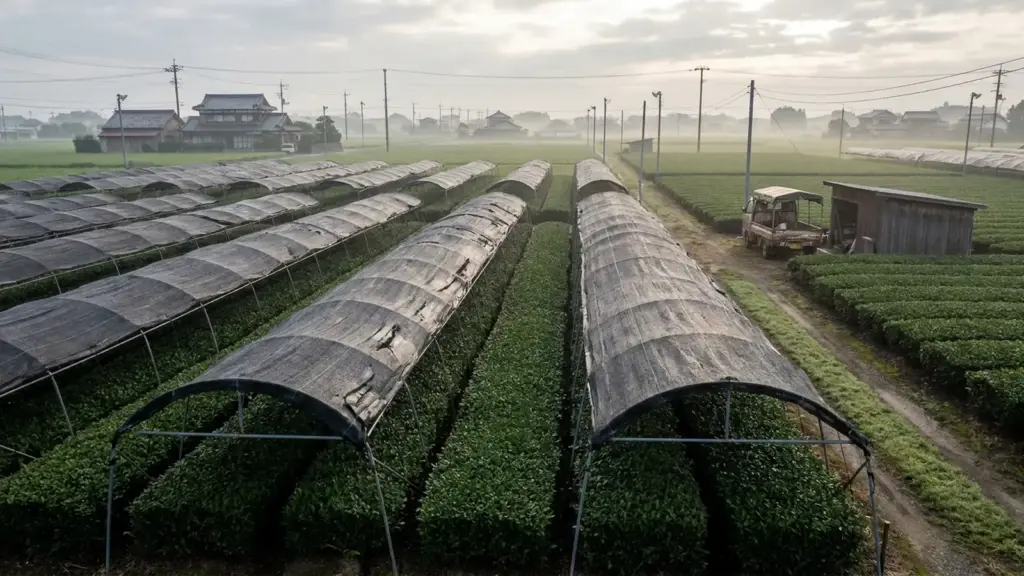
Geographic significance of Nishio
Nishio is a city in Aichi Prefecture, Japan, recognized as an important matcha production center. The city’s official introduction describes the Yahagi River, fertile soil, and a mild climate as features supporting local agriculture. Tea is part of a wider local economy, not the city’s only crop or industry.
When tea sellers speak of Nishio, they may mean the city, a surrounding production region, or a regional brand. Those meanings should not be collapsed into one boundary. The Nishio Tea Cooperative Association itself describes Nishio City and surrounding areas in Aichi, rather than defining every tea product by municipal limits alone.
Regional branding: an important GI correction
Nishio Matcha received Japanese geographical indication protection in March 2017. However, USDA’s March 3, 2020 report, Japan Withdraws Product from GI Protection List, records withdrawal of that registration in February 2020 at the cooperative’s request. The historical 2017 registration must not be described as continuing certification.
The same report states that the cooperative would maintain its Regional Collective Trademark and had applied for protection of Nishio Tencha. An application is not a registration, and a trademark is not a GI. The cooperative’s own English page separately describes its regional trademark recognition in February 2009. These different dates concern different legal events, not successive quality grades.
For a purchase, ask which designation the particular product uses and what traceability supports it. Neither a town name nor an old GI summary proves that a tin currently holds certification. A regional designation also does not necessarily identify one farm or one cultivar.
Tencha cultivation and processing
Nishio’s association with matcha comes from specialization in tencha, the leaf material milled into the powder. The cooperative describes overhead tana frameworks supporting shade covers and emphasizes traditional stone grinding with chausu. These are useful production details, not reasons to promise identical flavor from every local producer.
Nanzan-en provides a concrete local example: its process includes shading, picking, steaming, tunnel-furnace drying, sorting, and stone milling. It describes removing stems and veins from crude tencha before milling the refined material. Its traceability system links product lot codes to production and cultivation records.
Flavor, history, and uses
The cooperative associates Nishio matcha with green color, aroma, umami, and a rich flavor. Treat these as regional descriptions; cultivar, cultivation, processing, blending, and storage still influence an individual tea. Covered-tea aroma is not exclusive to Nishio, and a regional origin does not certify nutrient content.
The area has a long tea-growing history alongside its castle-town heritage. Nanzan-en describes tea cultivation going back centuries, while the city documents its broader historical setting. Those sources support historical context without requiring an unsupported precise founding narrative or treating modern municipal boundaries as unchanged through that history.
Nishio matcha is used both as a whisked drink and in food. MAFF’s tea-experience page connects local fields, stone milling, and tea preparation with modern uses such as lattes and ice cream. Nanzan-en also describes applications in confectionery and dairy drinks.
Reading production claims responsibly
Published promotional pages may quote a national production share or call Nishio the largest producer. Without the statistical year, geographic boundary, and a clear distinction between tencha leaf and finished matcha powder, such numbers are not a dependable current comparison. This entry therefore does not repeat a current percentage, acreage, or tonnage. Use origin and lot information to understand the tea rather than treating a historic ranking as a quality guarantee.
Sources and scope