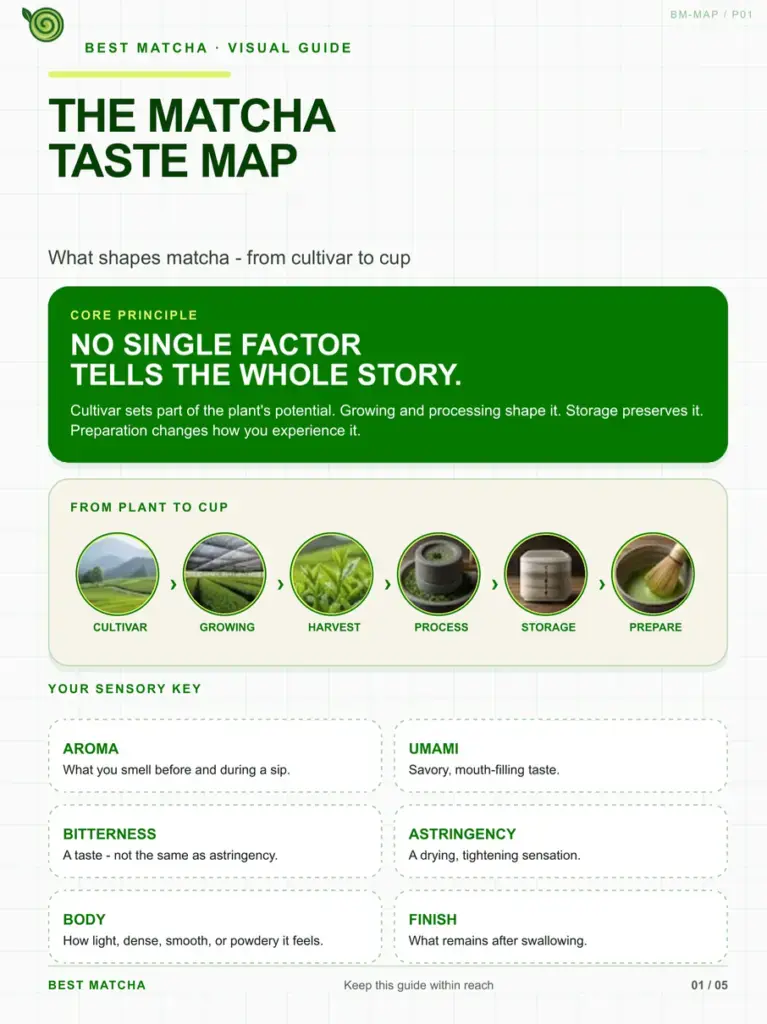

Matcha taste reflects a chain of factors, including cultivar, environment, shading, harvest, processing, blending, grinding, storage, and preparation.
Cultivar influences the plant's sensory potential, but it cannot guarantee a fixed flavour, umami level, or quality.
Origin, shading, and first-harvest labels provide useful context, but none can predict the finished cup on its own.
Traditional stone milling can produce a fine powder, but the words “stone-ground” do not prove that the raw material or final matcha is superior.
Storage protects what production created, while water, ratio, temperature, and whisking change how the matcha is expressed in the cup.
Two matchas can come from the same country and still taste remarkably different. One may feel savory and rounded, while another is more aromatic, brisk, bitter, astringent, light, or dense. That difference is rarely explained by a single label.
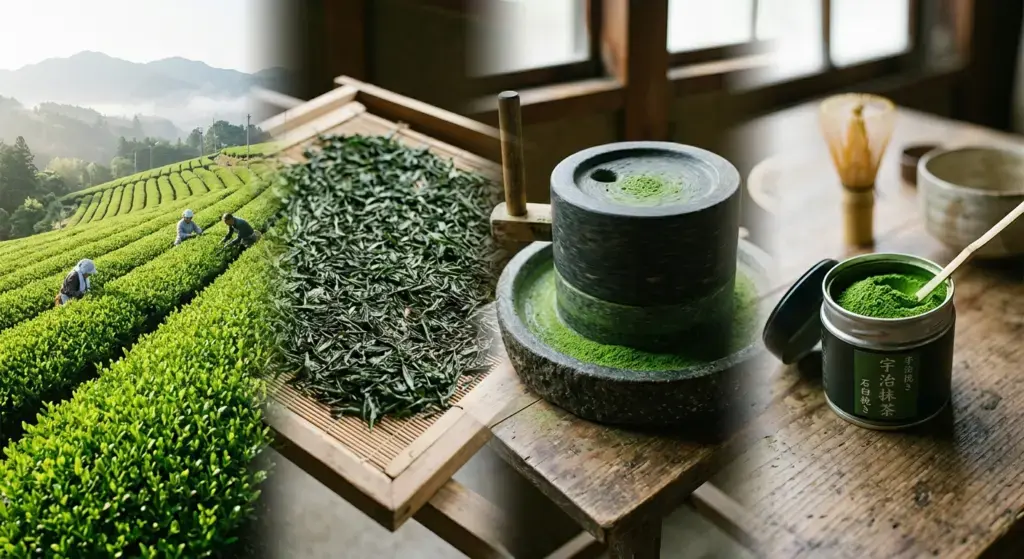
Matcha taste reflects an entire chain: cultivar, growing environment, shading, harvest, tencha processing, blending, grinding, storage, and preparation. Each factor can influence the final cup, but none can predict it alone.
The short answer: Cultivar sets part of the plant's potential. Growing and processing conditions shape how that potential develops. Storage determines how well it is preserved, and preparation changes how you experience it.
This guide explains what each factor can tell you, what it may influence, and what it cannot prove. Use it to read product information more critically – not to predict every matcha before tasting it.
What Do We Mean by “Taste”?
Before comparing production methods, it helps to separate the sensations that are often grouped together as “taste.”
- Aroma is what you smell before drinking and what reaches the nose from the mouth while you sip.
- Umami is a savory, mouth-filling taste associated in tea with free amino acids including theanine and glutamate.
- Sweetness is a sweet impression. It does not necessarily mean the matcha contains added sugar.
- Bitterness is a taste. Caffeine and several other compounds can contribute to it.
- Astringency is not the same as bitterness. It is the drying, tightening, or puckering sensation felt in the mouth. Tea polyphenols, including catechins, can contribute to it.
- Body and texture describe how light, dense, smooth, creamy, powdery, or drying the drink feels.
- Finish is the taste, aroma, and physical sensation that remain after swallowing.
This distinction matters. A matcha can be intensely aromatic without being very bitter, or low in bitterness while still producing noticeable astringency.
1. Cultivar Sets the Plant’s Potential
A cultivar is a cultivated variety of the tea plant, Camellia sinensis. It is the plant's genetic identity – not its region, farm, harvest, or final product name.
Cultivar can influence the raw material's composition, color potential, aroma compounds, growth cycle, and response to cultivation. In a controlled 2024 study, four tea varieties received the same three-week shading treatment and were processed using the same methods. Researchers still found differences in sensory evaluation, color, amino acids, polyphenols, catechins, and aroma-active compounds.[3]
That finding supports a careful conclusion: cultivar matters. It does not support the claim that one cultivar must taste identical wherever or however it is grown.
The same cultivar may express differently because of:
- climate and yearly weather;
- soil and field conditions;
- shading strategy;
- leaf maturity and harvest date;
- tencha processing;
- blending;
- storage;
- preparation.
A single-cultivar matcha can be useful for focused comparison and traceability. A blend can be equally intentional and well made.
What cultivar may tell you: the declared genetic identity of the tea plant.
What it cannot guarantee: a fixed aroma, a precise umami level, or superior quality.
2. Growing Environment Is More Than a Region Name
Tea develops within an environment that includes temperature, rainfall, sunlight, altitude, topography, soil, drainage, and the conditions of a particular growing season. Farming decisions – such as pruning, fertilization, plant health management, and field exposure – also affect the leaf that reaches harvest.
This is why geographical origin is useful but incomplete. A named region improves traceability and can point to established production traditions. It does not mean every farm, field, cultivar, and batch from that region shares one sensory profile.
Descriptions such as “Uji is always creamy” or “Kagoshima is always fresh” turn complex production systems into regional stereotypes. Even within a small area, producers may use different cultivars, shading methods, harvest dates, processing facilities, and blending strategies.
Region should therefore be treated as context, not a flavor guarantee.
What origin may tell you: where the tea or its raw material was grown.
What it cannot guarantee: one universal regional taste.
3. Shading Changes the Leaf Before Harvest
Shading is one of the defining cultivation steps associated with matcha. NARO, Japan's National Agriculture and Food Research Organization, led the preparation of ISO/TR 21380, a technical report summarizing the cultivation and manufacturing methods that distinguish matcha. NARO describes new tea shoots grown under shade as matcha's raw material.[1]
Reducing direct light changes how the plant develops. Research on shaded tea plants has reported changes in chlorophyll, amino acids, caffeine, polyphenols, and catechins. In one controlled study, shading increased theanine and caffeine while reducing measured epicatechin and epigallocatechin levels; chlorophyll responses also differed between 85% and 95% shade treatments.[6]
These chemical changes help explain why shading can influence:
- green color;
- umami and savory depth;
- bitterness and astringency;
- aroma development.
But “shaded for 20 days” is not a complete sensory prediction. The result also depends on the cultivar, shade intensity, timing, plant condition, weather, leaf maturity, and every stage that follows.
More shade is not automatically better. The controlled study above is a useful reminder: different shade intensities did not produce identical responses across every measurement.[6]
What shading information may tell you: how long or how intensively the producer says light was reduced.
What it cannot guarantee: stronger umami, lower bitterness, or better flavor in every finished matcha.
4. Harvest Timing and Leaf Selection Shape the Raw Material
“First harvest” is commonly used as a quality signal, but it describes timing – not the quality of the entire production chain.
Harvest information may help identify the season in which the leaves were collected. Leaf maturity and selection also matter: a batch made from tender shoots is not the same raw material as one containing more developed leaves and stems. Yet a harvest label alone does not reveal how uniformly the leaves were selected, how they were handled, or how well they were processed.
The harvesting method also needs context. Hand picking may allow selective collection. Mechanical harvesting makes larger-scale production possible and can be followed by careful sorting. Neither phrase is a complete verdict without knowing what material was collected and what happened afterward.
When reading a product page, distinguish between:
- harvest season: first, second, or later crop;
- harvest date: when the leaves were picked;
- processing date: when the fresh leaves became tencha;
- milling date: when the tencha was ground into matcha;
- best-before date: the producer's shelf-life guidance.
These dates answer different questions and should not be treated as interchangeable.
What “first harvest” may tell you: the declared seasonal crop.
What it cannot guarantee: ideal leaf selection, expert processing, freshness after milling, or superior taste.
5. Fresh Leaf Must First Become Tencha
Matcha is not made by simply grinding any green tea leaf. The harvested material must first be processed into tencha, the leaf material prepared for grinding.
NARO's account of the matcha technical report emphasizes the combination of shade cultivation and a specialized manufacturing method.[1] In broad terms, the chain includes:
- harvesting the shaded shoots;
- heating the fresh leaf to limit unwanted enzymatic change;
- drying the leaf without the rolling process used for teas such as sencha;
- sorting and refining the dried material;
- preparing the tencha for grinding.
The exact machinery, temperatures, timings, and sorting systems can vary. Those details should not be turned into universal rules unless they come from evidence directly applicable to the process being discussed.
Tencha and matcha are related, but they are not synonyms. Tencha is the prepared leaf; matcha is the powder produced after grinding it.
For a closer look at these manufacturing stages, read Best Matcha's guide to the matcha production process.
6. Processing Can Preserve – or Diminish – the Leaf’s Potential
Cultivation creates the raw material. Processing determines how well that material is stabilized, refined, and preserved.
Careful processing may help protect:
- color;
- aroma;
- chemical balance;
- sensory cleanliness;
- consistency between portions of a batch.
Poor control may allow unwanted oxidation, aroma loss, uneven drying, contamination with coarse material, or excessive heat exposure. However, processing cannot recreate a cultivation decision that never happened. It cannot add authentic shade growth to an unshaded leaf or turn unsuitable raw material into exceptional tencha.
This is why individual marketing claims must be interpreted as pieces of a chain. A producer can perform one stage well and still lose quality elsewhere.
7. Blending Can Create Balance and Consistency
A matcha may come from one cultivar, field, or lot, or it may be an intentional blend. Producers can combine cultivars, fields, harvest lots, or tencha with complementary characteristics.
Blending may be used to achieve:
- a consistent house style;
- balance between aroma, umami, bitterness, and astringency;
- stable color and texture;
- complexity;
- suitability for usucha, koicha, or lattes;
- continuity when agricultural conditions change between seasons.
A single-cultivar matcha offers a narrower identity for comparison, but it is not automatically better. Likewise, a blend is not evidence of low quality. The relevant question is whether the composition is transparent and whether the result is coherent for its intended use.
8. Grinding Changes How the Powder Behaves
Grinding turns tencha into matcha powder. The resulting particle size and distribution can influence dispersion, suspension, texture, and the sensation of powder in the mouth.
Grinding conditions also matter because matcha is a delicate, high-surface-area powder. Producers may manage throughput and heat differently depending on their equipment and target product. However, precise claims about ideal particle size, mill speed, or temperature should be tied to a specific study or process rather than repeated as universal standards.
Traditional stone milling remains the best-known and historically established method for producing fine matcha powder. Research descriptions of matcha production also identify grinding speed and mill type as quality-relevant variables, and describe slow stone milling as a way to preserve delicate color and flavor.[8] This does not mean that the words “stone-ground” guarantee superior matcha. The result still depends on the tencha, the mill, its condition, the feed rate, and how the process is controlled. If milling is pushed too quickly, greater friction and heat exposure can work against the qualities the slow method is intended to protect.
The phrase stone-ground describes one stage. It does not tell you:
- which cultivar was used;
- how the plants were shaded;
- which leaves were harvested;
- how the tencha was processed or sorted;
- how old the powder is;
- how it was stored.
A stone mill cannot correct weak raw material. Conversely, equipment should be judged by the powder and sensory result it produces, not by romantic language alone.
What “stone-ground” may tell you: the declared milling method.
What it cannot guarantee: excellence across the complete production chain.
9. Packaging and Storage Determine What Remains
Once tencha becomes a fine powder, storage becomes especially important. Temperature, oxygen, moisture, light, time, and repeated opening can all influence the condition of the product.
A two-month matcha storage study measured progressive changes at different temperatures. As storage temperature and time increased, the researchers observed decreases in brightness and green color values, along with reductions in measured phenolics, flavonoids, several catechins, caffeine, and antioxidant activity.[4] The study used one Korean matcha under controlled storage conditions, so its exact figures should not be applied to every product. Its broader lesson is still useful: storage conditions materially affect matcha.
Packaging can help limit exposure, but no container stops time completely. Nitrogen-flushed pouches deserve specific mention: replacing much of the oxygen in a sealed package with inert nitrogen can reduce the powder's initial oxygen exposure before opening. Research on green tea storage supports the broader value of limiting oxygen; for example, oxygen-scavenger packaging reduced aroma deterioration and stale-odor development in stored Longjing tea.[9] Nitrogen flushing is therefore a meaningful preservation measure, not a guarantee of freshness. Its benefit depends on low residual oxygen, an effective oxygen and moisture barrier, a sound seal, appropriate temperature control, and the package remaining unopened. Once the pouch is opened, normal air enters and the original protective atmosphere is lost.
It is also important to distinguish unopened storage from daily use after opening.
When evaluating freshness, ask separate questions:
- When were the leaves harvested?
- When was the tencha milled?
- How was the powder packaged?
- How was it transported and stored before purchase?
- How long has the package been open?
A recent harvest date cannot prove good storage. A best-before date cannot reveal how many times a warm, humid container has been opened.
For practical definitions, see Best Matcha's glossary entries on storage conditions, matcha milling date, and matcha shelf life.
10. Preparation Is the Final Variable
Production determines what is present in the powder. Preparation determines how that powder is dispersed, diluted, aerated, and perceived.
Important variables include:
- water composition;
- water temperature;
- matcha-to-water ratio;
- sifting;
- whisking time and motion;
- serving temperature;
- whether the matcha is prepared as usucha, koicha, or a latte.
Research on matcha agitation found that changing stirring speed and time altered sensory evaluation and measured flavor substances. The authors concluded that agitation can influence the sensory profile rather than acting as a purely cosmetic step.[7]
This does not mean there is one universally perfect whisking method. It means preparation is a real experimental variable. If two matchas are prepared with different ratios or techniques, you cannot confidently attribute every sensory difference to cultivar or production.
For a fair comparison: use the same powder weight, water, temperature, bowl, and whisking method. Record aroma, umami, bitterness, astringency, texture, and finish separately.
How to Read a Matcha Product Page
No product page can let you taste the powder in advance. It can, however, provide enough transparent information to help you ask better questions.
| Claim or information | What it may tell you | What it cannot prove alone |
|---|---|---|
| Named cultivar | The declared genetic identity of the plant | A fixed flavor or superior quality |
| Single cultivar | That one named cultivar was used | That it will taste better than a blend |
| Named origin | Where the tea or raw material was grown | A universal regional flavor |
| First harvest | The declared seasonal crop | Perfect leaf selection or processing |
| Long-shaded | One detail about cultivation | Strong umami or low bitterness in every cup |
| Hand-picked | The declared harvesting method | Excellent sorting, processing, and freshness |
| Stone-ground | The declared grinding method | Quality across the full production chain |
| Single origin | Greater geographical traceability | Uniformity within an entire region |
| Ceremonial grade | The seller's intended positioning | A universally regulated quality standard |
| Organic certification | Compliance with an organic standard | Better sensory quality |
| Harvest date | When the leaves were collected | Recent milling or proper later storage |
| Milling date | When the tencha was reportedly ground | Good transport and storage after milling |
| Cultivar not disclosed | That the information is unavailable | That the matcha is necessarily inferior |
The most informative sellers provide a coherent picture rather than a pile of premium-sounding claims.
The Three Ideas to Remember
1. No Single Label Predicts Taste
Cultivar, origin, harvest, shading, and grinding are useful pieces of information. None is a complete sensory verdict.
2. Production Factors Interact
Genetics, environment, cultivation, processing, blending, and storage influence one another. A claim should always be interpreted within the complete chain.
3. Tasting Remains Essential
Product information can improve your questions and comparisons. It cannot replace tasting under consistent preparation conditions.
The most useful matcha label is not the one with the largest number of premium claims. It is the one that provides transparent, verifiable information about how the tea was grown, processed, protected, and intended to be prepared.
Method and Editorial Note
This guide was developed using Japanese institutional documentation and peer-reviewed research. Sensory effects are presented as possible influences or documented tendencies – not guarantees – unless they were directly demonstrated under controlled conditions. Studies on one cultivar, country, processing system, or storage protocol should not automatically be generalized to every matcha.
Sources
[1] https://www.naro.go.jp/english/laboratory/nifts/press/matcha/index.html – NARO – ISO technical report on the definition of matcha
[3] https://pmc.ncbi.nlm.nih.gov/articles/PMC10900760 – Metabolomics analysis of matcha from different tea varieties
[4] https://pmc.ncbi.nlm.nih.gov/articles/PMC7406592 – Effect of storage temperature on matcha
[6] https://pmc.ncbi.nlm.nih.gov/articles/PMC9696345 – Effect of Shading on Matcha Green Tea
[7] https://pmc.ncbi.nlm.nih.gov/articles/PMC11415815 – Agitation Effects on the Sensory Profiles of Matcha Tea
[8] https://pmc.ncbi.nlm.nih.gov/articles/PMC12157965 – Comparative characterization of different matcha grades and production factors
[9] https://pmc.ncbi.nlm.nih.gov/articles/PMC11698971 – Effect of oxygen-scavenger packaging on green tea aroma during storage

Author: Emilie Schol
Founder of Best Matcha