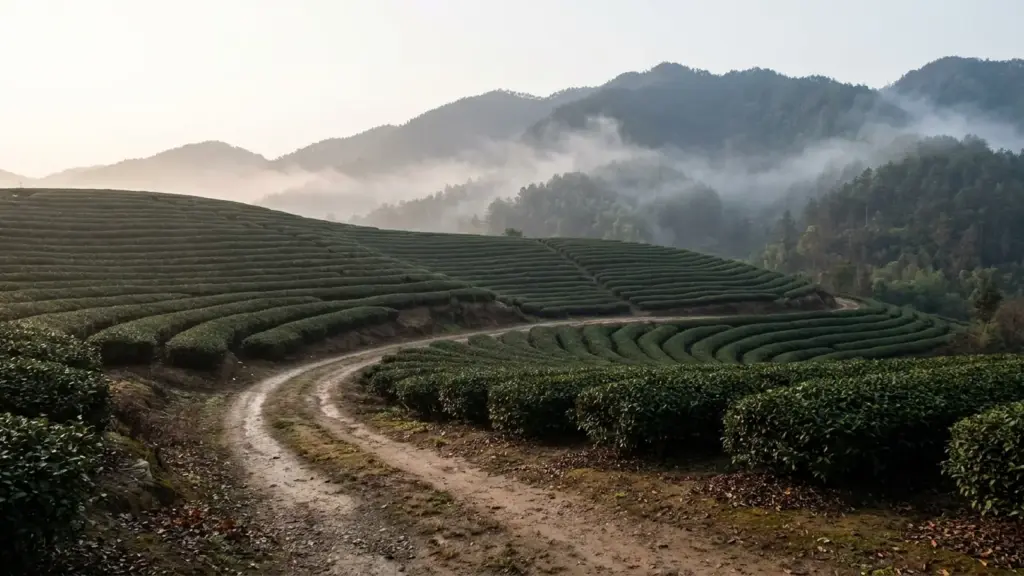
A documented Chinese matcha-producing province
Zhejiang is a province in eastern China with both leaf-tea industries and documented matcha production. Those activities should not be conflated: the existence of a famous loose-leaf tea does not show that it is routinely ground into matcha. A product’s raw material and manufacturing steps need their own evidence.
A March 26, 2026 report on the provincial government’s English portal gives Zhejiang’s 2025 matcha output as 8,851 metric tons and says it accounted for more than 60% of China’s total matcha production. These are attributed provincial figures for a stated year, not a current output guarantee, a Hangzhou city total or a measure of factory capacity.
Local process evidence challenges simple stereotypes
A separate April 24, 2026 Lishui government-hosted report describes shade nets covering tea plants in Liandu for 20 days before harvest. It names businesses converting tea areas for matcha and using automated processing and milling. The page is marked advertorial, so its company-performance claims should be read with that promotional context.
This local example does not establish one covering schedule across Zhejiang. It does, however, make it inappropriate to assume all Zhejiang matcha is sun-grown or that mist alone is the region’s shading method. The process described for a named locality is stronger evidence than importing assumptions from the province’s ordinary green teas.
Milling and leaf treatment are separate questions
The Lishui report describes different milling arrangements, including high-speed ball mills at Zhejiang Mingye Plant Technology. That is not evidence of universal traditional stone milling. Similarly, the pan-heating used for some Chinese leaf teas should not be assigned automatically to every matcha factory in Zhejiang. Ask about the particular product’s oxidation-arrest and drying steps.
For a Japanese process comparison, the Japan Matcha Association describes shaded leaves that are steamed and dried without rolling before tencha is milled. This benchmark explains the questions to ask; it is not proof that any named Chinese supplier follows every step. A supplier should state its own method and applicable product standard.
Production, capacity and product quality
The provincial output report and the Lishui company descriptions cover different scopes. A factory’s annual capacity is potential throughput, while provincial output is a reported amount produced. Tea garden area is a land measure. None should replace another, and an alliance or factory may source leaves beyond the locality where it processes them.
Check the growing location, harvest, ingredients, cultivation method and mill for a Zhejiang powder. Request certificates and batch testing where relevant rather than assuming province-wide organic status or a universal A-to-AAA grade system. Compare actual samples for aroma, texture and astringency. Chestnut notes from a pan-fired leaf tea, or a claim of lower umami than Japanese matcha, cannot safely be assigned to all powders from this varied province.