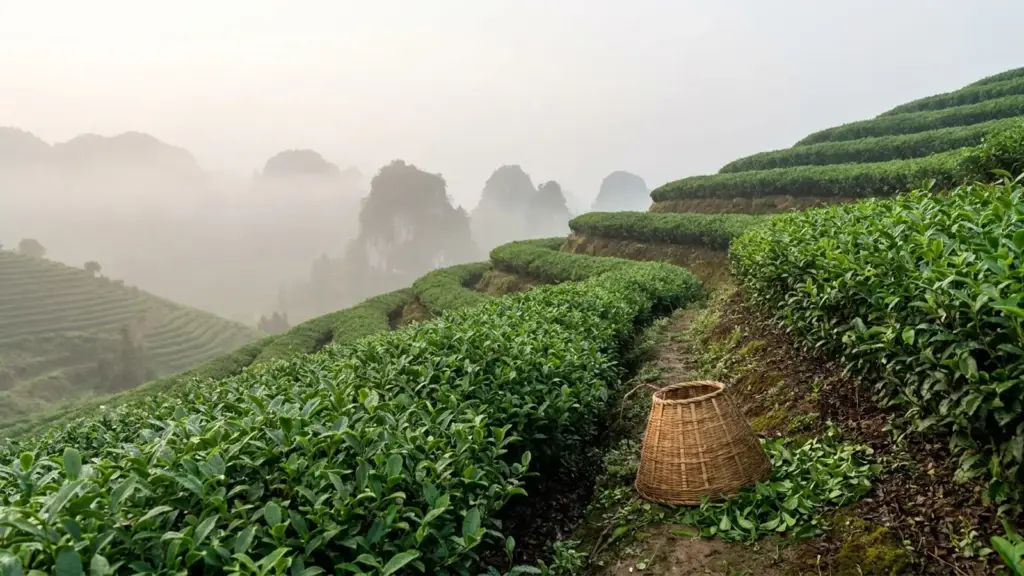
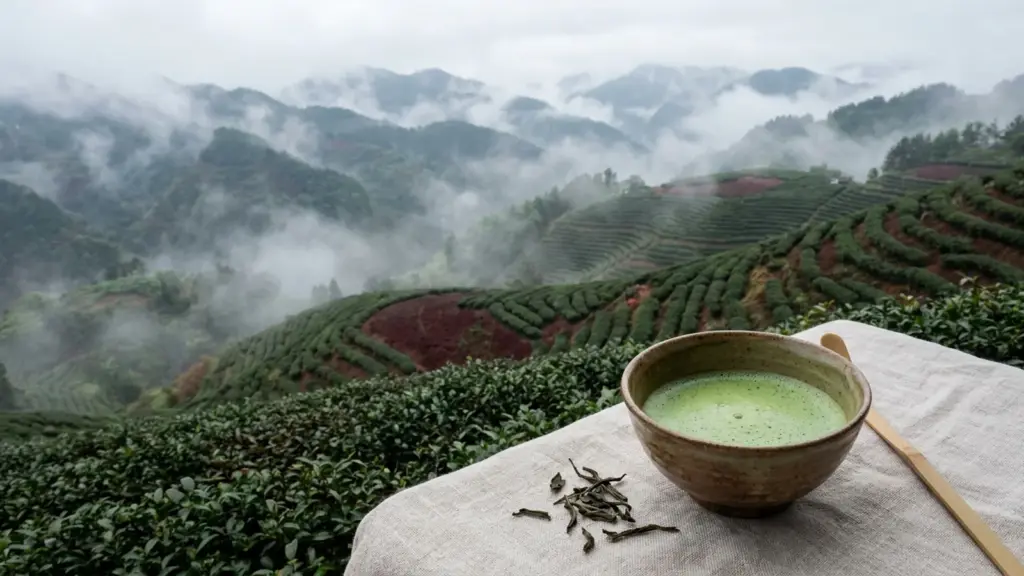
Guizhou is a province in southwestern China with a tea industry that includes documented commercial matcha production. The province’s name is a broad origin statement: it does not identify a single growing altitude, factory, cultivar or flavor profile.
A documented matcha center in Jiangkou
A March 2025 China Daily report published on Guizhou’s government website describes matcha production and exports from Jiangkou County. It identifies Guizhou Tongren Gui Tea Co Ltd and discusses an alliance involving businesses and farmers across multiple counties. This provides a concrete industrial and geographical reference, rather than relying on a generic description of Chinese green tea.
The report describes ball milling and uses such as beverages, ice cream, chocolate, cakes and noodles. These examples explain why an ingredient supplier’s requirements may differ from those of someone buying tea to whisk with water. They do not establish a quality ranking for every Guizhou producer, and the article’s company figures should not be treated as a permanent provincial production total.
Province, factory and farm are different origins
The same report quotes a company representative describing Guizhou’s high altitude, limited sunlight and frequent mist. That is regional context attributed to an industry participant. It does not establish that every matcha field stands above a particular elevation, or that tea from the whole province shares chestnut, seaweed or umami notes.
For a meaningful origin check, ask which county supplied the leaves, who grew them and where primary processing took place. A factory in Jiangkou can identify the manufacturing location without, on its own, resolving the location of every supplying farm. The wider China entry should be read as country context, not a substitute for this traceability.
Check the process behind the matcha name
The Japan Matcha Association explains the Japanese process through tencha: shaded leaves are steamed, dried without rolling and ground into powder. Its explanation is useful for comparing manufacturing descriptions, but it is not evidence that a particular Chinese producer follows every Japanese practice.
Ask the supplier to document shade cultivation, heat treatment, drying, sorting and milling for the product being offered. The distinction between tencha and other powdered green teas matters more than whether a label borrows Japanese terminology. Likewise, a claim of shading needs a cultivation account; a misty landscape photograph is not one.
How to assess a Guizhou ingredient offer
Consider a supplier offering “Guizhou matcha for lattes” with a factory address and an “EU standards” statement. The news report describes that phrase as the named company’s product branding and reports its representative’s testing claims. It is not a certificate covering every Guizhou matcha lot or proof of organic status.
- Request a lot-specific specification and identify the leaf-growing county separately from the processor.
- Ask which tests support any compliance statement, when they were performed and which batch the report covers.
- Check the ingredient list for pure tea versus a sweetened or otherwise blended preparation.
- Evaluate a sample in its intended recipe, keeping the preparation consistent when comparing suppliers.
The matcha quality-testing guide offers a related starting point. Origin narrows the supply-chain question; documentation and the actual product answer it. Neither Guizhou nor a competing origin should be used as shorthand for an assured taste, safety result or grade.