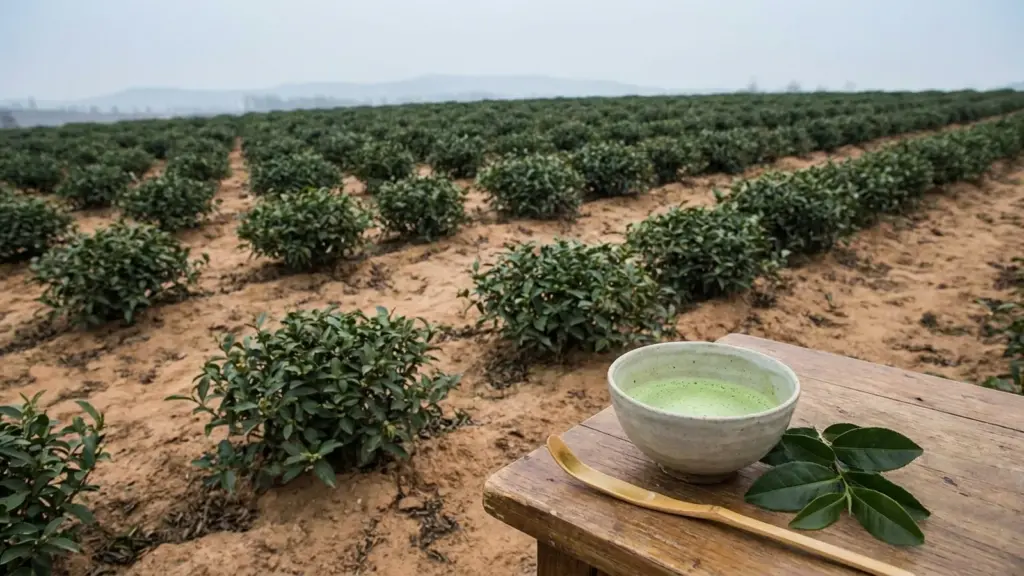
Shandong as a northern tea origin
Shandong is a province in northern China with documented green-tea production. Rizhao, on the coast, offers a particularly clear local example. The provincial government’s English-language information site describes Rizhao green tea in the context of sea winds, northern winters and the influence of the Yellow Sea. This provides a real regional tea connection without declaring Shandong the absolute northern limit of Chinese tea cultivation.
The province name and the city name also have different scopes. Evidence about Rizhao should not automatically become a claim about every garden in Shandong, still less about every powdered tea sold by a Shandong business.
How tea became established in Rizhao
A June 2025 China Daily report describes an effort to introduce tea to Rizhao that began with the government’s south-tea-northward initiative in 1954. It dates successful cultivation in the city to 1966, after years of development. These milestones give the local tea story a specific historical shape.
They are more informative than saying tea simply began everywhere in the province in the 1950s. They also distinguish an introduction programme from the point at which cultivation succeeded. The report concerns the establishment of tea growing in Rizhao; it does not provide a foundation date for a Shandong matcha industry.
What the regional flavour descriptions refer to
The same account associates Rizhao tea with thick leaves, a rich taste, a yellow-green infusion and a chestnut aroma. Those details describe leaf tea and its brewed liquor. They should not be rewritten as a promise that Shandong matcha has bright green powder, a seaweed aroma or an identical mouthfeel.
The reporting links the tea to a coastal climate and differences between daytime and nighttime temperatures. That is a regional account, not a controlled comparison with every southern growing area. It does not support claims that southern tea plants never encounter cold stress, or that local spring water compensates for all soil or rainfall limitations.
Tea culture, tourism and product identity
China Daily also describes efforts to combine tea culture, sightseeing and leisure in Rizhao. This shows another way the tea origin reaches consumers: not only through harvested leaf, but through experiences connected with tea fields and local businesses. It is not evidence that every tea shop manufactures the products it serves.
For a Shandong-labelled matcha, separate the seller’s location from the place where the leaves were grown and processed. The Japan Matcha Association describes matcha as powdered tencha, involving shade cultivation, steaming, drying without rubbing and milling. Ask for those product details rather than inferring them from green-tea farming. Rizhao’s documented tea history and regional leaf-tea character are useful on their own; a matcha claim requires a named product and a supported processing description.
Sources and further reading