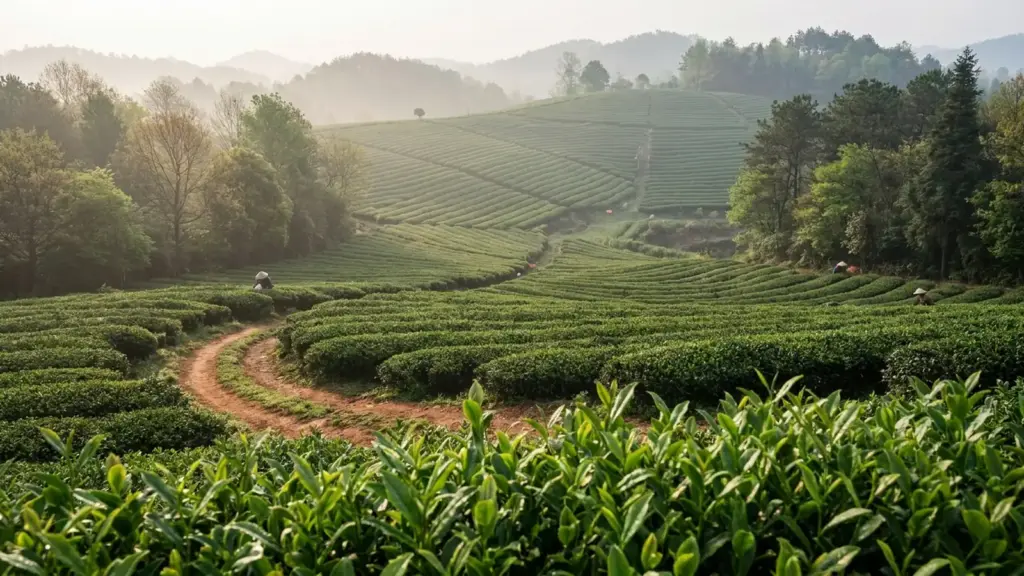
Jinhua: Tea Origin and Regional Context
Jinhua includes Wuyi county, where public reports document matcha processing and a named supplier, alongside a broader leaf-tea industry.Definition of Jinhua
Jinhua is a city-level region in Zhejiang, China, that includes the tea-producing county of Wuyi. Public reports identify Wuyi matcha processing and a named commercial supplier. This is a specific local supply connection, not evidence that every Jinhua tea or tea business produces matcha.
Learn more
Where Jinhua’s matcha connection is documented
Jinhua is a city-level region in Zhejiang Province, China. Within that geography, Wuyi county provides a specific, documented link to matcha. A March 2024 report on the Zhejiang government’s English-language portal identifies matcha sourced from Wuyi for a Starbucks beverage launch. It names Zhejiang Huashida Tea Co as the Wuyi supplier.
This is a narrower and more useful statement than calling Jinhua a world-leading matcha centre. It connects an identifiable county and company with a reported product supply relationship, without turning provincial tea-industry reputation into a claim about every part of the city-level region.
Wuyi’s tea industry is broader than powder
An earlier Zhejiang portal report, published in September 2020, describes Wuyi as an established tea-manufacturing area. It discusses Wuyang Spring Rain, a pine-needle-shaped green tea developed locally in the early 1990s, and later diversification beyond green tea. The same account explicitly says the county had begun processing green tea into matcha.
The two reports together establish both a tea background and a matcha-specific connection. They also prevent a common misreading of production figures: statistics covering the whole Wuyi tea industry are not matcha output. Leaf teas, different processing styles and powdered products must not be added together and then presented as a matcha-only total.
What the named supplier example shows
The 2024 article reports that Huashida’s cooperation with Starbucks began in 2019. It separately locates the company’s research and development centre in Hangzhou. That distinction matters: a business can grow, process, develop and sell products through different locations. The address of a research centre is not necessarily the origin of the leaf.
The article concerns a particular commercial relationship at a particular time. It is not a certification audit, a present-day inventory or proof that a limited-time beverage is still available. Its customer comments about prepared drinks also should not become universal tasting notes for pure Jinhua matcha.
How to assess a Jinhua-labelled matcha
For a buyer, Jinhua is best treated as the starting point for more precise sourcing questions. Ask whether the product identifies Wuyi or another growing locality, names the manufacturer, and describes the material used to make the powder. A company’s presence in the region does not supply those details for every item in its catalogue.
The Japan Matcha Association distinguishes matcha from powdered sencha through tencha production: shade cultivation, steaming, drying without rubbing and milling. The regional news reports document a product called matcha, but they do not provide a complete technical specification for each batch. Use the maker’s product documentation for that next level of detail. This preserves Jinhua’s real matcha connection while leaving unsupported claims about sterile workshops, universal grades and world-largest production aside.
Sources and further reading
- Starbucks introduces new lineup featuring Jinhua matcha — Zhejiang government portal / China Daily
- Steady progress made in Wuyi’s tea industry — Zhejiang government portal / China Daily
- What is MATCHA — Japan Matcha Association
Sources and references

Accessed: 2026-09-08
Language: en
March 2024 reporting identifies Wuyi county in Jinhua as a matcha supply origin, names Zhejiang Huashida Tea Co and distinguishes its Hangzhou R&D center. No world-leading production claim is supported.
Accessed: 2026-09-08
Language: en
September 2020 account documents Wuyang Spring Rain green tea, tea diversification and Wuyi processing green tea into matcha; totals are historical all-tea figures, not matcha output.
Accessed: 2026-09-08
Language: en
Matcha is powdered tencha: shaded leaves are steamed and dried without rubbing before milling. This supports processing distinctions, not regional production or health claims.

Emilie Schol
Founder of Best MatchaFrequently asked questions
Here are some frequently asked questions and answers.Does Jinhua have a documented matcha connection?
Does Jinhua have a documented matcha connection?
Yes. Public reports identify matcha processing in Wuyi county and name Zhejiang Huashida Tea Co as a supplier in a March 2024 account.
Is a Hangzhou research centre proof that the tea grew in Hangzhou?
Is a Hangzhou research centre proof that the tea grew in Hangzhou?
No. The 2024 report distinguishes the Wuyi company from its Hangzhou research and development centre. Growing, development and sales locations are separate details.
Do Wuyi’s total tea statistics measure matcha production?
Do Wuyi’s total tea statistics measure matcha production?
No. The local tea industry includes leaf teas and other products. An all-tea total should not be presented as matcha output.