What Okashi Means in Japanese Tea Culture
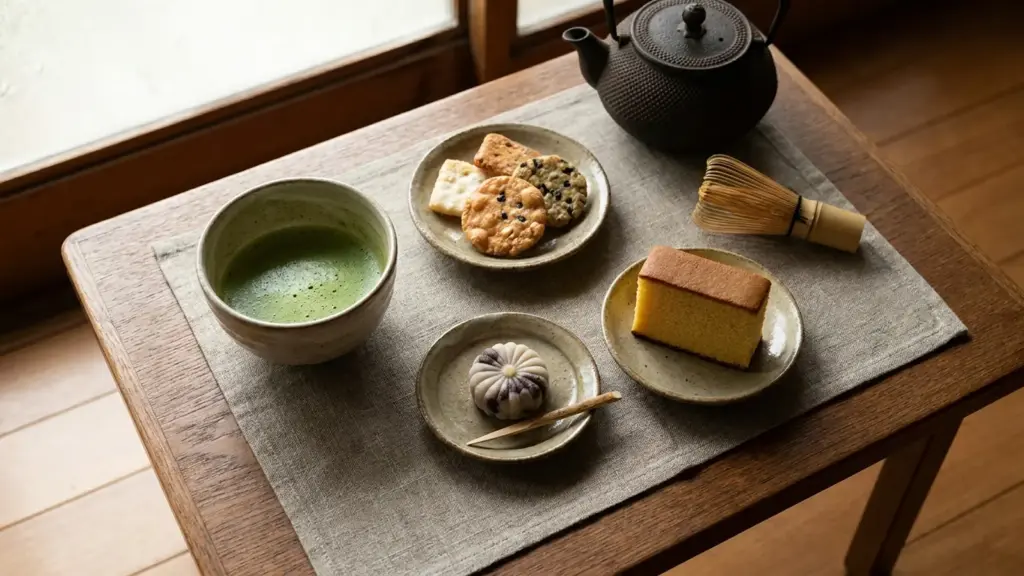
Okashi (お菓子) means sweets or confectionery in everyday Japanese. It is not limited to handmade sweets for a tea ceremony. NHK’s Japanese lesson uses the word in an ordinary souvenir-shopping conversation and translates it as “sweets.” In a matcha gathering, the context usually points to the sweets the host has selected to accompany tea.
Okashi and wagashi are not exact synonyms. Wagashi refers to traditional Japanese confectionery, while okashi is the broader everyday word. Wagashi itself is not confined to ceremonial service: Japan’s Ministry of Agriculture, Forestry and Fisheries describes regional, household, festival and everyday confections as well as the history of sweets associated with tea.
Types of Okashi for Different Tea Preparations
Omotesenke’s tea-sweets guide distinguishes omogashi, or main sweets, from higashi, dry sweets. Its account also calls omogashi namagashi and describes their moist character. Examples include shaped bean-paste confections and steamed sweets. Higashi includes molded or pressed sweets and sugar confections.
At a formal tea event, omogashi accompany thick tea, or koicha, and higashi accompany thin tea, or usucha. These pairings are not an absolute rule for every gathering. Omotesenke explicitly notes that both kinds may appear when only thick tea is served, and that a simple gathering serving only thin tea may offer an omogashi. The event format matters, not just the name of the tea.
This distinction is more useful than assuming that all moist sweets are for koicha or that usucha always requires a dry sweet. Ask what kind of gathering is being held and follow the host’s arrangement.
The Sweet and Bitter Balance
A sweet provides a contrast to plain matcha and forms part of the host’s hospitality. It need not be described as a protective coating for the palate, and there is no need to claim that tea without a sweet will overwhelm the drinker. Sweetness, texture and the tea’s flavor can be appreciated separately as well as together.
For an informal tasting, try a small sweet and notice how the following sip seems different. This is a suggestion for paying attention to taste, not a physiological promise or a requirement to add sugar to the bowl. Plain matcha can also be enjoyed without confectionery.
Seasonal Selection and Aesthetic Considerations
MAFF explains that some wagashi express a season through ingredients, while others use names, colors or shapes. A change in the shape of a bean-paste sweet can suggest a different time of year even when its basic ingredients stay the same.
For example, its seasonal guide includes cherry-blossom imagery, clear streams, autumn leaves and snow. These are examples of a broad tradition, not a mandatory color chart. Regional practices, the maker and the occasion all contribute to the selection.
Serving and Eating Tea Sweets
Omotesenke describes formal service in stacked boxes, with a sweet pick used to transfer the confection to kaishi paper. It also describes simpler individual dishes and other serving vessels. A single universal instruction to eat every kind of okashi with a pick would miss these differences in food and setting.
As a guest, follow the host or teacher’s guidance about when to take and eat the sweet. At home, a small dish and an appropriate utensil are enough for a casual pairing; that is not the same as claiming to reproduce a school’s formal procedure.
Choosing Sweets for Everyday Matcha
Choose something you enjoy, in a portion that leaves room to taste the tea. A seasonal wagashi can add cultural context, but the word okashi does not certify ceremonial suitability or a particular recipe. Check the maker’s ingredient and storage information: MAFF’s examples include wheat flour and eggs, so neither gluten-free nor vegan status follows from the name.
Sources
Lesson19 I'd like a pair of gloves. | Easy Japanese | NHK WORLD-JAPAN; Japanese sweets | Traditional Foods in Japan : MAFF; FORMS AND BEHAVIOR : Tea sweets.