Who was Sen no Rikyū?
Sen no Rikyū (千利休, 1522–1591) was a Japanese tea master associated with the development of wabi-cha. Born in Sakai, he studied under Takeno Jōō and served Oda Nobunaga and Toyotomi Hideyoshi. Omotesenke’s glossary records these biographical points.
His importance lies in his influence on an existing tradition of chanoyu, not in inventing tea drinking or single-handedly transforming a previously nonspiritual beverage. Tea practice, religious associations and aesthetic debates preceded him.
Wabi-cha and restrained hospitality
Omotesenke describes wabi through a clean, simple life and finding spiritual sufficiency and beauty amid material poverty. Stanford places Rikyū’s practice within that aesthetic history. This is more precise than a slogan that any imperfect object is automatically beautiful.
Humble materials and intimate settings are important to this aesthetic. Small tea spaces, bamboo tools and local bowls direct attention away from conspicuous display. They do not prove that historical society lacked hierarchy or require every contemporary matcha setting to imitate one room.
Tea rooms and utensils
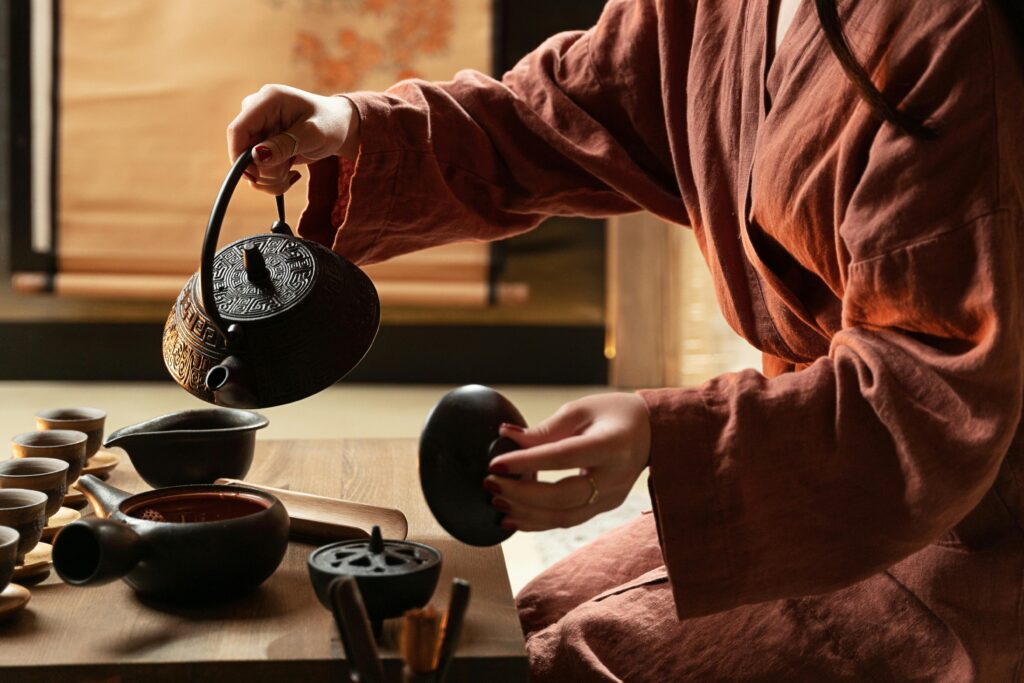
Rikyū’s association with small tea spaces and the potter Chōjirō appears in Stanford’s discussion of wabi. Raku bowls and bamboo tools explain why chanoyu history is also architectural and craft history, rather than merely a recipe for powder and water.
Separate aesthetic influence from undocumented technical inventions. Modern recommendations for water temperature, whisking patterns, foam thickness or powder ratios should not be attributed to Rikyū without historical evidence. Today’s instructions may belong to a particular school or producer.
The three Sen schools came later
Omotesenke, Urasenke and Mushakōjisenke trace their heritage through Rikyū’s family. Omotesenke explains that separate houses developed through sons of his grandson Sen no Sōtan: Kōshin Sōsa, Sensō Sōshitsu and Ichio Sōshu. A shared ancestor is not the same as personally founding all three organizations.
These schools transmit tea practice, but should not be reduced to unsupported personality labels such as formal, accessible or individualistic. Follow the school and teacher concerned when learning a procedure rather than assuming one identical method.
Reading later teachings carefully
Omotesenke distinguishes a saying attributed to Rikyū in the Yamanoue Sōjiki from the wording ichigo ichie in Ii Naosuke’s later Chanoyu Ichie Shū. One can discuss the importance of a unique gathering without claiming that Rikyū coined every familiar modern phrase.
Stanford identifies Nampōroku as a later text attributed to him. That matters when stories become exact quotations. Rikyū died in 1591 after being ordered to take his own life; a neat tale that one aesthetic disagreement caused his death should not be offered as settled fact.
Relevance for matcha readers
This history adds context to tea bowls, scoops, rooms and hospitality. It does not authenticate a commercial grade or make any personal bowl a formal ceremony. It enriches understanding while leaving room for historical evidence and living traditions to differ.