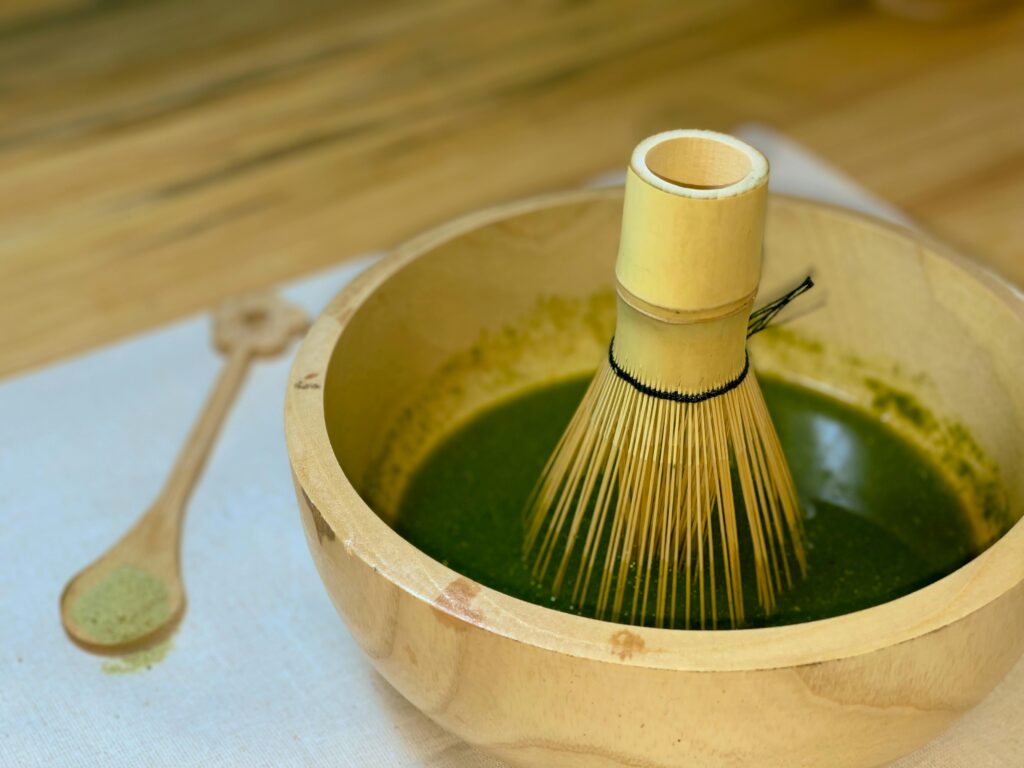
M-ji describes an M-shaped pattern: in matcha instructions, it is a letter-based cue for moving a chasen forwards and backwards through the tea. The M describes the motion, not a separate recipe or tea-school lineage. It is the same zigzag commonly called The W Method, viewed or pictured differently.
Understanding the letter cue
Ji (字) means a written character or letter, so M-ji is an M-character or M-shaped description. Read it as a visual comparison, not as the name of a special ingredient, utensil or grade. The useful instruction is repeated changes of direction rather than circular stirring.
Ippodo’s English chasen guide makes the comparison explicit: an M shape, zigzagging forwards and backwards. The guide also describes a loose grip and wrist movement. It does not require carefully drawn corners, a counted number of complete letters or a fixed distance between their peaks. Concentrating on a perfect alphabet shape can distract from how the whisk is actually moving in the liquid.
A Japanese producer can describe the action without a letter
Marukyu Koyamaen’s Japanese instructions use direct movement language instead of naming an M method. They say to mix slowly to disperse the powder at the bottom, lift the whisk slightly, then move the wrist firmly forwards and backwards while avoiding a circulating swirl of water.
That sequence is useful when reading a translated tutorial. The Japanese phrase 前後 describes forwards and backwards; 手首 identifies the wrist. These cues can explain the intended action even when M-ji, W or zigzag does not appear in the text. A difference in instructional vocabulary is not evidence of a different traditional technique.
Once foam has formed, the same producer describes raising the tips towards its surface and moving more slowly to refine it. The rapid letter-shaped motion is therefore one phase of preparation, not a command to whisk every stage at maximum speed.
What M-ji does not specify
- A recipe: the cue gives no powder quantity, water volume or temperature.
- A mandatory stroke count: a precise number of M shapes is not needed to understand the motion.
- A whisk specification: the letter does not establish a required tine count or handle length.
- A historical origin: a modern teaching comparison does not identify who first developed the underlying action.
- A quality grade: foam coverage cannot certify the matcha or the skill of its maker.
Limits and alternative aims
For foamy usucha, quick back-and-forth whisking is a useful starting point. It is not compulsory to produce a thick foam cap. Ippodo explicitly describes deliberately making tea with little foam by whisking slowly, and Marukyu Koyamaen also acknowledges low-foam preparation.
Koicha has a different concentration and texture goal. Ippodo’s recipe uses more powder with less water and calls for slow mixing. Calling this “M-ji at one-third speed” would introduce a precision the source does not provide and obscure the difference between aerating thin tea and blending thick tea.
When learning from a teacher, follow the demonstrated action in context. When making tea at home, use the producer’s full recipe alongside any letter cue. For a practical sequence and troubleshooting, the W Method entry covers the same motion without treating M and W as rival systems.