What Akibancha Means
Akibancha is a seasonal term used in Japanese tea production for material gathered from autumn growth after the principal spring and summer harvests. It identifies when the shoots are taken, rather than guaranteeing a particular grade, flavor, or finished tea. The exact date depends on local climate and field management. Mie Prefecture’s tea guidance places the related autumn trimming period around early to mid-October, while noting that growers may harvest autumn tea somewhat earlier when market conditions justify doing so.
Harvesting and Autumn Field Management
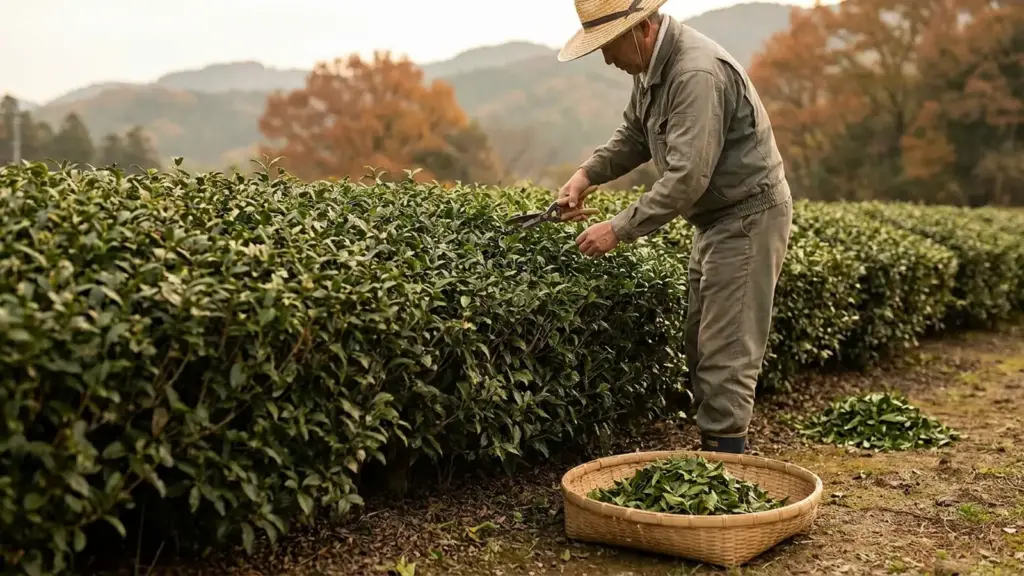
Autumn work has two connected purposes: making use of the season’s leaf growth and preparing an even canopy for the following first harvest. Tea bushes need enough mature leaves below the cutting surface to support winter buds. If trimming is too early, some buds may sprout again before winter; if it is too late, the buds have less time to develop. Mie’s guidance therefore treats timing and cutting depth as agronomic decisions, not merely as a calendar label.
Not every autumn shoot becomes a finished tea. Leaves removed during trimming may be returned to the field as organic material. Where harvesting and processing are economically practical, the same growth can instead be manufactured and shipped as Akibancha. This is why the term should not be interpreted as a universal product specification: it can describe a commercial autumn tea, but it also sits within a broader field-management stage.
How Akibancha Can Be Processed
Akibancha does not prescribe one manufacturing route. Its eventual character depends on the cultivar, leaf maturity, shading, harvest date, and factory process selected by the producer. Autumn material may be manufactured and sold as autumn tea, while specialized systems can direct shaded shoots to tencha production. The seasonal name alone does not establish sweetness, astringency, caffeine level, color, or culinary suitability, so those qualities should be evaluated from the producer’s specifications rather than inferred from the harvest term.
Relationship to Tencha and Matcha
A common oversimplification is that autumn-picked leaves cannot be used for matcha. Aichi Prefecture’s Agricultural Research Center developed a system that uses autumn shoots for tencha, the leaf material milled to make matcha. In that trial, summer canopy trimming was followed by about 20 days of shading before an autumn harvest. The published table compares summer trimming dates and autumn shading periods of 12 and 20 days, with harvests on September 30 and October 8 respectively. It records differences in appearance scores under those trial conditions, not a guaranteed result for every autumn crop.
This does not mean all Akibancha is matcha-grade tencha. It shows that autumn harvest and matcha production are not mutually exclusive. Accurate descriptions should distinguish ordinary autumn tea from deliberately shaded and processed autumn tencha. The producer’s cultivation and processing records determine which description applies.
A Practical Harvest Example
Mie Prefecture describes a two-stage approach when autumn tea is picked before the preferred trimming date. The grower harvests slightly above the intended final cutting surface, then performs the main autumn trimming roughly two weeks later. This sequence reduces the risk of unwanted regrowth and limits harm to the next first harvest. It illustrates why Akibancha is best understood through both the harvested leaf and the management of the tea bush that remains.
How to Read the Term
When Akibancha appears on a tea description, look for the region, harvest date, shading method, processing style, and intended use. Those details explain more than the seasonal label by itself. For matcha, confirm that the leaves were produced as tencha and milled accordingly. For brewed tea, confirm the producer’s processing and preparation guidance. Used precisely, Akibancha names an autumn harvest context while leaving quality and final form to documented production choices.