Where Xihu fits on the tea map
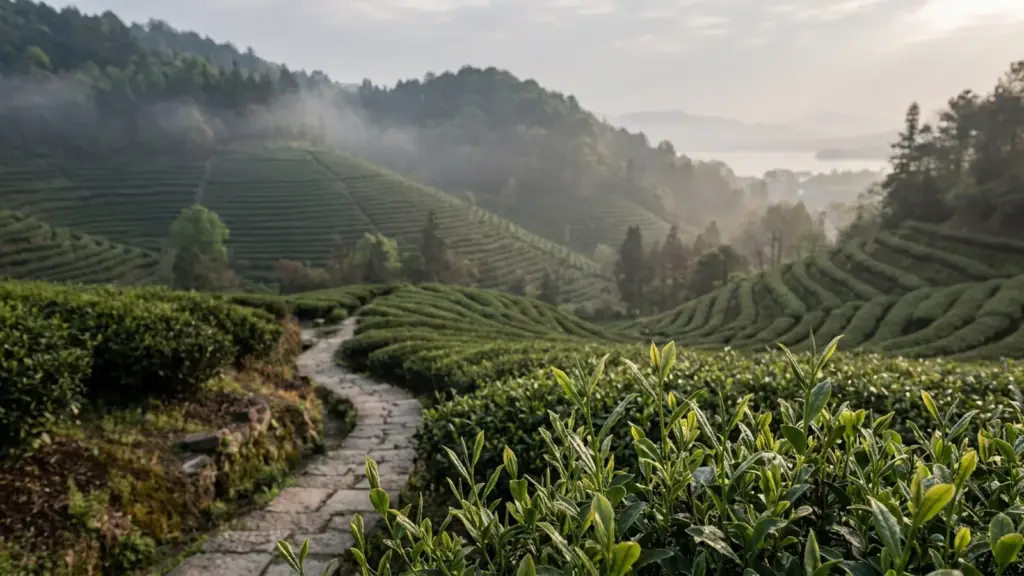
Xihu means West Lake and is associated with Hangzhou in Zhejiang province, China. The name also appears in Xihu district, which the Hangzhou municipal government identifies as the birthplace of Longjing, or Dragon Well tea. A lake, an administrative district and a tea production designation are related geographical references, but they should not be treated as interchangeable boundaries.
For a tea buyer, the important connection is West Lake Longjing green tea. The Zhejiang provincial government describes it as tea produced in designated protected areas around West Lake. This is more specific than simply saying that a tea comes from China or from somewhere in Hangzhou.
Origin and processing answer different questions
The geographical name tells you where to investigate a product’s origin. Longjing identifies the tea associated with the area, while pan-frying describes a processing practice. Official local reporting documents Longjing pan-frying in the West Lake scenic area; it does not establish a traditional product category called Xihu matcha.
Keep those distinctions when reading a label for powdered tea. A place name alone cannot establish the leaves used, how they were grown or how they were processed. Ask the producer to identify the starting tea and production method rather than assuming that Xihu is a matcha grade or that every green tea from the district follows one process.
What the local craft involves
Hangzhou’s account of a Longjing training session describes ten hand-frying methods. These include shaking, turning, grasping, pushing, pressing and rubbing. The session brought trainees to tea-frying centers in the scenic area, with experienced practitioners teaching the craft. This is practical evidence of a living processing tradition, rather than proof that every package is entirely handmade.
A March 2026 report describes both hand processing and a digitized factory that translates experienced makers’ techniques into machine parameters. It also describes drones carrying freshly picked leaves downhill to reduce transport delays. Traditional craft and modern production therefore coexist; ask about the actual lot instead of inferring hand production from a regional name.
Harvest claims need a season and a source
The provincial government’s March 2026 harvest report places the first batch in the Wengjiashan protected area on March 17. Pickers followed a one-bud, one-leaf standard for that early harvest. This is a documented example, not a permanent opening date for every garden or evidence that all Longjing must be picked as two leaves and a bud.
When comparing teas, record the harvest year, picking information and producer alongside the origin. An early harvest claim does not by itself identify the processing method or provide a laboratory measurement of amino acids. Likewise, a price quoted for one producer or season is not a universal price or quality threshold.
Checking a Xihu tea description
Look for a named production area, a traceable producer and clear processing information. Keep protected-origin statements separate from tasting notes: a pleasant aroma cannot authenticate geography. The official sources consulted here support the West Lake location, Longjing identity and documented production practices, not exact rainfall, humidity or soil-composition figures for every garden.
They also do not establish an EU recognition date of 1998 or justify describing Xihu as a uniquely superior matcha terroir. Those claims should not be used to explain the term. The useful starting point is simpler: identify West Lake, identify the Longjing tea tradition, then verify the individual product.