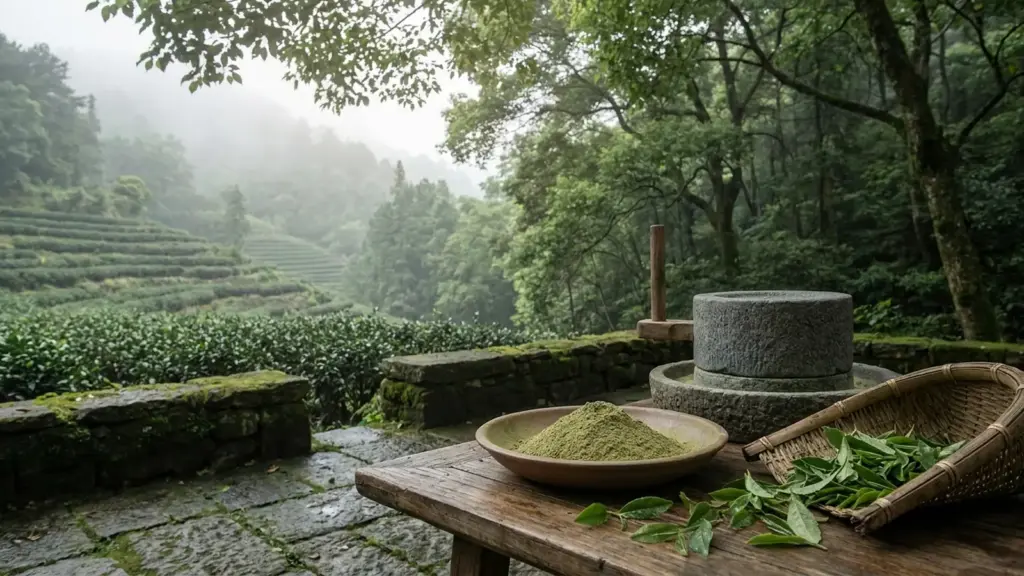
Yuhang: Jingshan Tea Heritage and Modern Matcha
Yuhang’s Jingshan area has documented modern matcha businesses. Separate producer-specific shading from tea heritage and broad flavour claims.Definition of Yuhang
Yuhang is a district of Hangzhou in Zhejiang Province, China, with tea businesses in Jingshan. Its modern matcha connection is supported by named producer information, including a stated shading practice. Tea heritage, present manufacturing and the flavour of individual products remain separate kinds of evidence.
Learn more
Locate the district before the tea
Yuhang is a district of Hangzhou in Zhejiang Province, China. Jingshan is a local tea area within that district. A useful explanation keeps those nested places separate: Zhejiang is the province, Hangzhou the city, Yuhang the district and Jingshan the town named in producer information. None of these names is automatically interchangeable with the West Lake Longjing growing area.
A named modern matcha business
Hangzhou Yinquan Tea’s company page gives its address as Jingshan Town, Yuhang District, Hangzhou, and states that the business was established in 2001. Its published product range includes matcha, steamed green tea, Jingshan tea and Jingshan black tea. This directly supports a contemporary tea-processing and matcha business in the district. It is more specific than asserting that ancient tea culture alone proves current matcha manufacture.
A production detail with a clear owner
Yinquan’s matcha product page states that its Jingshan matcha gardens are covered for about twenty days before processing. It also describes grinding, screening, inspection and packaging operations. These are the producer’s published claims about its own operation. They should not be expanded into a rule for every Yuhang farm, or treated as an independently audited process specification for every batch sold under the Jingshan name.
Heritage is not the same as manufacturing history
Jingshan’s tea culture is part of the district’s identity, and the company presents its matcha within that historical context. However, medieval powdered-tea practices, temple hospitality and modern export manufacturing are different subjects. An exact claim that a single monk or journey created today’s Japanese tea ceremony needs historical evidence beyond a product page. There is no reason to turn Lu Yu’s lifetime dates into the dates he supposedly wrote an entire body of work at one mountain.
What the evidence says about Chinese matcha
The documented twenty-day shading statement is a concrete counterexample to blanket descriptions of Chinese matcha as necessarily sun-grown or only briefly shaded. It does not prove that Yinquan’s matcha tastes the same as a Japanese product, and it does not establish all Chinese manufacturing practices. The producer describes colour and taste on its own page; those are product marketing observations, not a controlled ranking of Chinese and Japanese powders.
Check provenance at the right level
For a Yuhang-labelled powder, check the actual business, the stated location of its gardens and the relevant product specification. A Jingshan factory address establishes a manufacturing connection but need not locate every supply garden. If organic status matters, request the certificate and its product scope rather than extending a company-wide promotional claim to all purchases. Compare intended use, harvest information and a sample of the actual lot. Yuhang’s contribution can be explained through an identified modern producer without unsupported production shares, regional taste stereotypes or claims about a comparison platform’s inventory.
Sources and scope
Hangzhou Yinquan Tea Co., Ltd; Matcha powder-Matcha powder-Hangzhou Yinquan Tea Co., Ltd. Sources checked on 8 September 2026. Producer statements are attributed; they are not independent tests of every product.
Sources and references
Accessed: 2026-09-08
Language: en
Producer address in Jingshan Town, Yuhang District, Hangzhou; established in 2001. Company explicitly lists matcha, steamed green tea, Jingshan tea and black tea; manufacturer self-description, not independent certification verification.
Accessed: 2026-09-08
Language: en
Producer states about twenty days of covering for its Jingshan matcha gardens. Producer describes grinding, screening, inspection and packaging. No regional taste or ancient-origin claims adopted.

Emilie Schol
Founder of Best MatchaFrequently asked questions
Here are some frequently asked questions and answers.Is there a modern matcha producer in Yuhang?
Is there a modern matcha producer in Yuhang?
Yes. Hangzhou Yinquan Tea lists a Jingshan Town, Yuhang District address and explicitly includes matcha in its product range.
Is Yuhang matcha necessarily sun-grown?
Is Yuhang matcha necessarily sun-grown?
No. Yinquan’s own Jingshan matcha page states about twenty days of covering. This is a producer-specific statement, not a district-wide rule.
Is Yuhang the same as West Lake Longjing?
Is Yuhang the same as West Lake Longjing?
No. Yuhang is a Hangzhou district. A Yuhang address alone does not establish West Lake Longjing provenance.