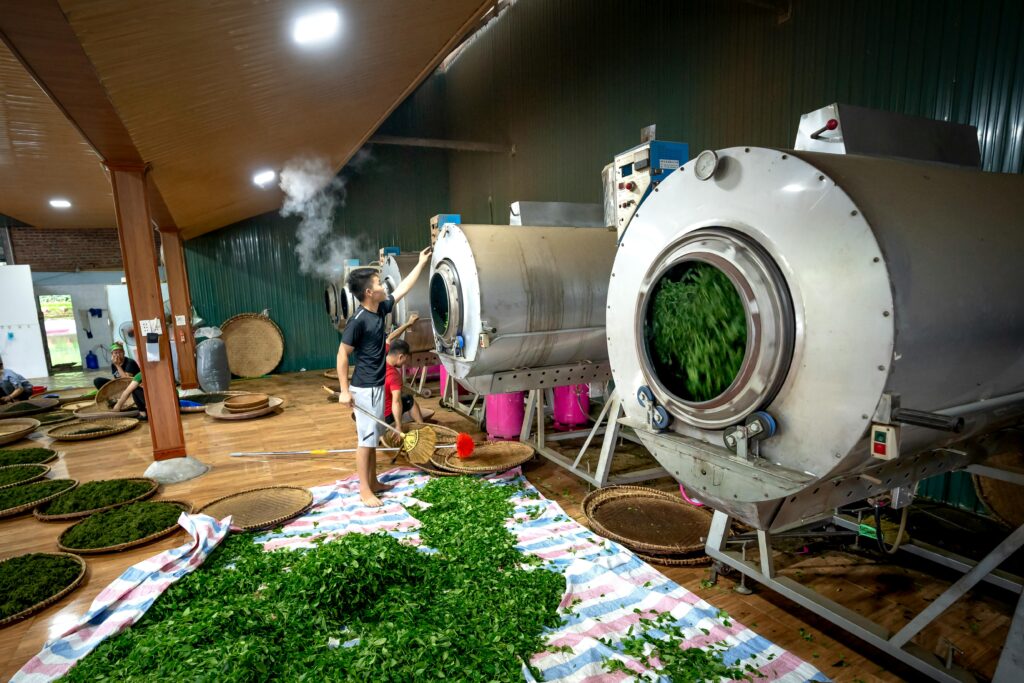
Defining the tencha-ro
Tencha-ro (碾茶炉) is a furnace used in the drying stage of tencha production. Tencha is the unrolled leaf material that becomes matcha after refining and milling. The furnace removes moisture from steamed leaves; it does not grind the finished powder or perform the rolling used in other Japanese green-tea processes.
Ise Matcha quotes an industry definition describing shaded leaves that are steamed and dried without rolling in a tencha furnace or comparable equipment. That definition makes the leaf-processing distinction clear without requiring every factory to use identical machinery.
From steaming and cooling to drying
After steaming, leaves need to be separated and prepared for drying. Ise Matcha describes a blowing and cooling stage that removes surface steam moisture and loosens overlapping leaves. d:matcha similarly describes agitation in vertical columns before leaves are spread for the drying stage.
These preparatory steps are different from rolling. They help leaves enter the dryer in a condition that allows more even heat exposure. The useful distinction is unrolled tencha processing, not a claim that the leaves are untouched or never moved mechanically.
Three conveyors describe one arrangement
d:matcha’s factory explanation describes leaves traveling on three conveyor belts through a tencha-ro. It also distinguishes a traditional Horii-style brick furnace from a net-type furnace. The three-belt description is a concrete example of equipment design, not a universal definition of every tencha dryer.
A chamber length, belt speed, capacity, or residence time belongs to a specified machine and operating procedure. These details should be attributed to a manufacturer or producer if quoted. They should not be converted into a universal recipe for good tencha or used to judge an unfamiliar factory from a photograph.
Heat transfer is not an either-or choice
It is incorrect to contrast conveyor drying with hot air as though they were mutually exclusive. A conveyor transports leaves; hot air and radiant heat describe ways of transferring heat. Kawasaki Kiko’s Net type Tencha Dryer EX explicitly combines high-temperature hot air with far-infrared radiant heat in its product description.
That manufacturer’s explanation also emphasizes aroma and more even drying. It does not establish that heat-sensitive compounds remain entirely unchanged. Drying affects the material, and controlling it involves balancing moisture removal with the desired tea characteristics.
Temperature and timing need context
A furnace setting is not automatically the temperature of every leaf. Dryer construction, airflow, leaf loading, moisture, and travel time all belong to the process description. For that reason, this entry does not prescribe one optimal temperature range or claim that a fixed number of minutes guarantees color and aroma preservation.
Producer accounts can help explain a named furnace, but they should not be treated as operating instructions for a different machine. Commercial equipment should be run according to the manufacturer’s procedures and the producer’s validated process.
What happens after the furnace
The initial dryer produces crude tencha rather than a finished bowl of matcha. Ise Matcha and d:matcha describe subsequent removal of stems and veins, with additional refining before milling. d:matcha also notes that re-drying may be used according to the desired aroma.
The larger sequence remains important: shaded cultivation, harvest, steaming, cooling and separation, drying without rolling, refining, and milling. The tencha-ro is one link in that sequence. It neither guarantees a particular commercial grade nor proves hand-picking, and its role is not confined to Uji simply because the region is important in its history.
Sources and scope