What Asamushi Means in Japanese Tea Processing
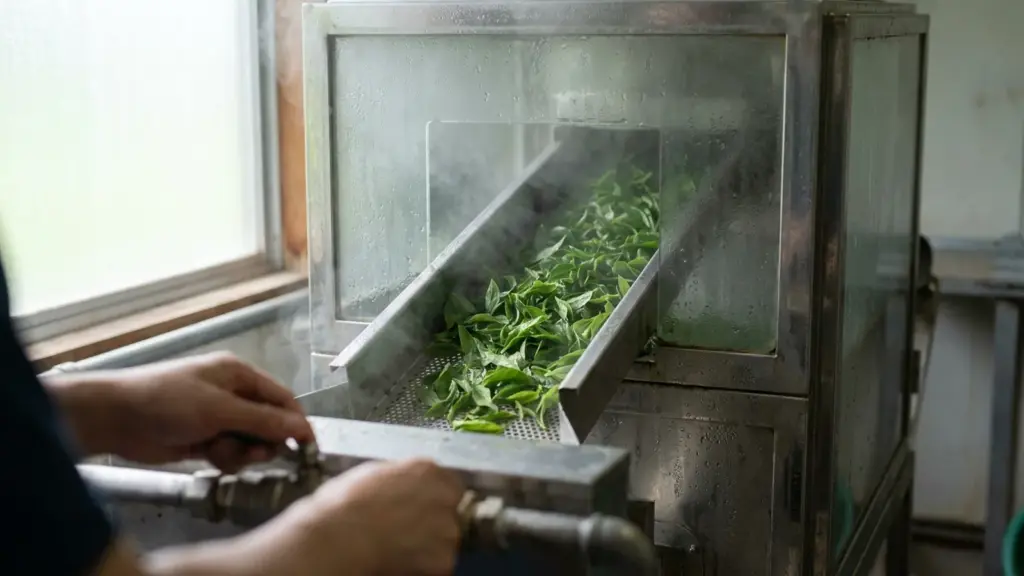
Asamushi (浅蒸し) means light steaming in tea processing. It describes the treatment of leaves, especially when distinguishing styles of sencha. The steaming process is not the hot-spring destination Asamushi Onsen; a tourism source about that place cannot support tea-processing claims.
The Steaming Spectrum
Asamushi, chumushi and fukamushi describe lighter, intermediate and deeper steaming. They are useful processing descriptions, not a universal ranking from best to worst. The duration should be read in the context of the producer and the leaf being processed.
For a concrete example, Sayama tea producer Miyaokaen describes 15–20 seconds of steam for its asamushi tea. It also describes a withering step before steaming for that product. Those details establish one producer’s method, not a requirement that all asamushi must be withered or timed identically.
How Light Steaming Affects Tea Characteristics
Miyaokaen describes its short-steamed tea as retaining its leaf shape and producing clear, light-green liquor, in contrast to its deep-steamed tea. Relatively intact leaves and a clearer infusion are therefore useful descriptive clues, but neither appearance alone nor the absence of leaf dust authenticates a processing label.
Sencha’s slender dry-leaf form also reflects rolling and drying after steaming. Light steaming does not by itself manufacture a needle shape, and later handling can still break leaves.
Flavor Profile and Sensory Qualities
The producer emphasizes the aroma of young shoots. A particular asamushi tea may offer fresh vegetal notes and a lighter-looking cup, but a fixed list of asparagus, hay, seaweed or buttery notes should not be promised for every product. Cultivar, growing conditions and brewing all matter.
A clear cup should not be called nutritionally inferior to a cloudy one. The cited producer page does not establish comparative antioxidant levels or guarantee a set number of successful infusions.
Identifying and Selecting Asamushi Sencha
Look for asamushi, 浅蒸し or light-steamed in the seller’s description. Ask for origin, cultivar and steaming details if you want to compare teas. Whole-looking leaves can support a description, but explicit producer information is stronger evidence than visual guesswork.
Miyaokaen’s example is from Sayama in Saitama. Asamushi is a processing term, not a regional designation or a synonym for first-flush tea.
Brewing and Multiple Infusions
Start with the maker’s instructions rather than one supposedly optimal temperature. Miyaokaen offers different approaches for aroma and taste: its aroma-led recipe uses 7 g with about 120 ml of water cooled below 90°C for about 30 seconds, while its taste-led variation uses water around 50°C for about three minutes. These are instructions for that producer’s tea, not a standard recipe for all asamushi.
The same page advises pouring subsequent infusions without a waiting period. For another tea, use its own instructions and adjust to taste; neither a mandatory rising-temperature schedule nor a guaranteed three or four infusions follows from the term.
Asamushi in the Broader Tea Context
Asamushi is most useful when discussing steaming level, while matcha names a powdered product made from tencha. Tencha is also steamed, as Marukyu Koyamaen’s production account explains, so it is too absolute to say light steaming cannot occur in matcha production. A sencha steaming label alone does not define the entire tencha process.