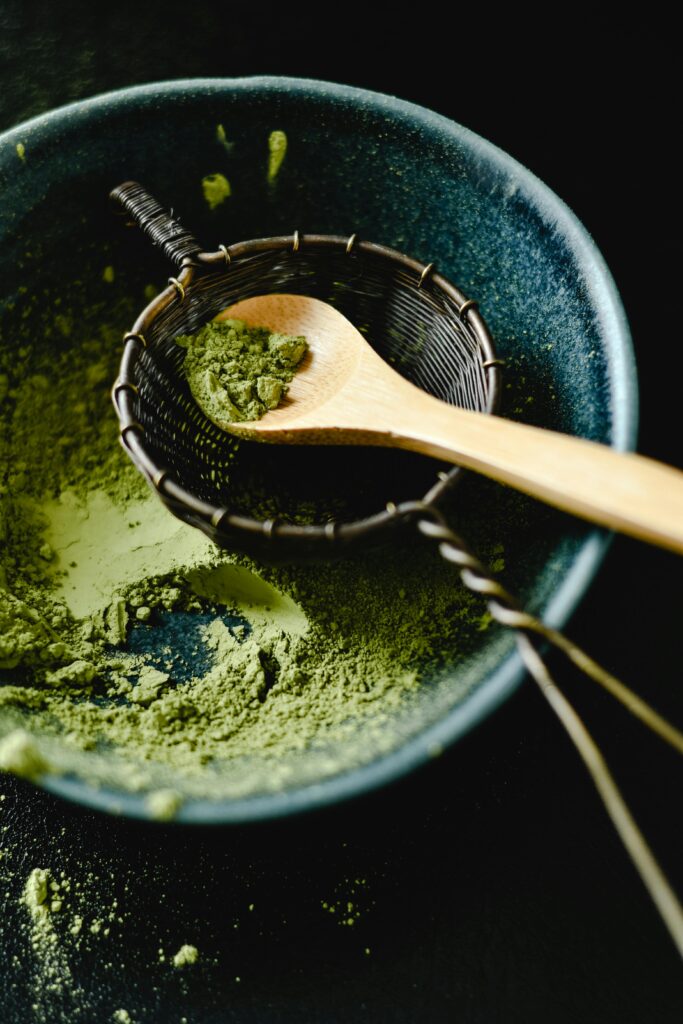
What Is Stone Grinding in Matcha Production?
Stone Grinding mills dried tencha into matcha between grooved stones. The grooves guide leaf material across the grinding surfaces as a stone rotates. The resulting powder is intended to disperse when whisked, but stone milling does not make the whole leaf dissolve in water.
Traditional tea mills have low throughput compared with many industrial powdering systems. That is a useful description of the process, not a universal specification for every machine. Mill dimensions, groove condition, feed material, speed, and the desired fineness influence the operating result.
The Mechanics of Traditional Stone Mills
In a 2014 account, Uji tea wholesaler Kuwabara Zensuke Shoten describes motor-driven tea mills commonly operating at about 50–60 revolutions per minute and producing around 40 grams per hour. The account also describes earlier, higher outputs and says that more than 100 grams per hour can be produced, at the cost of coarser powder and changes in color and texture. These are the author’s production observations, not mandatory rates for all stone mills.
This example explains why a single promised rotation speed or hourly output is misleading. A quoted rate should identify the equipment and the desired powder quality. It should not be copied into a definition as though every producer runs the same mill under the same conditions.
Why Milling Conditions Matter for Quality
Grinding involves friction, so temperature management matters. Slow operation may limit heat buildup, but it does not eliminate heat or guarantee complete preservation of aroma and other constituents. A claim that every stone mill stays below one temperature, or preserves every nutrient, requires actual operating measurements.
Particle size also varies. “Stone-ground” does not certify that every particle falls within a 5–10 micrometre band. Where fineness is important, ask for a measured particle-size distribution and the measurement method, rather than treating a single quoted diameter as the size of the entire powder.
Flavor and Aroma Preservation
The quality of the tencha still matters before milling begins. Milling cannot turn unsuitable leaf material into a particular flavor grade. Color, aroma, umami, and mouthfeel reflect the material and the rest of its handling as well as the grinding step. Finished-product assessment is needed to support a comparison between milling methods.
Stone Grinding Versus Modern Methods
Stone mills may be driven by motors, so “stone-ground versus machine-ground” is a false distinction. The useful comparison is between specified milling technologies and operating conditions. Alternative systems can provide different production capacities; their output should be assessed rather than rejected simply because the grinding surfaces are not traditional stones.
No sensory rule reliably identifies the mill from a bowl of matcha. A smooth texture, green color, rich umami, or high price is not proof of stone grinding. Equally, a non-stone milling method does not by itself establish poor flavor or inadequate fineness.
Comparing Production Outputs
For a useful supplier comparison, record the raw material, mill type, production rate, and measured powder properties together. Two factories reporting the same grams per hour may be producing different particle distributions. Two powders of similar fineness may have different taste because their tencha differs.
Practical Implications for Consumers
A stone-ground label describes a production method. Check whether the producer identifies the material as tencha and explains how it is milled. Evaluate texture and flavor in the intended preparation, but do not mistake that evaluation for authentication of the equipment.
The method has a place in traditional matcha production and can help explain production capacity and cost. It is not a guarantee of a commercial “ceremonial” grade, a fixed nutritional profile, superior foam, or permanent suspension. Those claims must be tied to the actual powder rather than the name of the process.
Related Reading
Chlorophyll; L-theanine; umami; whisking; ceremonial grades.