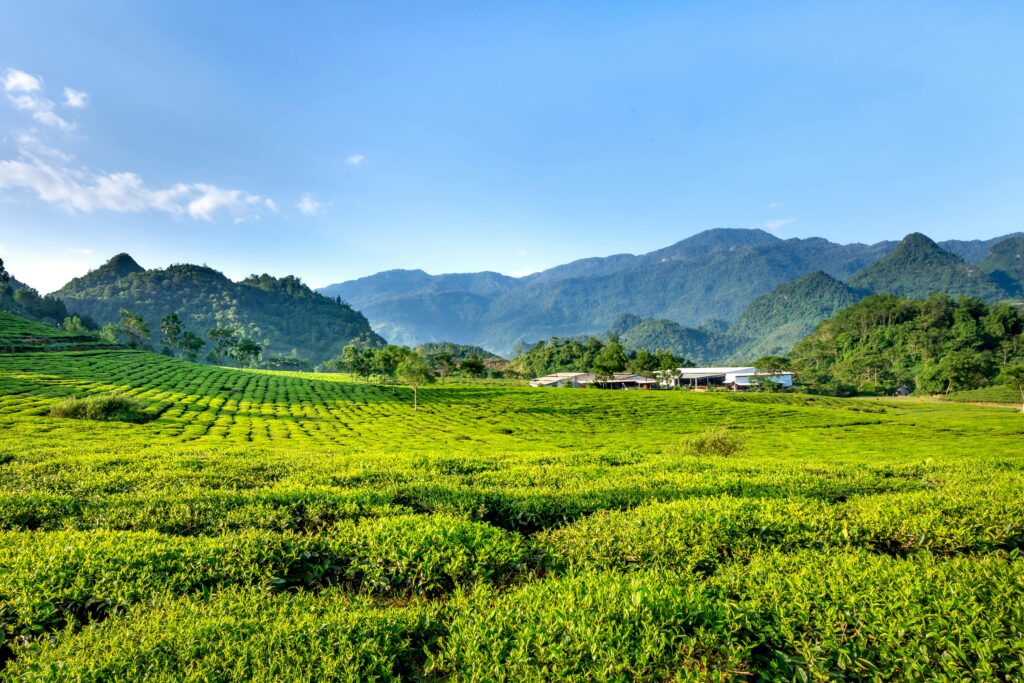
Nuwara Eliya as a high-grown origin
Nuwara Eliya is a high-grown tea district in Sri Lanka. The Sri Lanka Tea Board describes a rugged, mountainous region with cool air and cold nights, sometimes including frost. These are meaningful regional conditions for Ceylon tea, but they should not be converted into an assumed formula for matcha cultivation.
The town and the tea-growing district are not identical measurements. The Board places the town on a plateau at 1,868 metres; that town altitude should not be presented as the exact elevation of every estate. Its certification regulations describe the agro-climatic tea region within the wider administrative district.
A delicate Ceylon tea profile
The Tea Board characterizes Nuwara Eliya tea through delicate fragrance and a pale, golden infusion. It identifies whole-leaf Orange Pekoe, abbreviated OP, and Broken Orange Pekoe, or BOP, as sought-after grades. These terms belong to the regional leaf-tea trade. They do not describe matcha particle size or a ceremonial quality category.
The distinction is especially important when reading colour claims. A pale golden brewed infusion is not a prediction of a vivid green powder. Likewise, the region’s reputation for fragrance does not prove that a powder made from its leaves will have a particular level of sweetness or umami.
Climate and history without a matcha calendar
The Board describes a drier period between February and April, alongside generally cool conditions and sometimes frosty nights. This supports a regional climate description, not the claim that all estates avoid irrigation or use an identical shading schedule. Mountain mist and a deliberately managed cover over tea bushes are not interchangeable evidence.
Its historical account explains how tea took over from coffee after the nineteenth-century coffee blight. It records modest tea plantations flourishing by 1875 and Nuwara Eliya becoming a principal Ceylon tea district by the end of that century. Those dates concern the local tea industry. They do not establish an emerging matcha industry or an optimum month for harvesting tencha.
What the regional mark tells a buyer
The Tea Board’s certification rules tie Nuwara Eliya tea to gardens and factories within the defined agro-climatic region. The rules allow blends of qualifying teas from more than one regional estate, but reserve the certification mark for pure regional tea rather than mixtures with other origins. A regional blend therefore need not be a single-estate tea.
For a product advertised as Nuwara Eliya matcha, origin and processing remain separate questions. Ask for the estate or growing locality and the maker’s production details. The Japan Matcha Association describes matcha as powdered tencha, made through shading, steaming, drying without rubbing and milling. A Ceylon tea origin or regional certification does not by itself establish that route. Nuwara Eliya’s documented strength is its distinctive high-grown tea identity, which does not need an imagined matcha tradition to be useful.
Sources and further reading