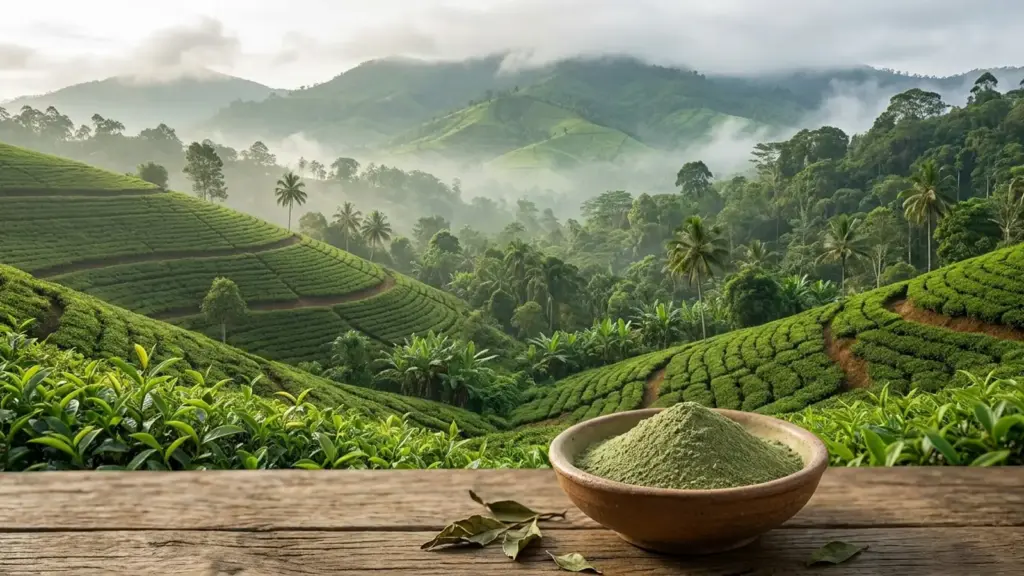
Kandy: Tea Origin and Regional Context
Kandy is a mid-grown Sri Lankan tea district known for strong, full-bodied Ceylon tea, rather than an established regional matcha style.Definition of Kandy
Kandy is a mid-grown tea district in Sri Lanka’s Central Province, with estates on the hills around the city. Its established Ceylon teas are known for strength, body and coppery infusions. These regional leaf-tea characteristics do not establish a separate Kandy matcha tradition.
Learn more
Kandy as a tea-growing district
Kandy is a tea origin in Sri Lanka’s Central Province. In tea terminology, the name refers to a growing district surrounding the city, not simply the urban centre. The Sri Lanka Tea Board places its estates in hill areas including Nilambe, Hantane, Pussellawa, Gampola and Hewaheta. Understanding that distinction is important when comparing a tea’s growing origin with the address of a shop or exporter.
The Board describes Kandy tea as mid-grown, with cultivation between 650 and 1,300 metres. That elevation band separates its general tea profile from the higher-grown Nuwara Eliya district without implying that one region is universally better.
Monsoon exposure and the cup
The Tea Board describes Kandy infusions as bright and coppery, with pronounced strength and body. These are regional tasting descriptions for Ceylon tea, not a promise of bright green powder or a seaweed-like matcha aroma. Even within Kandy, the Board notes that flavour varies with altitude and shelter from monsoon winds.
The southwest monsoon influences local weather. Some estates are sheltered in valleys, while others experience stronger winds through mountain passes. The Board associates sheltered estates with stronger, deeper-coloured teas. Most district estates lie on western slopes, and its account links the western quality season to cool, dry conditions in the first quarter of the year. That is guidance about the regional tea trade, not a matcha shading or harvesting calendar.
Separating tea history from matcha history
Kandy has a central place in the history of commercial Ceylon tea. The Tea Board connects the district with James Taylor and Loolecondera, an estate that had originally grown coffee. The Board’s regional certification material dates Sri Lanka’s first commercial tea plantation to 1867. A date for a planter’s arrival is a different event and should not be substituted for the plantation date.
This history helps explain why Kandy is a significant tea name. It does not establish that Taylor produced matcha, or that modern growers inherited a local tencha-processing tradition. The history of the crop and the history of a specific manufactured tea are separate questions.
What to check on a powdered-tea product
Matcha is not a synonym for tea grown in a suitable climate. The Japan Matcha Association describes shaded leaves that are steamed, dried without rubbing and milled as tencha. A regional description of coppery Ceylon tea does not demonstrate that sequence.
If a seller offers Kandy matcha, ask for the producing estate or growing locality and a description of the processing method. Check whether Kandy refers to the leaves or only to the seller. The district has an established identity in Ceylon tea; a powdered product needs its own explanation rather than borrowing the colour, season and body of its traditional leaf teas.
Sources and further reading
- Kandy — Sri Lanka Tea Board
- Regulations governing the use of the certification mark for geographical indication of Nuwara Eliya Tea — Sri Lanka Tea Board
- What is MATCHA — Japan Matcha Association
Sources and references

Accessed: 2026-09-08
Language: en
Kandy tea-growing district in Central Province; mid-grown cultivation at 650–1300m, surrounding localities, monsoon exposure, coppery infusion, body and first-quarter western quality season.
Accessed: 2026-09-08
Language: en
Historical background in the Tea Board certification document dates Sri Lanka’s first commercial tea plantation to 1867; not used as evidence about Kandy regional certification.
Accessed: 2026-09-08
Language: en
Matcha is powdered tencha: shaded leaves are steamed and dried without rubbing before milling. This supports processing distinctions, not regional production or health claims.

Emilie Schol
Founder of Best MatchaFrequently asked questions
Here are some frequently asked questions and answers.What does mid-grown mean for Kandy tea?
What does mid-grown mean for Kandy tea?
The Sri Lanka Tea Board describes cultivation between 650 and 1,300 metres in the Kandy district.
Is Kandy tea’s coppery colour a matcha characteristic?
Is Kandy tea’s coppery colour a matcha characteristic?
No. The Tea Board’s coppery infusion and full-bodied tasting description concerns regional Ceylon tea, not a standard for green matcha powder.
When did commercial tea cultivation begin in Sri Lanka?
When did commercial tea cultivation begin in Sri Lanka?
The Tea Board’s regional certification material dates Sri Lanka’s first commercial tea plantation to 1867. This is tea history, not evidence of a matcha industry.