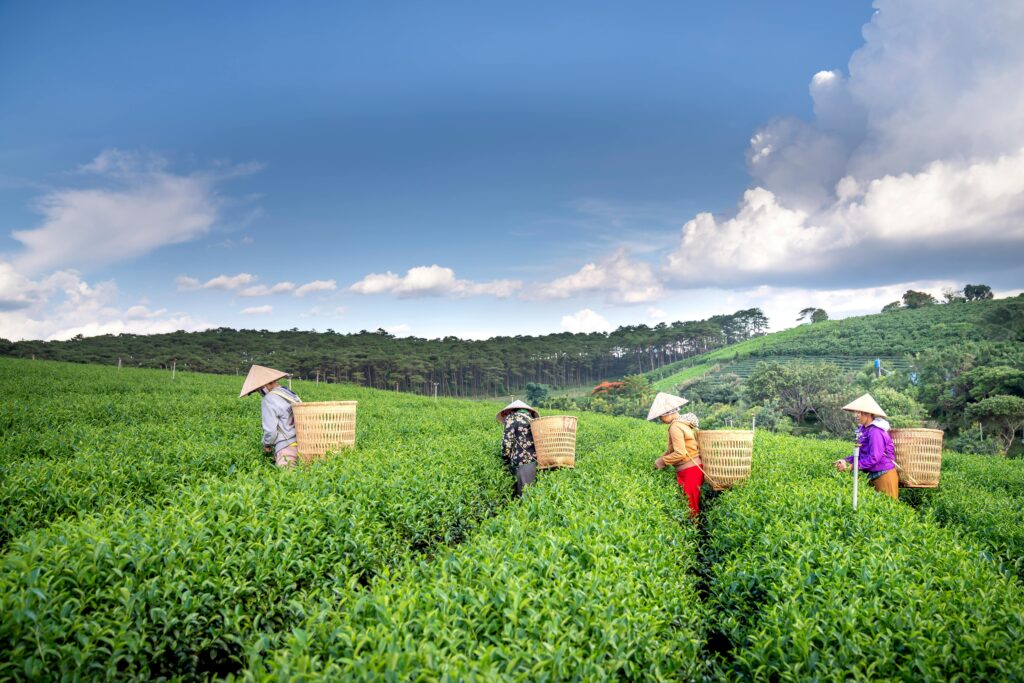
Kikai-zumi: Machine Harvesting, Not a Matcha Grade
Kikai-zumi means machine harvesting, not machine grinding. See how cutting height, leaf selection and processing affect matcha quality.Definition of Kikai-zumi
Kikai-zumi is mechanical harvesting of tea shoots, using equipment rather than workers selecting each shoot by hand. In matcha production it identifies the picking stage, not how tencha is dried or milled. Harvest timing, cutting height, sorting and later processing help determine the finished tea’s quality.
Learn more
Kikai-zumi means machine harvesting
Kikai-zumi (機械摘み) refers to gathering tea shoots with mechanical equipment. It contrasts with tezumi, or hand-picking. These terms describe harvest, not stone milling, steaming depth or a quality certificate. The same matcha can be machine-harvested and stone-ground, because the two operations occur at different stages.
Selection is managed differently
Hand-pickers can choose individual shoots; machinery cuts across a managed picking surface. This is a real difference in selectivity, but “indiscriminate” is misleading if it implies that growers have no control. The condition of the canopy, the timing of harvest and the position of the cutter influence what enters the collection system.
MAFF’s 2022 Kakegawa feature describes hand-picking and the use of harvesting machines within the short window when shoots are ready. The value of mechanization is not simply maximum volume: it can also help complete a time-sensitive harvest. That example concerns a sencha producer, so its detailed factory process should not be relabeled as tencha manufacture.
Evidence that machine settings affect quality
Takayuki Nakano’s 1998 Tea Research Journal study tested different plucking positions with rail-guided machinery. Across four experiments involving first and second crops over two years, a higher plucking position reduced yield but improved crude-tea quality and market price. This demonstrates a controllable yield–quality trade-off within mechanical harvesting.
The experiment was not a finished-matcha comparison and does not establish a universal cutter setting for matcha gardens. Its useful lesson is narrower: machine harvesting is not a single, fixed-quality treatment. Rejecting every mechanically picked tea as culinary-only ignores the variables that the study actually measured.
What happens after picking matters too
Yamamasa Koyamaen explicitly describes both hand and machine harvesting in its matcha production account. The leaves are then steamed and dried without rolling. Sorting removes stems, veins and unwanted older leaves; evaluation, blending, storage and milling follow. The producer values handpicked tencha, but its account does not establish that machine-picked tea is unsuitable for drinking.
Powder fineness should not be diagnosed from harvest method alone. Refinement and milling intervene between a fresh shoot and the powder. Likewise, a bitter taste, pale color or weak foam cannot identify the harvesting equipment. Those observations may prompt a quality question, but they are not a traceability record.
How to read a matcha label
Treat “first harvest,” “hand-picked,” “stone-ground” and a suggested use as separate claims. A first-harvest label does not tell you whether workers or machinery gathered the shoots. A stone-ground label answers a milling question. Price and terms such as “ceremonial” do not establish either operation.
Ask the seller whether the method applies to the whole lot or only one component of a blend. If selecting tea for drinking plain, compare actual samples prepared the same way and read the producer’s use recommendation. Kikai-zumi is useful production information, not an automatic ceiling on flavor or a reason to restrict the tea to baking.
Sources and further reading
- Influences of Plucking Position on Yield and Quality of Tea in Mechanically-Plucked Tea Bush — Japanese Society of Tea Science and Technology
- Cultivation and processing of Matcha — Yamamasa Koyamaen
- 茶畑から美味しいお茶が届くまで — Ministry of Agriculture, Forestry and Fisheries of Japan
Sources and references

Accessed: 2026-09-08
Language: en
Nakano 1998 abstract: raising machine plucking position reduced yield and improved crude-tea quality and market price in four experiments; not a finished-matcha trial.
Accessed: 2026-09-08
Language: en
Producer describes 3–4 weeks covering, both hand and machine harvest, steaming, unrolled drying, sorting out stems, veins and old leaves, evaluation, blending, cool dry storage and milling.
Accessed: 2026-09-08
Language: ja
April 2022 Kakegawa producer case: ordinary sencha about 30–60 seconds and deep steaming around 120 seconds; finer leaves; hand and machine harvest; finishing; protective packaging and condensation precautions.

Emilie Schol
Founder of Best MatchaFrequently asked questions
Here are some frequently asked questions and answers.Is kikai-zumi machine grinding?
Is kikai-zumi machine grinding?
No. It is mechanical harvesting. Milling tencha into matcha is a later, separate operation.
Can machine-harvested matcha be stone-ground?
Can machine-harvested matcha be stone-ground?
Yes. Harvest method and milling method are separate; Yamamasa Koyamaen describes machine harvest within its matcha production sequence.
Does first harvest mean hand-picked?
Does first harvest mean hand-picked?
No. It identifies a crop timing, not the harvesting equipment. Ask for a lot-specific picking description.