Hidaka: Sayama Tea and Matcha Origin Labels
Hidaka’s Sayama tea offerings include matcha. Learn why a municipal gift listing can identify Saitama origin without proving city-grown leaves.Definition of Hidaka
Hidaka is a city in southwestern Saitama Prefecture, Japan, associated with Sayama tea. Its municipal gift listings include matcha, but identify that product’s origin at prefecture level. A Hidaka sales or finishing connection should not be mistaken for proof that all leaves grew within the city.
Learn more
Hidaka in the Sayama tea landscape
Hidaka is a city in southwestern Saitama Prefecture. A municipal hometown-tax gift listing includes a selection of Sayama teas. The area’s connection to Sayama tea is useful context, but a regional tea name is broader than one municipality. Neither Saitama membership nor a Hidaka retailer address establishes that a particular powder was grown exclusively in Hidaka fields.
A concrete matcha listing
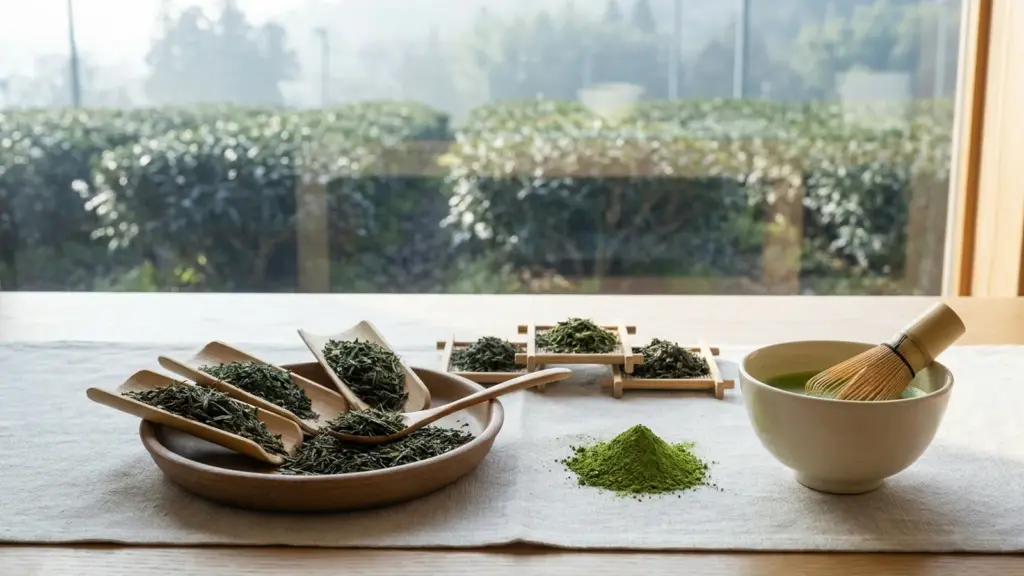
Hidaka’s Koma no Sato branded five-tea gift set on Satofull includes Sayama matcha named Hisui, alongside sencha and lightly fermented tea. The product information specifies Saitama Prefecture as both origin and manufacturing location for the matcha, with Saitama-grown green tea as the ingredient. This is direct evidence of matcha in a Hidaka municipal offering. Its stated geographical resolution is prefectural, not a named farm within Hidaka.
Read origin and manufacture separately
The verified gift-set listing provides separate fields for origin and manufacture. For its matcha, both say Saitama Prefecture. Neither field names a particular Hidaka garden or locates every production step within the city. Municipal presentation and the name of a gift set should therefore be read alongside the actual product specification, not substituted for it. Ask the supplier for narrower provenance if city-grown leaves matter to your purchase.
Tea type matters more than borrowed flavour language
The same gift programmes distinguish sencha, matcha and lightly fermented tea rather than presenting them as one product. Descriptions of hand-picked sencha, withering or pan-firing in another tea should not be transferred to the matcha. Likewise, the reputation of Sayama finishing techniques is not enough to assert that every Hidaka-associated matcha tastes of roasted sesame, is strongly astringent or is more robust than tea from Kyoto.
What is not established about local cultivation
These listings do not provide a city-wide cultivar survey, a count of matcha farmers or a uniform harvest schedule. They do not establish Okumidori as Hidaka’s primary cultivar, or show that all local matcha is blended from the same group of farms. Cooler regional conditions may be relevant when documented for a grower, but they cannot substitute for the identity of the actual leaves. A claimed single-origin Hidaka powder needs more precise farm evidence than a Saitama origin label.
Choosing a Hidaka-associated matcha
Use the municipal connection as a starting point and read the ingredient and origin fields. Ask for the grower or source area, cultivar if known, harvest information and whether the product uses tencha. The Japan Matcha Association distinguishes tencha-based matcha from powdered sencha, so the word powder alone is insufficient. Compare the actual tea in the intended preparation rather than assuming that a northern growing location guarantees stronger flavour, extra nutrients or a particular ceremonial grade. This preserves Hidaka’s real tea connection while making the limits of a local-product label clear.
Sources and scope
高麗の郷ブランド品狭山茶 5種セット | 埼玉県日高市 | ふるさと納税サイト「さとふる」; What is MATCHA | Japan Matcha Association. Sources checked on 8 September 2026. Producer statements are attributed; they are not independent tests of every product.
Sources and references

Accessed: 2026-09-08
Language: ja
Koma no Sato five-tea gift set includes Sayama matcha Hisui. Matcha origin/manufacture specified as Saitama Prefecture; green tea ingredient Saitama-grown, not narrower Hidaka farm provenance. Hidaka lies in southwestern Saitama.
Accessed: 2026-09-08
Language: en
Matcha uses tencha; fresh leaves steamed, dried without rolling and milled. Powdered sencha is distinguished from matcha. No health or historical claims adopted.

Emilie Schol
Founder of Best MatchaFrequently asked questions
Here are some frequently asked questions and answers.Does Hidaka offer matcha as a local gift?
Does Hidaka offer matcha as a local gift?
Yes. Its Koma no Sato five-tea set includes Sayama matcha Hisui. The listing gives Saitama Prefecture, not a named Hidaka farm, as the origin.
Does a municipal gift prove city-grown leaves?
Does a municipal gift prove city-grown leaves?
Not necessarily. The cited matcha listing gives Saitama Prefecture as origin and manufacture location, which does not establish a particular Hidaka garden.
Is Okumidori the main cultivar of Hidaka matcha?
Is Okumidori the main cultivar of Hidaka matcha?
The sources reviewed here do not establish a city-wide cultivar ranking. Check the named product rather than treating that claim as fact.