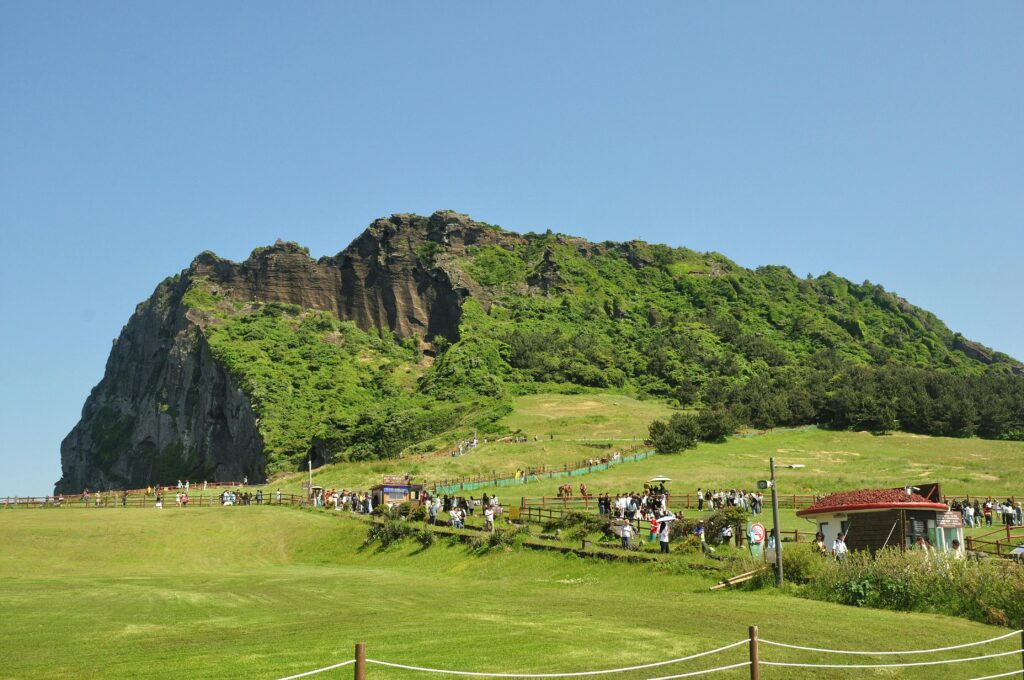
Jeju’s Documented Tea Landscape
Jeju is a South Korean island with tea fields as well as tea museums, cafés and tea-learning experiences. The Jeju Tourism Organization identifies Osulloc’s Seogwang Tea Fields in the southwest and Seogwi Dawon on the southern side of Hallasan as places connected with local green tea.
That is a useful starting point for an origin glossary. It establishes a tea-growing landscape rather than merely a café destination. It does not establish that all tea grown on the island becomes matcha, nor that every Jeju-branded green powder has followed the same process.
Specific Fields Are More Informative Than Island Averages
The tourism authority places the Osulloc Tea Museum within Seogwang Tea Fields and describes opportunities to learn about tea wares and taste tea from local fields. Its account of Seogwi Dawon says the farm changed from citrus to tea in 2005 and is situated about 250 meters above sea level. Those are details of a named site, not a universal elevation or planting history for Jeju.
The island’s volcanic setting can be retained as geographical context without making it a flavor formula. A statement about the proportion of farmland on volcanic soil would need a defined survey, date and land category. No 59.5 percent farmland statistic is adopted here, and no claim that porous soil prevents all root disease follows from a regional description.
Tea Fields Do Not Prove Matcha Processing
JETRO’s account of matcha manufacture describes intentionally shaded leaves that are steamed and dried without rolling. The resulting tencha is refined and milled. A Korean green tea can be a well-documented local product without its producer having demonstrated that particular sequence.
For a Jeju powder marketed as matcha or malcha, ask the maker how the leaves were shaded, how they were dried, and what material was milled. Fog over an island is not a substitute for those answers. The tourism source describes tea fields and drinks, not measured theanine changes or a shared island-wide shading protocol.
Do Not Turn Geology into a Taste Guarantee
A seller may describe a particular lot as herbaceous, sweet or savory. Those can be useful tasting notes when clearly attached to that product. They should not become a claim that volcanic minerals make every Jeju powder sweeter, less bitter or more nutritious than Japanese matcha.
Likewise, a broad season such as spring does not prove that every spring lot outranks every later one. Cultivar, leaf selection, processing and preparation need to be considered alongside harvest information. The available regional evidence does not provide a comparative chemical study or a national quality ranking.
What to Check on a Jeju Tea Label
- Origin: does Jeju refer to where the leaves grew or where the product was sold?
- Farm: is a named field or producer given?
- Ingredients: is it pure tea powder or a sweetened drink mixture?
- Manufacture: is the shading and non-rolled tencha route actually documented?
Use this information to compare products on equal terms. A confirmed island origin and a confirmed processing method answer different questions. Keeping them separate gives Jeju’s real tea culture appropriate recognition without manufacturing a uniform matcha character from tourism descriptions.