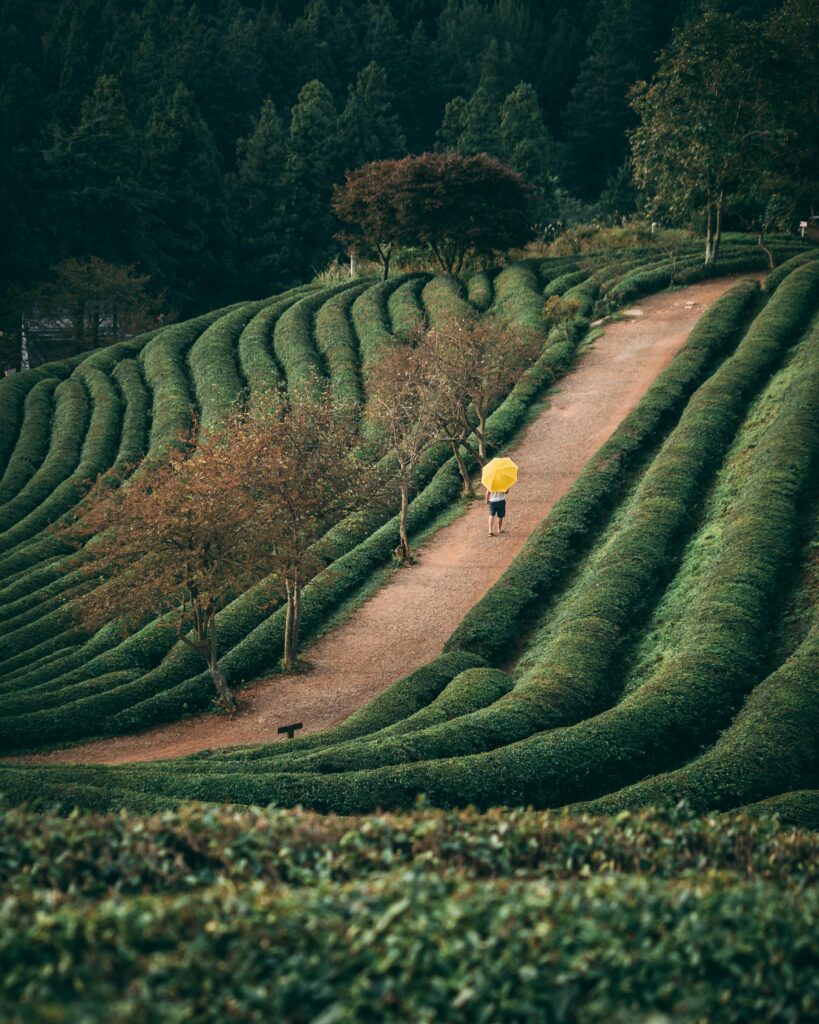
Boseong: Korean Tea Fields and Matcha Provenance
Boseong is known for Korean hillside green tea fields. Separate its regional tea heritage from the production claims on a matcha powder.Definition of Boseong
Boseong is a tea-growing county in South Korea’s South Jeolla region, known for hillside green tea plantations. Its place name describes origin, not a matcha process. A Boseong powder needs its own evidence of leaf sourcing, shading and manufacture before it can be compared with tencha-based matcha.
Learn more
What Boseong identifies
Boseong is a Korean tea-growing county associated with the South Jeolla, or Jeollanam-do, region. Its hillside tea plantations are an important part of its identity. For someone choosing powdered tea, however, Boseong is first an origin name. It does not describe whether a particular leaf was shaded, steamed, pan-heated or milled.
The Korea Tourism Organization’s Daehan Dawon listing provides a concrete example: a green tea plantation in Boseong with rows of tea bushes on the hillside, a cedar-lined entrance and a viewpoint on a peak about 350 metres above sea level. That elevation describes the visitor site, not every field in the county.
Growing conditions without a guaranteed flavor
The tourism organization’s Jeollanam-do regional guide describes Boseong’s warm temperatures and foggy days as part of its tea-growing environment. Hillside planting and the surrounding landscape help explain the region’s visual character. They should not be converted into an exact chemical composition or a universal sweetness claim.
Fog is also not a documented pre-harvest covering schedule. A misty landscape may receive variable light, whereas shade nets are a deliberate cultivation intervention. A photograph of fog or terraced rows cannot establish that leaves for a particular powder received weeks of managed shading. Ask the producer rather than treating climate as proof of method.
Green tea and matcha are not interchangeable
The Japan Matcha Association describes matcha as powdered tencha: leaves are grown with sunlight blocked, steamed, dried without rolling and then milled. This is a useful process benchmark when comparing a Korean product with Japanese matcha, not a reason to dismiss Korean tea. Different leaf teas and powders can be worthwhile products without being identical.
The official Boseong visitor listing establishes green tea cultivation. It does not document a county-wide conversion to tencha, the percentage of farms using shade cloth, or the date a matcha industry began. A specific producer may provide such information for a specific item. Until then, the green tea reputation alone should not supply missing manufacturing details.
Reading labels and regional statistics
Request the farm or growing district, harvest, leaf-processing method and milling location for a Boseong powder. Check the ingredients as well: a sweetened latte mixture is not directly comparable with plain powdered tea. Organic or pesticide-free claims require a relevant certificate or documented production practice, not a regional reputation.
Figures for Boseong’s share of Korean tea production need a date and a denominator. Total tea, green tea, harvested area and matcha are not the same category. Different percentages should not be combined into a new matcha market share. For taste, compare actual lots under the same preparation conditions. Clean aroma, sweetness or astringency should be observations about the sample, not promises made by the county name.
Sources and references

Accessed: 2026-09-08
Language: en
Daehan Dawon is a green tea plantation in Boseong with hillside rows, a cedar-lined entrance and a viewpoint on a 350-metre peak. These visitor-site details do not establish a matcha manufacturing process.
Accessed: 2026-09-08
Language: en
Boseong green tea in the Jeollanam-do regional context; warm temperatures and foggy growing conditions; Jangheung Cheongtaejeon is fermented disc tea, not matcha.
Accessed: 2026-09-08
Language: en
Matcha process only: shaded leaves, steaming, drying without rolling, and milling tencha; not its speculative history or health claims.

Emilie Schol
Founder of Best MatchaFrequently asked questions
Here are some frequently asked questions and answers.Does a Boseong green tea listing prove matcha production?
Does a Boseong green tea listing prove matcha production?
No. It establishes green tea cultivation. A powder needs separate information about shading, leaf treatment and milling.
Does Boseong fog replace shade cloth?
Does Boseong fog replace shade cloth?
Fog describes variable weather, not a controlled pre-harvest covering schedule. Confirm the practice for the specific farm and product.