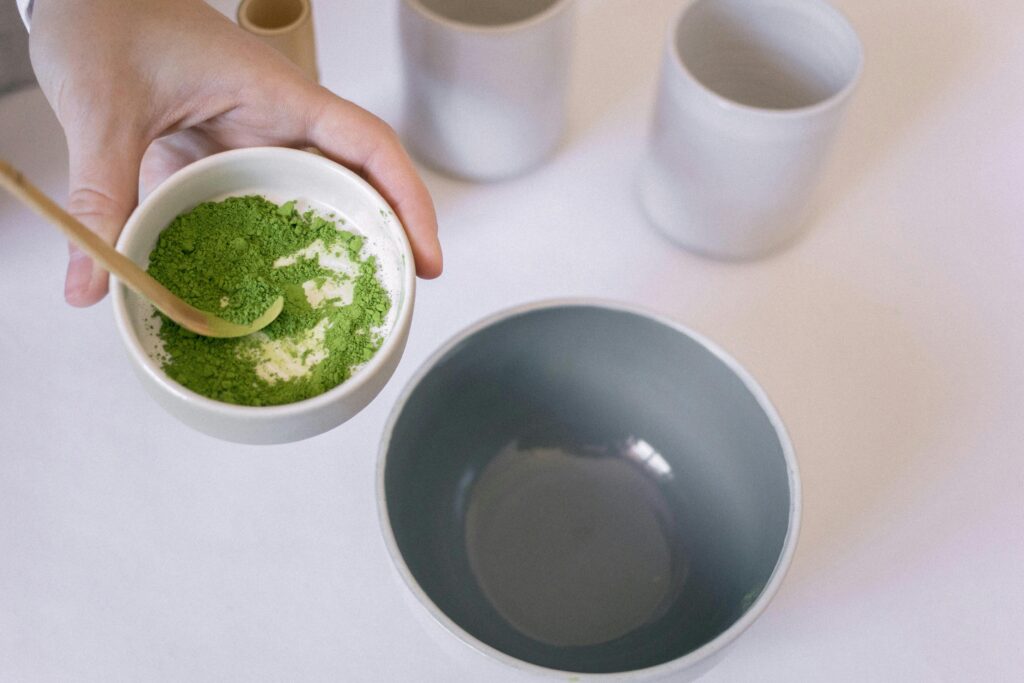
Mogacha (もが茶 or モガ茶) is Japanese green tea manufactured for use as a powdered food ingredient. Its identity concerns how the leaf is processed, not simply whether a finished tea has been roasted. Producer descriptions distinguish the leaf material from the powder made by grinding it.
How mogacha is made
Nakamori Seicha’s explanation of mogacha describes harvested leaves being steamed and mechanically processed, as in sencha manufacture. Unlike sencha, however, the leaves are not worked into slender shapes: they are dried flat. Stems are removed and the leaf material is ground to make powdered green tea resembling matcha.
The producer calls mogacha a manufacturing-method name, not a cultivar such as Yabukita. That distinction matters when reading an ingredient offer. A supplier can identify the material as mogacha without telling you which plant variety was grown, when it was harvested or how it was cultivated.
The name is documented in tea research
Mogacha appears by that exact English spelling in a Tea Research Journal paper on the cultivar Danshin37. The paper’s abstract describes mogacha as tea used in powdered form for processing and reports the cultivar’s suitability for that use. This supports the name and its ingredient context; the cultivar comparison is not a universal quality ranking of mogacha and matcha.
Hagimura Seicha’s product introduction also lists mogacha alongside kabusecha and tencha in its production. Together, these sources establish actual research and producer usage rather than an invented category of unroasted tea.
Mogacha, tencha and powdered sencha
The Japan Tea Industry Central Association’s green-tea labeling standard defines matcha through tencha: shade-grown leaves dried without rolling in a tencha furnace or equivalent equipment, then made into fine powder. This is not a definition based on a compulsory roasting step that mogacha simply skips.
The same standard mentions モガ茶 in a note about food-processing tencha materials dried without rolling. Nakamori describes mechanical working in its own explanation. These accounts should retain their stated scope rather than be collapsed into one universal production sequence.
Powdered sencha is another useful comparison. Nakamori sells powders made from sencha and from mogacha separately, identifying their raw materials. A green powder’s appearance or intended use in a latte therefore does not establish that its starting material was tencha.
A practical ingredient example
Nakamori’s mogacha-based powder is offered for confectionery and drinks. The producer specifies an average particle size of 30–40 micrometers for this product and warns that it does not dissolve like instant tea: particles can settle or be noticeable in some recipes. Those are specifications and cautions for the named product, not a particle-size standard for all mogacha.
For a bakery comparing ingredients, that makes raw material and particle size separate questions. Two powders intended for baking need not behave identically in a smooth cream or beverage. Obtain the supplier’s specifications rather than inferring texture, sweetness or bitterness from the name.
- Identify the producer and whether the offer is leaf material or milled powder.
- Ask about cultivation, harvest and processing rather than assuming a fixed shading schedule.
- Check particle size, ingredients and intended application for the specific powder.
- Follow the product’s own storage instructions and best-before information instead of a universal mogacha shelf-life claim.
Mogacha is a documented tea-processing term. It does not, by itself, promise lower bitterness, a particular aroma, organic certification or superiority to another powder.