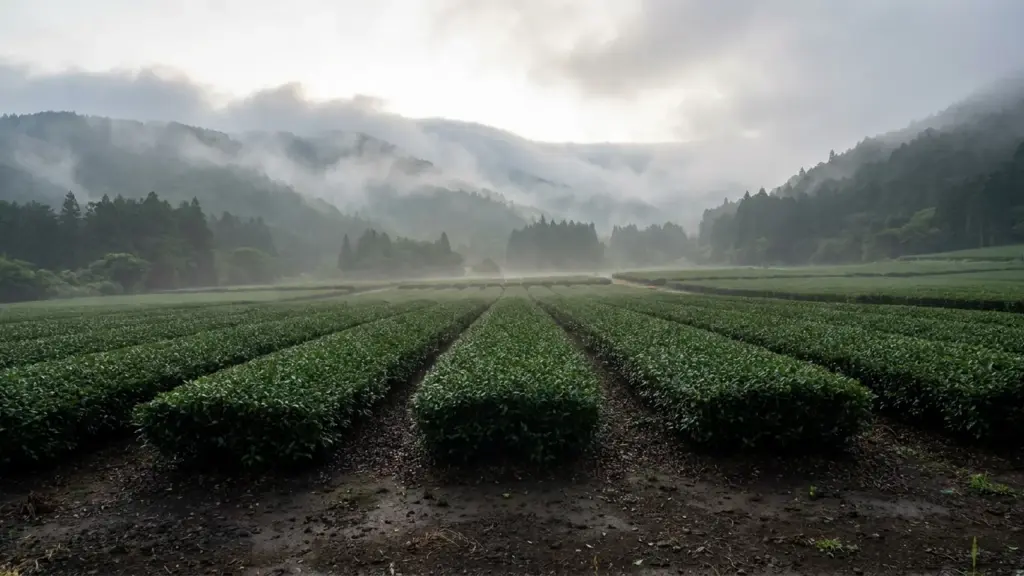
Kirishima as a Tea Origin
Kirishima is a place in Kagoshima Prefecture on Kyushu with an identifiable local tea industry. Kirishima City’s tea-business directory groups businesses by Mizobe, Makizono, Hayato and Kokubu. This provides a more useful picture than treating the entire region as one plantation or one uniform matcha style.
The city lists Nishi Tea Factory in Makizono and Imamura Tea Garden in Hayato, preserving two concrete producer references. A municipal listing establishes the business’s local connection; it does not verify every cultivation claim, cultivar, product or certification associated with that business.
A Mountain and Volcanic Setting
Japan National Tourism Organization places Kirishima in northeastern Kagoshima near Miyazaki and describes its mountain landscape and volcanic hot springs. These features are geographical context. The destination account does not establish the soil composition of a particular tea field or quantify effects on its leaf chemistry.
It is therefore too strong to say that rare volcanic minerals can be tasted in every Kirishima matcha or that volcanic ash automatically produces vivid color and a smooth finish. Even the elevation of a mountain summit is not the elevation of every tea garden nearby. A named farm’s growing information is more relevant than the maximum height of the surrounding landscape.
Regional History and Farm History Are Different
A date attached to the founding of one tea garden should not be used as the starting date for all Kirishima tea cultivation. Likewise, a regional tea tradition should not automatically become centuries of matcha production. The available municipal directory is not a source for either an 1897 regional origin or an exact medieval introduction date, so neither date is asserted here.
That leaves the well-supported point intact: Kirishima has local tea businesses across several districts. More detailed histories can be added when a farm or historical authority documents the event, its date and whether it concerns tea generally, a family enterprise or tencha manufacture.
Organic Is a Product and Producer Claim
A Kirishima origin statement is not an organic certificate. Ask whether the particular product carries the relevant certification and who is responsible for it. It would be misleading to describe all local farms as pesticide-free, to give them a common conversion date or to infer that volcanic soil creates organic status.
Organic cultivation and matcha manufacture also answer different questions. JETRO describes matcha as tencha made from shaded leaves, steamed and dried without rolling, refined and milled. A tea can be from Kirishima without that regional name establishing which of those steps were used. Confirm the route with the producer rather than assuming that every local green tea is matcha.
Comparing Kirishima Matcha Products
- Identify the farm or business and the leaf-growing district where possible.
- Separate leaf origin from the place of finishing, milling or sale.
- Check product-specific cultivation and certification information.
- Use the maker’s preparation guidance and compare the actual bowls.
Sweetness, umami, vegetal aroma and texture remain useful tasting observations. They should be attached to a named tea rather than promised for the whole region. This lets the origin guide a comparison without turning mountain scenery, a family history or one farm’s methods into universal claims about Kirishima.