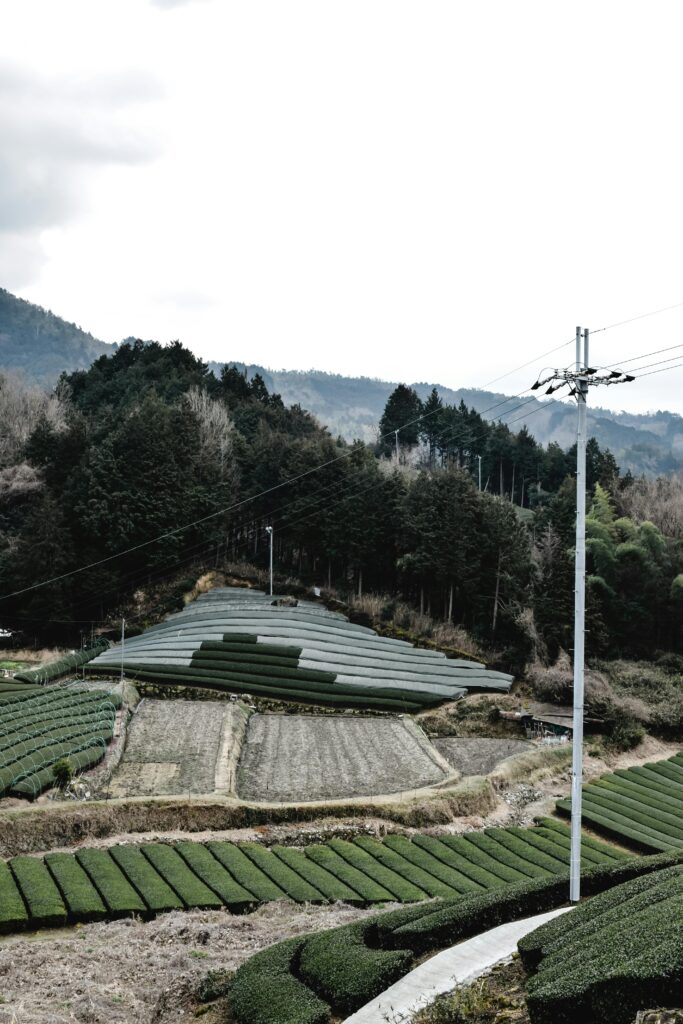
Jikagise: Direct Covering in Tea Cultivation
Jikagise describes direct covering of tea bushes. Learn how it differs from overhead shade without assuming fixed timing, hand-picking, or grade.Definition of Jikagise
Jikagise is a direct-covering approach in tea cultivation, with shading material laid onto the surface of the tea bushes before harvest. It differs from covering supported on an overhead frame. The arrangement alone does not determine shade intensity, covering duration, harvesting method, or the flavor and grade of the finished tea.
Learn more
Direct covering of growing tea plants
Jikagise is used here for the direct-covering approach to shading tea bushes. Kyoto Prefecture calls the method jikagake hifuku (直がけ被覆): shading material is placed directly on the surface of the tea plants. This is a physical arrangement of the cover, not a finished-tea grade.
The distinction from overhead covering is straightforward. In overhead or shelf-supported covering, a framework holds the material above the bushes. In direct covering, the canopy itself supports the material. This tells you where the cover sits, but not how dark the conditions are or how long the cover remains.
Materials and practical variables
Kyoto’s agricultural guidance identifies black shade cloth and materials with a silver-colored upper surface as common direct-covering materials. The method is therefore not limited by definition to one type of black fabric. A description of an individual field should identify its actual material rather than infer it from the method name.
Timing is another separate variable. Covering happens while shoots are growing, before picking. There is no fixed twenty-to-thirty-day requirement contained in the word jikagise. A producer may report a duration for a particular crop, but it should not be presented as the universal definition of direct covering.
Evidence on leaf chemistry
A 2016 Tea Research Journal study examined first-harvest shoots under different direct-cover shade rates over time. It found changes in shoot growth and several chemical components. Growth was lower at higher shade rates; epigallocatechin content also decreased as shading became stronger.
The response was not identical for every amino acid. The researchers reported higher theanine than in uncovered controls after twenty days at shade rates of seventy-five percent or more. This is an experimentally bounded result, not a recipe for every cultivar and field and not proof that direct covering always produces the sweetest tea.
Those findings are more informative than saying the technique delivers one precise flavor profile. The arrangement, light reduction, duration, growing conditions, and leaf material must be considered together. A change in one compound does not certify the taste, texture, or grade of the powder eventually made from the leaves.
Direct covering versus an overhead frame
Kyoto’s account presents both arrangements within covered cultivation. Overhead systems can use black cloth or traditional reed screens and straw. Direct covering does not require that same supporting framework. Neither term by itself tells the reader whether leaves were hand-picked or mechanically harvested.
Do not infer that direct contact always provides more consistent conditions, higher chlorophyll, or a more concentrated flavor than an overhead system. Such a comparison needs matched observations or experiments. The source cited here establishes the arrangements; it does not rank every crop grown under them.
Where matcha processing fits
Shading is only the cultivation part of the chain. MAFF explains that tencha is made from shaded shoots that are steamed and dried without rolling, then refined to remove stems and veins. Milling tencha produces matcha. Direct covering alone cannot establish that the finished product followed this processing route.
Nor does it explain a powder’s grittiness. Milling and preparation are distinct from placing a cover over growing leaves. Describing smooth texture as proof of jikagise confuses a sensory observation with evidence about the farm.
What to ask a producer
- Was the crop direct-covered or grown under an overhead frame?
- What material and covering duration were used for this harvest?
- Was the leaf processed as tencha or another tea?
- Is the harvesting method documented separately?
These questions preserve what is useful about the term while avoiding claims about mandatory hand-harvesting, guaranteed ceremonial suitability, or a centuries-old history for a particular modern fabric. A transparent process description is stronger evidence than judging the cultivation system from green color or a premium price.
Sources and references

Accessed: 2026-09-08
Language: ja
Covering during shoot growth; kabusecha, gyokuro and tencha as covered teas; overhead versus direct-cover arrangements; black cloth, silver-surfaced direct-cover materials, and traditional reed/straw honzu. Does not guarantee hand-harvest or grade.
Accessed: 2026-09-08
Language: ja
2016 abstract: greater shade reduced shoot growth and EGC; component responses changed with time; theanine higher than uncovered controls after twenty days at >=75% shade. Bounded experiment, not a mandatory schedule or guaranteed sensory profile.
Accessed: 2026-09-08
Language: ja
April 2022 overview: kabusecha about one week of covering; gyokuro about twenty days; Mie/Nara/Fukuoka listed for kabusecha; temperature-dependent brewing descriptions; tencha steamed and dried without rolling then refined and milled for matcha.
Author: Margot Claudel
Accessed: 2026-09-08
Language: en
English commercial usage of Jikagise for direct covering of bushes. Consulted only for the name; its quality rankings, timing, health and historical claims are not adopted. Physical arrangement is corroborated by Kyoto Prefecture.

Emilie Schol
Founder of Best MatchaFrequently asked questions
Here are some frequently asked questions and answers.What is the defining feature of Jikagise?
What is the defining feature of Jikagise?
The shade material rests directly on the tea-bush surface. Kyoto Prefecture describes this arrangement as jikagake hifuku, or direct covering.
Does it require twenty to thirty days of shade?
Does it require twenty to thirty days of shade?
No. The arrangement does not define the covering duration. Duration and shade intensity must be documented for the particular crop.
Does direct covering guarantee hand-picked ceremonial matcha?
Does direct covering guarantee hand-picked ceremonial matcha?
No. Covering arrangement, harvesting method, subsequent processing, and intended use are separate facts.