Asahina: Gyokuro Heritage, Not a Matcha Ranking
Asahina is known for gyokuro in Fujieda, Shizuoka. Learn why its shaded-tea heritage does not establish a top-three matcha ranking.Definition of Asahina
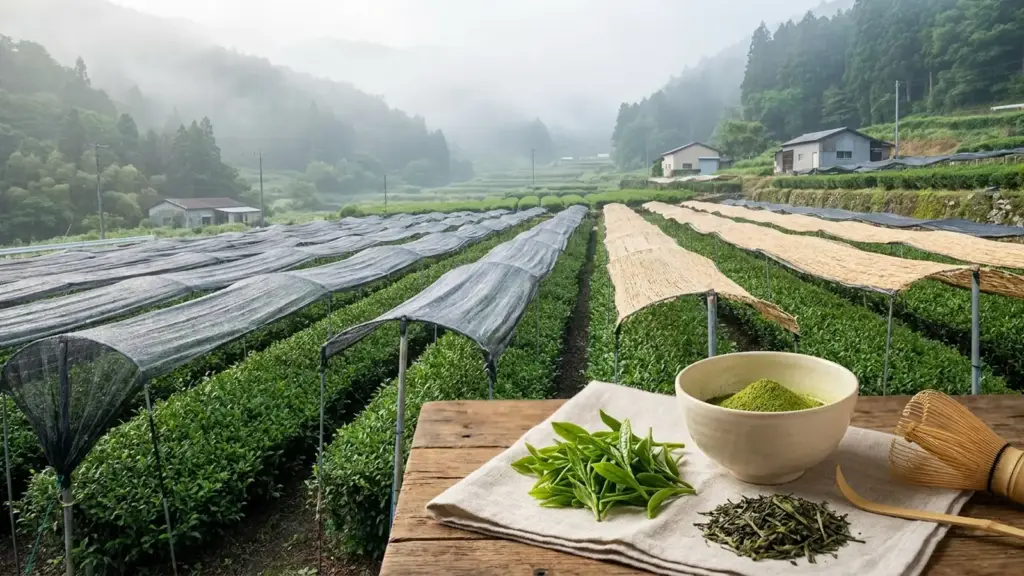
Asahina is a tea-growing area in Okabe, Fujieda City, Shizuoka Prefecture, Japan, best documented for gyokuro. Shizuoka identifies it among three major gyokuro production areas. That reputation concerns shaded leaf tea and does not establish a top-three matcha ranking or a uniform local powder.
Learn more
Asahina’s tea identity
Asahina is a tea-growing area in Okabe, within Fujieda City in Shizuoka Prefecture. The prefecture’s official food-culture account identifies Asahina as one of Japan’s three major gyokuro production areas, alongside Uji in Kyoto and Yame in Fukuoka. The category is gyokuro, not matcha. Preserving that distinction explains the area’s importance without turning a genuine reputation into an unsupported matcha ranking.
River and mountain context
Shizuoka’s account describes the Asahina River flowing through Okabe, with mountains on both sides and relatively cool mountain conditions. It traces tea production in the area to the Muromachi period. These details provide relevant geographical and historical context. They do not establish that the area lies at an intersection of other tea districts, or that mineral content and mist give every local powder a predictable flavour.
What gyokuro shares with matcha
Gyokuro and matcha are both associated with shaded tea cultivation, but shade does not make them the same product. Gyokuro is a leaf tea prepared as an infusion. The Japan Matcha Association defines the matcha route through tencha: steaming, drying without rolling and milling. A description of Asahina’s shaded leaf tea cannot automatically be applied to locally grown tencha or a finished matcha. Grinding an unspecified shaded tea is not enough to establish its category.
How to read the regional flavour description
The prefecture describes Asahina gyokuro as sweet and mellow with a characteristic aroma. Those words concern the tea discussed in that source. They should not become a guarantee that all Asahina matcha has seaweed notes, confectionery aromas or less bitterness than Uji matcha. Nor does the regional account supply a complete cultivar inventory for local matcha. Specific cultivars, hand-picking methods and shading schedules need support from an identified producer or product.
A local tea experience is not leaf-origin proof
Fujieda City’s visitor guide describes Gyokuro no Sato in the Asahina area, with a tea room, tea-related food and local produce. It is a concrete place to encounter the area’s gyokuro culture. A facility serving powdered tea, however, does not by itself establish where that powder’s leaves grew. Visitor experiences, sales locations and production origins answer different questions and should be labelled accordingly.
Selecting an Asahina-labelled tea
First confirm whether the product is gyokuro, tencha-based matcha or another powdered green tea. Then check grower or supplier, leaf origin and any stated cultivar or harvest. If the goal is to explore the local reputation documented by Shizuoka, Asahina gyokuro is the clearest starting point. If the goal is matcha, ask for the matcha’s own provenance rather than relying on the area’s leaf-tea awards. This retains the useful story of mountain cultivation and shaded tea while avoiding invented product names, unsupported producer counts and claims of superiority over other origins.
Sources and scope
Asahina Gyokuro | [Shizuoka Prefecture Official] Shizuoka Food Information Center; Gyokuro no Sato|Fujieda Tokaido town walk; What is MATCHA | Japan Matcha Association. Sources checked on 8 September 2026. Producer statements are attributed; they are not independent tests of every product.
Sources and references


Accessed: 2026-09-08
Language: en
Asahina is one of three major gyokuro areas, not a top-three matcha ranking. Asahina River/Okabe mountain setting, Muromachi tea history; sweetness/mellowness descriptions apply to gyokuro.
Accessed: 2026-09-08
Language: en
Gyokuro no Sato in Asahina, Okabe, Fujieda; tea experiences and local goods. A visitor facility is not proof of growing origin of each powder served.
Accessed: 2026-09-08
Language: en
Matcha uses tencha; fresh leaves steamed, dried without rolling and milled. Powdered sencha is distinguished from matcha. No health or historical claims adopted.

Emilie Schol
Founder of Best MatchaFrequently asked questions
Here are some frequently asked questions and answers.Is Asahina a top-three matcha region?
Is Asahina a top-three matcha region?
The official Shizuoka source identifies it as one of three major gyokuro production areas. That is not a matcha ranking.
Does shaded cultivation make gyokuro into matcha?
Does shaded cultivation make gyokuro into matcha?
No. Matcha uses tencha processed without rolling before milling. Shared shading does not make the finished teas interchangeable.
Where is Asahina’s documented tea visitor facility?
Where is Asahina’s documented tea visitor facility?
Gyokuro no Sato is in the Asahina area of Okabe, Fujieda City. Its tea service should not be treated as proof of the growing origin of every powder it serves.