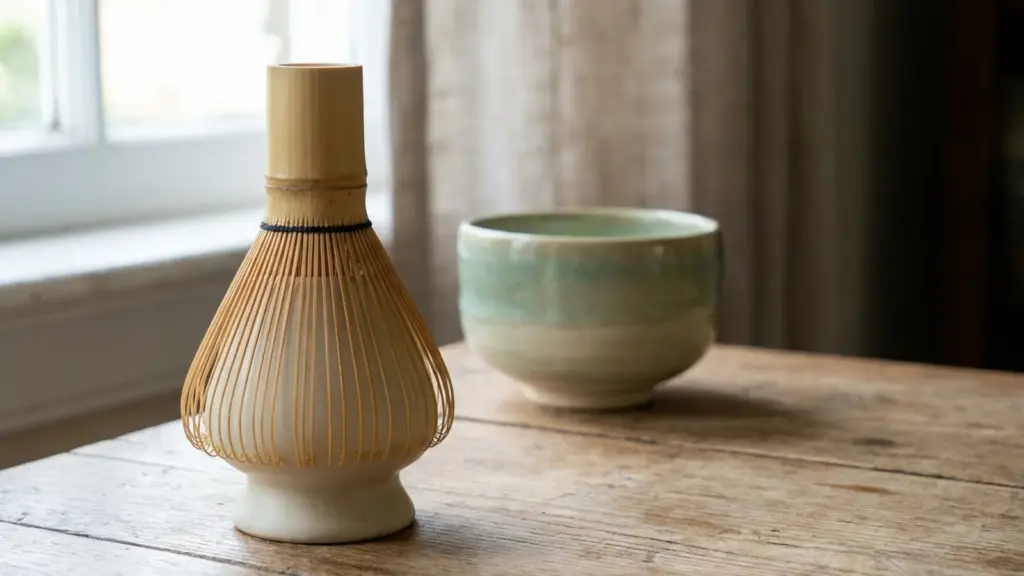
What the holder does
Kusenaoshi is a keeper used to support a bamboo chasen between matcha sessions. Hibiki-an explains that repeated use can change a whisk’s curvature and a keeper helps return it toward its curved form. The guide calls this useful, not essential.
Ippodo uses the product name chasen-tate for its ceramic stand. Its instructions place a rinsed whisk on the holder with tips facing down to dry between uses. This supports the shape-and-drying explanation without promising to restore every worn whisk.
Support is not repair
A stand provides a form for tines to rest around. It cannot join a broken tip or reverse all bamboo wear. Ippodo’s care guide says to replace a chasen when tips are broken, a clearer boundary than presenting the stand as a permanent solution.
The cited instructions establish no lifespan multiplier. Claims that a holder doubles or triples whisk life require a test specifying the whisk, use and handling. The purpose is care between sessions, not a guarantee of replacement savings.
A practical care sequence
Ippodo recommends wetting tips before use, rinsing with water without soap soon after preparation and gently removing stuck powder. Its advice to soak before use is intended to make tips less brittle. Follow the guidance for the particular whisk.
After rinsing, set the whisk on a compatible stand without forcing its tines against the form. Allow it to dry in open air. Ippodo warns that leaving it in its case can lead to mold. Supported, ventilated drying differs from enclosing a damp utensil.
Ceramic and wooden designs
Ippodo’s cited product is ceramic. Material and orientation are documented product facts, not proof that every ceramic stand has the same weight, drainage or surface properties. For a wooden design, check the maker’s description and maintenance instructions.
Do not assume wood restores internal tine spacing better or prevents mold by absorbing water. A ceramic label does not guarantee an unbreakable or maintenance-free object either. Shape, fit, surface condition and drying directions are more actionable than an unsupported material ranking.
Choosing a compatible stand
Check that the holder suits the whisk’s dimensions and form. Tines should not have to be forced into position. A chipped or rough contact surface deserves attention before use with delicate bamboo. Clean the holder according to its own material-specific instructions.
Aesthetic preferences can guide color, but do not substitute for fit. If buying a set, check that the seller intends the stand for that whisk. A matching appearance does not establish compatibility with every chasen you might later buy.
An optional part of care
The stand does not measure the quality of your tea or guarantee perfect foam. Its practical role is supporting the utensil during drying and storage. If you lack one, follow the whisk maker’s drying advice rather than enclosing the whisk while wet.
A kusenaoshi is an optional aid within a care routine, not a requirement for participating in Japanese tea culture. Respect for a crafted tool is better expressed through appropriate handling than exaggerated claims that one accessory prevents all damage.