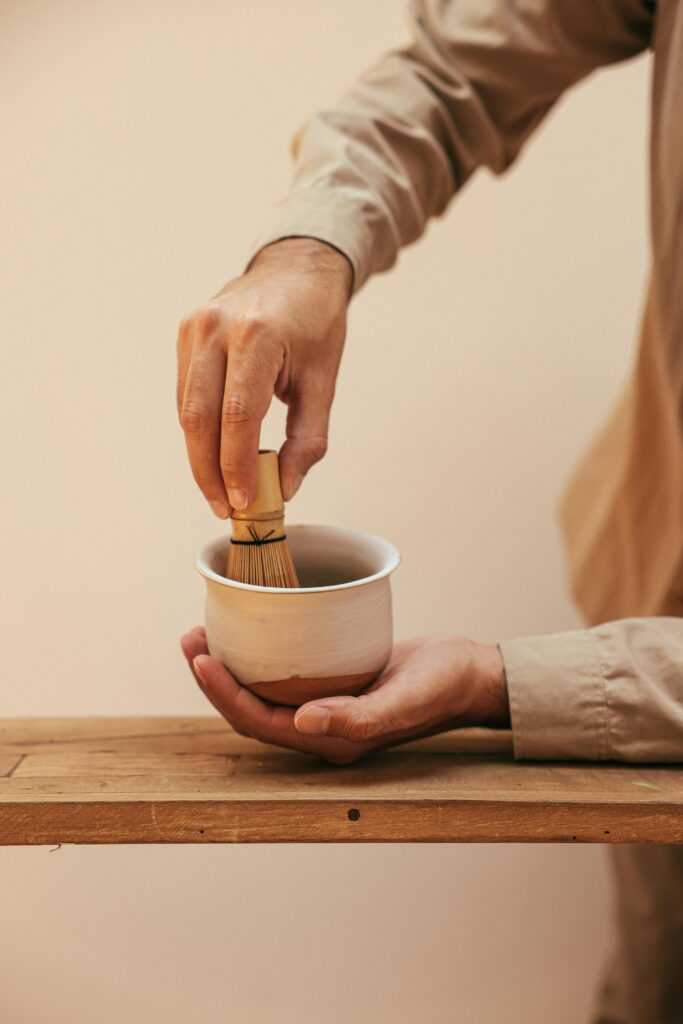
Defining Bamboo Whisk Care Fundamentals
Bamboo whisk care protects the thin tines of a chasen and keeps matcha residue from drying on the tool. It combines gentle handling, rinsing and an open drying place. No care routine guarantees that a handmade bamboo whisk will last a particular number of months or years.
Cleaning Your Bamboo Whisk Correctly
Ippodo Tea advises rinsing in plain water before the remaining matcha dries. If particles cling to the tines, gently brush them off with your fingers under water. Avoid harsh scrubbing or tugging at the tips.
For routine cleaning, use plain water rather than detergent, and clean by hand rather than putting the whisk through a dishwasher. Follow any more specific instructions from the maker of your whisk. Rinsing removes residue; it is not a claim of sterilization.
Pre-Use Preparation
Ippodo recommends placing the tips in water for a minute or two before whisking to make them more supple. This is a brief softening step, not prolonged soaking of the entire handle or a boiling treatment. New tips may open with normal use; do not pull them apart to force a particular shape.
Drying and Storage Best Practices
Let the clean whisk dry in open air. Ippodo recommends a clean chasen stand with the tips facing down to support the shape. Keep the drying area ventilated, and do not enclose the whisk while damp.
The shipping case is protective packaging, not a recommended everyday storage container. Ippodo specifically warns that mold may form if the chasen is kept in it. Drying time varies with conditions; do not assume that a fixed two-to-four-hour interval guarantees dryness.
The Role of Whisk Holders
A suitable stand supports the tines without forcing them. Keep the stand clean too, and allow airflow around the whisk. A stand is useful for shape retention, but there is no sourced promise that it doubles the whisk’s life.
Common Causes of Whisk Damage
Do not press or scrape hard against the bowl, crush the whisk in a drawer, or scrub the thin tines with force. A relaxed back-and-forth whisking motion lets the tips move through the drink. Heat, moisture and handling conditions vary, so a single household humidity band is not a guaranteed preservation rule.
Recognizing Replacement Signs
Ippodo Tea Global Support recommends looking at the tips: many broken tips combined with more difficult whisking suggest it is time for a replacement. Check for loose or splintering pieces before use, rather than waiting for the tool to stop producing foam. Foam alone is an unreliable condition test.
Ippodo also notes that a crack in the handle need not make a whisk unusable. Inspect its stability and the condition of the tines instead of automatically treating every cosmetic change as failure.
Addressing Mold Issues
If you suspect mold, stop using the whisk. The cited care guidance supports preventing damp enclosed storage, not a validated method for making a moldy whisk safe again. Do not rely on a vinegar rinse, citric-acid soak or brief boiling as proof that it is safe.
As a conservative precaution, replace a moldy food-contact whisk rather than trying to establish the depth of contamination at home. Ask the maker if marks are ambiguous, and improve the drying conditions before using a replacement. This is precautionary handling advice, not a tested decontamination protocol.
Extending Whisk Longevity
Rinse promptly, handle the tines lightly and make sure the whisk has an open drying place between uses. When preparing several bowls, leave time and space for cleaning and drying afterward. Buying several whisks is optional; a rotation is not a substitute for checking their condition.