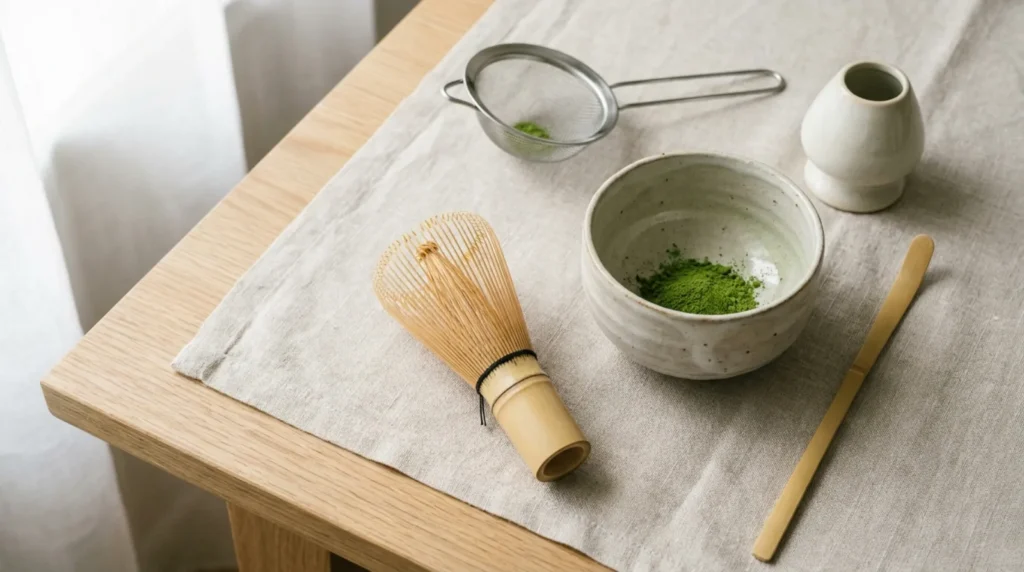
Short answer: You need three things: a bamboo matcha whisk (chasen), a wide bowl (chawan), and a fine-mesh sifter (furui). Everything else improves the ritual; nothing else changes the outcome as dramatically.
The difference between gritty, clumpy matcha and a silky, frothy bowl usually isn’t the powder. It’s the tools. The right setup aerates the tea, breaks up clumps, and gives you control over temperature. This guide covers the five traditional Japanese tools (chasen, chawan, chashaku, furui, and kusenaoshi), two modern alternatives worth knowing about, and exactly what to buy depending on where you’re starting. If you’re still choosing your tea, start with the guide to the best matcha. Shopping for a gift? A ready-made matcha set is the fastest shortcut to the whole toolkit.
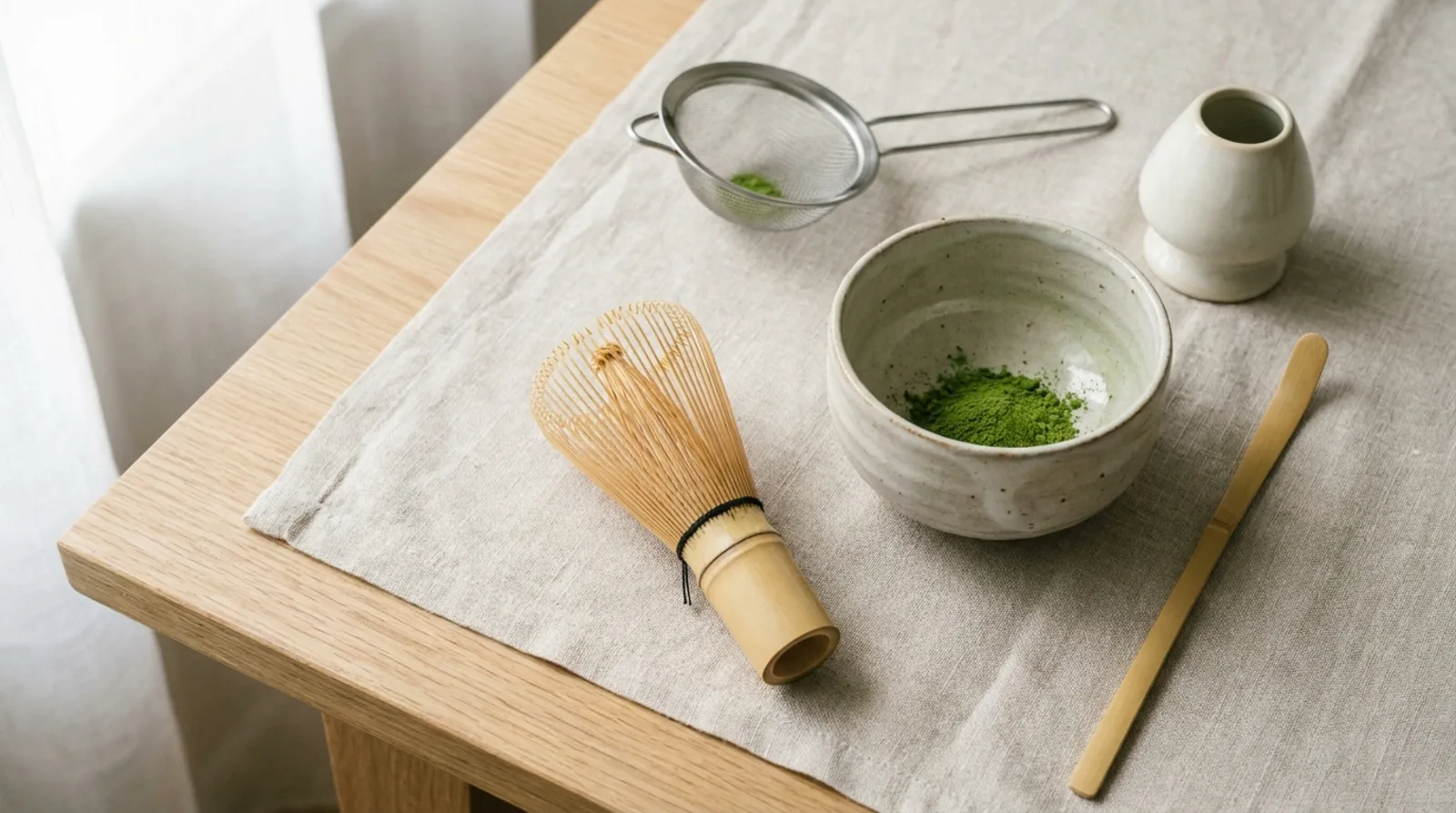
The complete starter kit: chasen whisk, chawan bowl, chashaku scoop, furui sifter, and kusenaoshi stand.
Want to compare every option yourself? Browse our matcha marketplace — 119+ Japanese brands you can filter by grade, origin, and certification.
The Essential Matcha Toolkit at a Glance
The full lineup, what each tool does, and whether it’s essential or optional. Read the table, then work through the sections below for the details that actually affect your bowl.
| Tool (Japanese name) | What it does | Essential? | Typical cost |
|---|---|---|---|
| Chasen (bamboo whisk) | Aerates the powder to create froth | Essential | Budget |
| Chawan (bowl) | Wide bowl giving the whisk room to move | Essential | Budget–mid |
| Furui (sifter) | Breaks up clumps before whisking | Strongly recommended | Budget |
| Chashaku (scoop) | Portions the powder gently | Optional | Budget |
| Kusenaoshi (whisk stand) | Holds the whisk in shape as it dries | Optional add-on | Budget |
| Electric frother | Fast froth for daily lattes | Alternative | Budget |
| Variable-temp kettle | Heats water precisely to 175°F | Optional upgrade | Mid–high |
Chasen: The Bamboo Matcha Whisk (Essential)
The chasen is the heart of the toolkit. It’s a single piece of bamboo, hand-carved and split into dozens of fine, springy prongs that fan out from a central core. Those prongs whip air into the tea and produce matcha’s signature creamy froth.
This is the one tool you cannot fake. A wire kitchen whisk underperforms badly, because its stiff, widely spaced loops can’t agitate ultra-fine powder the way bamboo can. You end up with a thin, bubbly liquid instead of a dense, velvety foam. The chasen’s flexibility and the sheer number of contact points are exactly what fine matcha needs.
80 vs. 100 Prongs: Which Should You Choose?
Prong count is the spec that confuses most shoppers. An 80-prong chasen is the everyday all-rounder and a solid first whisk. A 100-prong (or higher) whisk has finer, more numerous tines that produce a denser froth, especially good for thin tea (usucha). Fewer prongs make a sturdier whisk, better suited to whisking thick, paste-like tea (koicha). Beginners: an 80- to 100-prong chasen covers everything you’ll make.
What’s the Right Whisking Motion?
Technique matters as much as the tool. Whisk in a brisk W or M shape — quick up-and-down strokes from the wrist, not slow circles. Circular stirring just sloshes the tea around. The rapid back-and-forth motion drives air in and builds foam. Keep the whisk near the surface as the froth develops. For a full walkthrough applied to milk drinks, see the guide on how to make matcha latte.
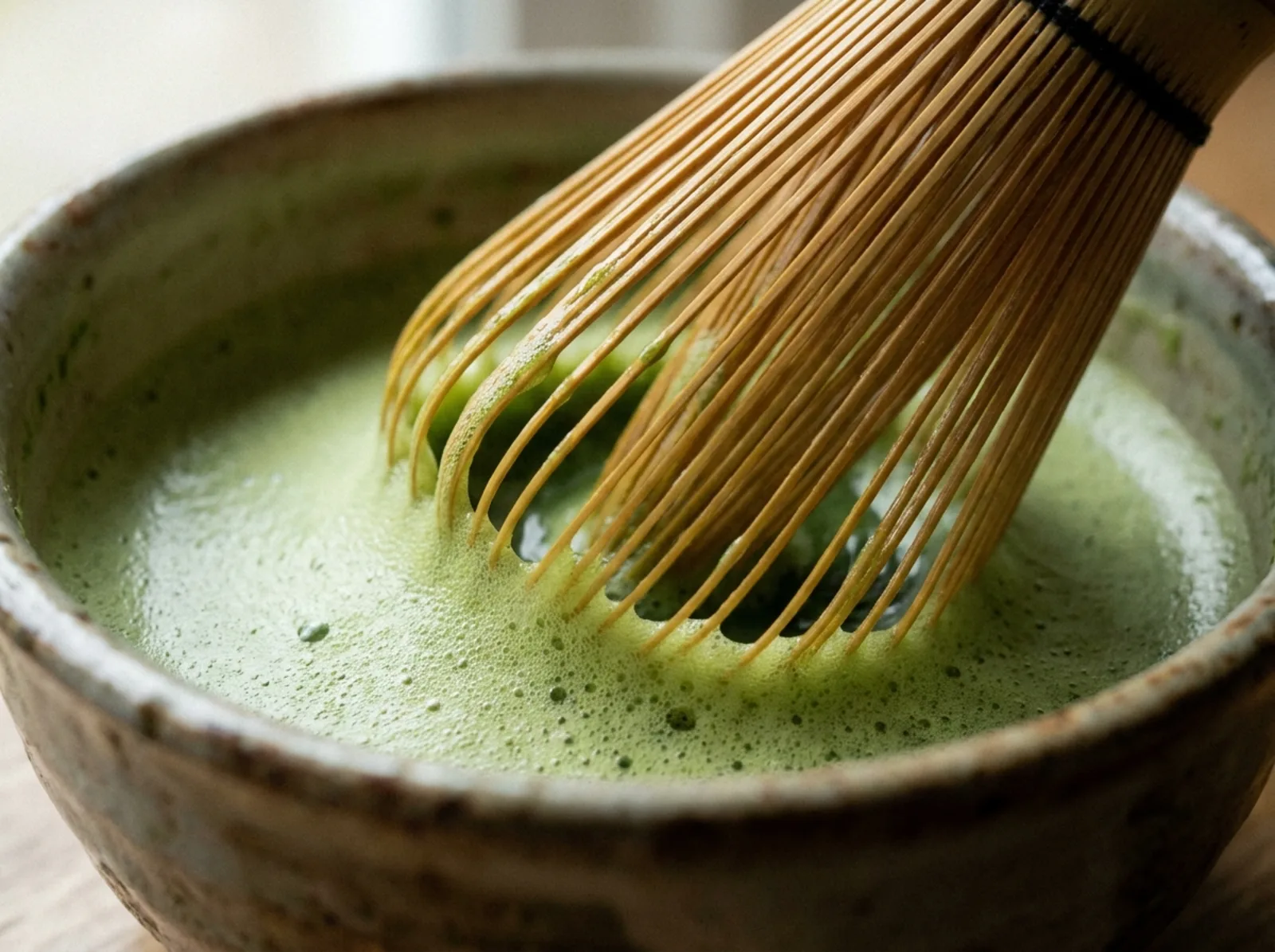
Quick W-shaped strokes near the surface build matcha’s signature creamy froth.
Chawan: The Matcha Bowl
The chawan is a wide, flat-bottomed bowl that gives the chasen room to move freely. That width is functional, not decorative: a narrow mug crowds the whisk and makes proper aeration nearly impossible. Traditionally, wider, shallower bowls are used in summer to cool the tea and deeper bowls in winter to retain heat. Skip the seasonal matching if you want, since one wide bowl handles both. A wide ceramic cereal bowl works in a pinch, as long as it has a flat base and enough surface area for the whisk to sweep across.
Chashaku: The Bamboo Scoop
The chashaku is a slender, hand-carved bamboo scoop for portioning the powder. One scoop is a small serving; two scoops equal roughly 2 grams, about right for a single bowl of thin tea. A regular teaspoon does the same job. But bamboo is gentler on the delicate powder, sliding under it cleanly without compacting or scattering it the way a metal spoon can.
Furui: The Sifter
If you only add one tool beyond the whisk and bowl, make it a furui. This fine-mesh sifter breaks up the clumps that form as matcha sits and compresses in its tin. Clumping is the single biggest cause of grainy, uneven tea. Sift the powder directly into your bowl before adding water and the chasen has far less work to do. Look for bamboo or static-resistant designs, which help prevent matcha from clinging to the mesh, a persistent annoyance with cheap metal sifters. Many are sold as a sifter-and-canister combo, so you can sift and store in one piece.
Kusenaoshi: The Whisk Stand
The kusenaoshi is a small ceramic stand shaped like a dome or pedestal. After rinsing, rest the wet chasen on it so the prongs dry in their natural bell shape rather than collapsing inward. Two benefits: it preserves the whisk’s curved form so it keeps whisking well, and it lets air circulate around the prongs to prevent mold. Inexpensive, takes up almost no space, and meaningfully extends the life of your whisk.
Modern Alternatives: Frother and Temperature Kettle
Two modern tools earn their place on the counter, especially for daily drinkers.
An electric milk frother or handheld frother produces froth fast and cleans up in seconds. It won’t replicate the dense, fine-bubbled crema of a well-whisked ceremonial bowl, but it’s a legitimate everyday alternative and excellent for travel. It shines with milk drinks, where the texture difference matters less — see the roundup of the best matcha for lattes if that’s your main use.
A variable-temperature kettle lets you hit roughly 175°F reliably, so you never scorch the tea with near-boiling water. Water that’s too hot pulls out bitterness and dulls the bright, sweet notes good matcha is prized for. Far more reliable than pouring off a rolling boil and counting seconds.
Reach for the chasen for a ceremonial-style bowl. Reach for the frother for a quick latte on a busy morning. Most regular matcha drinkers end up owning both.
What to Buy: Whisk Only, Set, or Starter Kit?
Your best purchase depends entirely on what you already own.
Just Starting: Buy a Starter Kit
A starter kit is the best value and the obvious gift choice. These typically bundle the whisk, scoop, and stand, and often a bowl: a coordinated, ready-to-use setup at a lower price than buying piece by piece. The Nami Matcha Starter Kit is a strong example of the format done right: it bundles a chasen, bamboo scoop, whisk holder, sieve, and a chawan, plus a 30 g tin of first-harvest Okumidori matcha from Kagoshima, so there’s nothing left to source separately before your first bowl.
Whisk Only: If You Already Have a Bowl and Sifter
If you’ve got a suitable wide bowl and a sieve in the kitchen, you may only need to add the one tool that can’t be substituted: the chasen itself. The safe choice is an 80-prong whisk from Takayama in Nara, the town where nearly every serious chasen has been carved for some 500 years. Rishi Tea’s Takayama Chasen fits the brief exactly: 80 prongs, hand-carved by the Kubo family in Takayama from white hachiku bamboo that’s been naturally dried and seasoned for two years before carving.
Full Traditional Set: The Complete Ritual
For the full experience, assemble the complete set: chasen, chawan, chashaku, furui, and kusenaoshi. This is the route for anyone who wants to do matcha properly, every time. If you’d rather get it in one order, Matcha Kari’s Premium Matcha Starter Kit, configured with the bowl-and-whisk option, covers all five: a hand-glazed chawan, an 80-prong bamboo whisk carved in Nara, a bamboo scoop, a stainless steel sifter made in Japan, and a whisk holder, rounded out with a tea caddy and 30 g of ceremonial matcha.
Accessories to Round It Out
Beyond the core tools, a few matcha accessories smooth out the daily routine: an airtight tin or canister for storage, a small cleaning brush, and a backup sieve. None are essential.
Care and Maintenance
A bamboo chasen rewards a little care and punishes neglect. After each use, rinse it in warm water with no soap, because detergent strips and weakens the bamboo. Reshape the prongs on the kusenaoshi and leave it to air-dry fully, prong-side up, with good airflow. Never let bamboo soak in standing water. Never put it in the dishwasher, where heat and harsh detergent will crack and splinter it fast. Replace your whisk once the prongs start breaking off or softening; a worn chasen simply can’t build proper froth.
Store your matcha sealed, cool, dark, and away from air and light, which degrade color and flavor quickly.
The Matcha Buyer’s Guide Hub: Choose the Right Matcha Without the Guesswork