Matcha may modestly support weight loss. Its main active compound, EGCG, can slightly increase fat oxidation (especially when paired with exercise), and the caffeine plus L-theanine combination can help curb stress-driven cravings. The evidence is mixed and the effects are small. Matcha works alongside a calorie-conscious diet and regular activity, not as a standalone fat burner.
Let me be honest up front: a daily bowl of matcha won’t melt anything off on its own. What it does is quieter than that. This guide covers the real science, how to actually use it day to day, and which matcha to pick if you want the most out of it. Matcha is the stone-ground powder of shade-grown Tencha leaves from the Camellia sinensis plant, and that whole-leaf format is exactly what makes the weight-loss conversation different from ordinary green tea.
A morning bowl of matcha pairs best with movement, not miracle claims.
This article is for general information only and is not medical advice. Matcha contains caffeine — if you are pregnant, caffeine-sensitive, or taking medication, check with your doctor before changing your intake.
Want to compare every option yourself? Browse our matcha marketplace — 119+ Japanese brands you can filter by grade, origin, and certification.
Matcha for weight loss: what the evidence shows
Yes, there’s a real effect, small but real: a marginal edge, not an engine. Researchers point to three overlapping mechanisms. First, EGCG (epigallocatechin gallate), the dominant catechin concentrated in matcha, may nudge up fat oxidation, particularly when you’re active. Second, the caffeine contributes mild thermogenesis and a bit more output during workouts. Third, the L-theanine and caffeine pairing produces calm, steady focus that takes the edge off stress snacking. Weight is just one of many matcha health benefits. Honestly, it’s one of the more modest ones.
One honesty flag: across the literature, results swing from a measurable 1 to 2 kg effect down to no significant difference at all, so don’t expect dramatic changes from matcha alone.
How much weight can matcha realistically help with?
Set expectations low. The green-tea trials that show anything at all tend to report differences on the order of 1 to 3 kg over 12 weeks, and those run on concentrated extract, not 1 or 2 daily bowls. At best, matcha gives you a supportive, single-digit-percent edge that compounds with good habits over months. Not a transformation. Anyone selling it as one is selling you something.
How Might Matcha Support Weight Loss?
The mechanism story, told straight. None of it is a guarantee, but each piece has a plausible basis.
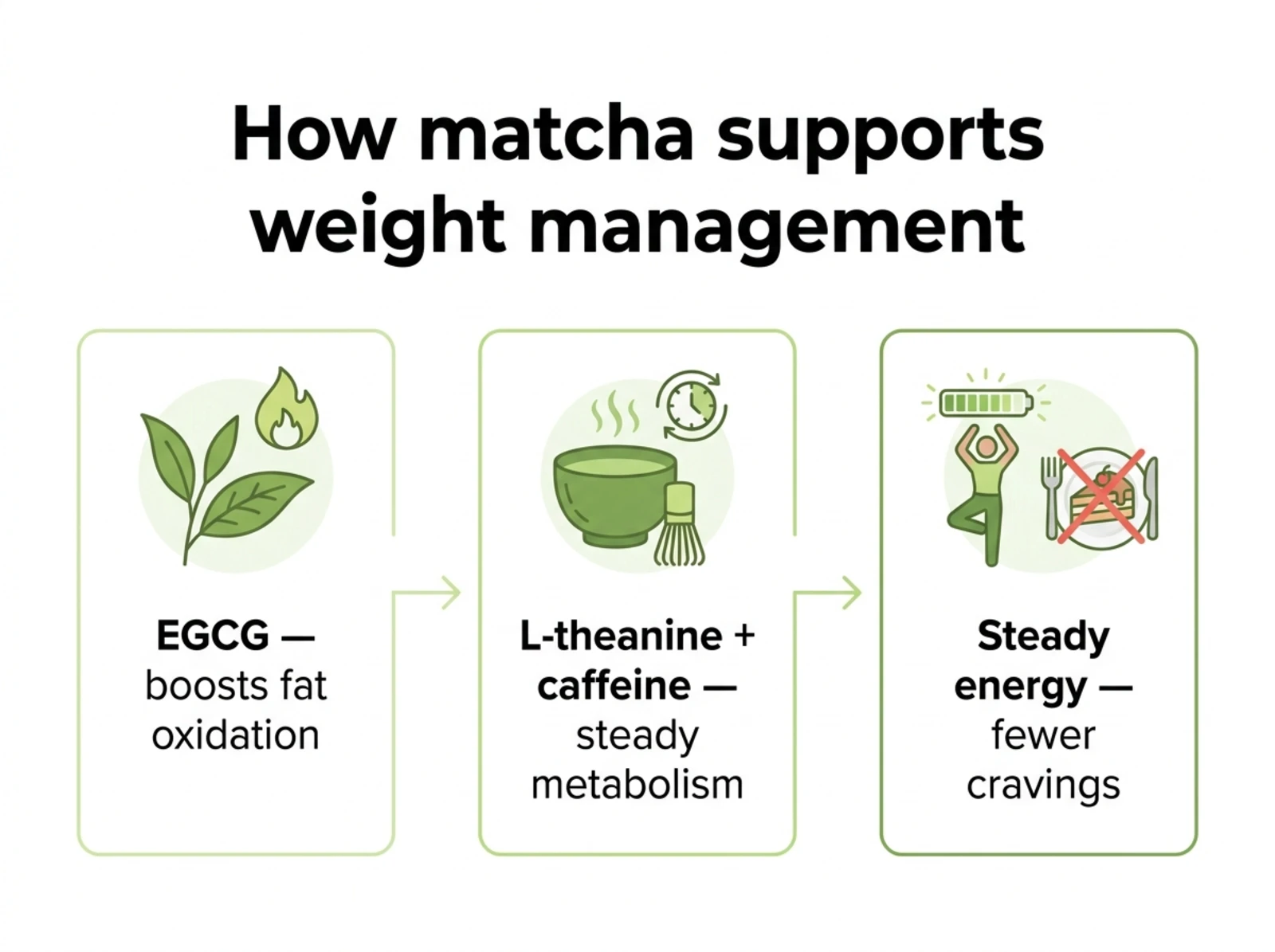
How matcha’s EGCG, caffeine, and L-theanine each play a small role in metabolism.
EGCG and fat oxidation
EGCG (epigallocatechin gallate) is the catechin everyone points to, and it’s the most abundant of the four green-tea catechins. Some studies suggest it can increase fat burning, with the strongest signal appearing when EGCG is combined with exercise rather than taken at rest (see the Sources below for the underlying green-tea catechin research).
The interesting thing about matcha specifically: you whisk and drink the whole powdered leaf instead of steeping and discarding it, so a single 2-gram serving delivers the compounds of the entire leaf rather than the 20 to 30 percent that leaches into a 200 ml cup of steeped Sencha green tea over 2 to 3 minutes. More leaf, more EGCG. That’s the logic, and it’s a reasonable one. Keep the word “may” attached to all of it.
Caffeine and metabolism
Caffeine drives mild thermogenesis: your body burns slightly more energy, and it lowers perceived effort during workouts. That’s a real, small effect. A 2-gram serving of matcha lands in the moderate range, roughly 60 to 70 mg of caffeine, below the 95 mg or so in a typical 240 ml cup of brewed coffee but above a steeped cup of green tea; if you want the full numbers and how it compares to coffee, the matcha caffeine page has the breakdown. The upshot is modest: a bit more energy in, a bit more energy out.
L-theanine, stress, and cravings
This is the lever people underrate. L-theanine, an amino acid abundant in shade-grown green tea and concentrated by the weeks of shading before harvest, works with caffeine to produce alert calm rather than a jittery spike (documented in matcha-specific clinical trials — see Sources below). Stress drives snacking. A calmer afternoon baseline can mean fewer reach-for-the-cookies moments. Indirect, yes. But anyone who’s stress-eaten through a bad workday knows it counts.
What the research actually shows (and its limits)
The evidence is modest and mixed. This is the part the “fat-burning tea” marketers skip.
Most cited studies are small, short, or run on concentrated green-tea extract rather than matcha itself. They often span just 8 to 12 weeks with a few dozen participants, and many pair the catechins with diet and exercise, which makes it genuinely hard to isolate what the tea contributed. Muddy the design and you can’t credit the tea cleanly.
There’s a line of emerging work worth noting: a 2022 study on the gut-liver axis found matcha eased high-fat-diet obesity and hepatic fat in mice, restoring gut microbiota and bile-acid changes. It’s preliminary, and much of it runs in mice rather than humans. An early thread, not proof of meaningful weight loss in people. I’d be misleading you to present it as more.
Bottom line: matcha is a helpful habit, not a treatment. If you have a medical condition or take medication, speak with a clinician first; catechins and caffeine can interact with some drugs.
How to use matcha for weight loss
Keep it simple: 1 to 2 cups per day, unsweetened, alongside a calorie-conscious diet and regular exercise. That’s the whole protocol.
The practical specifics, at a glance:
| Variable | Practical target |
|---|---|
| Serving | 1 to 2 grams of powder per cup |
| Daily amount | 1 to 2 cups, unsweetened |
| Water temperature | Around 80°C (175°F), never boiling, to avoid bitterness |
| Whisking water | About 60 to 70 ml per serving for usucha (thin) style |
| Best timing | Morning or 30 to 60 minutes pre-workout |
| Sweetener | Zero, or as close to zero as you can stand |
When Should You Drink Matcha for Weight Loss?
Two windows work best. Drink matcha 30 to 60 minutes before a workout so the caffeine and EGCG align with activity, right when the fat-oxidation signal is strongest. Or use it as a morning coffee swap to quietly cut a sugary drink out of your routine. Avoid late-day matcha if caffeine disrupts your sleep. Sensitivity varies, and the matcha caffeine page can help you gauge your own threshold.
Avoid the sugar trap
This is where most people undo the benefit. A serving of matcha whisked in plain water is essentially calorie-free, near 3 calories. Add 2 to 4 pumps of flavored syrup and 300 ml of whole milk and a cafe latte can climb past 200 to 300 calories, enough to erase any small metabolic edge. The drink that helped you is now the drink that didn’t. Whisk it traditionally in 80°C water, or keep sweetener minimal.
Do:
- Drink it unsweetened, or close to it
- Pair a serving with a workout
- Swap it in for sugary coffee drinks
Don’t:
- Lean on sweetened cafe lattes
- Expect results without diet and exercise
- Drink it late if caffeine disrupts your sleep
Best matcha for weight loss: the picks
The best matcha for weight loss is a high-EGCG, pure ceremonial grade matcha with no added sugar. Quality and catechin content matter far more than any “diet” or “slim” wording on the tin.
Why ceremonial grade? Ceremonial grade matcha comes from younger, shade-grown leaves that are stone-ground in granite mills at roughly 30 to 40 grams per hour, and it carries the highest EGCG content of any grade. The shading step, typically 3 to 4 weeks under cloth that blocks 85 to 90 percent of sunlight before harvest, is what builds up both the catechins and the L-theanine. More catechins per cup, more fat-burning potential per cup. If you’re drinking matcha partly for this reason, grade is where your money does the most work.
What to look for when you buy:
| Criterion | Why it matters |
|---|---|
| 100% pure, Japanese origin | No fillers, sugar, or mystery blends diluting the leaf |
| Vibrant jade-green color | A proxy for chlorophyll, freshness, and catechin density |
| First-harvest (ichibancha) | Younger spring leaves, the most prized and EGCG-rich |
| No added sugar or “diet” additives | Keeps the calorie count near zero |
| Third-party tested | Verifies purity and screens for heavy metals like lead and contaminants |
| Recent harvest date | Catechins and color fade over 6 to 12 months once a tin is opened |
Set a first-harvest Uji ceremonial matcha next to a culinary-grade tin and the color difference is immediately obvious: deep, saturated jade against a dull, yellowish-khaki powder. That color gap is real signal, not marketing.
Picks by use case
- Best overall: a first-harvest, single-origin ceremonial matcha from a named Japanese region such as Uji in Kyoto Prefecture, Nishio in Aichi, or Kagoshima. Vibrant color, verified sourcing, nothing added.
- Best budget: a clean entry-level ceremonial matcha that still lists harvest date and origin region. You trade some depth, not purity.
- Best for lattes: a robust late-first-harvest ceremonial that holds its flavor against 200 to 250 ml of oat or dairy milk, so you’re not tempted to sweeten it into a dessert. Use 2 grams of powder so the tea reads through the milk.
If you want to read an origin label with confidence, these are the regions worth recognizing:
| Region | Prefecture | First harvest | Known for |
|---|---|---|---|
| Uji | Kyoto Prefecture | Early to mid May | The historic home of Japanese matcha, prized for balanced umami |
| Nishio | Aichi Prefecture | Late April to May | A major production hub, smooth and approachable ceremonial grades |
| Kagoshima | Kagoshima Prefecture | Mid to late April | Southern, warmer climate; vivid color and brisk character |
| Yame | Fukuoka Prefecture | Late April to May | Smaller artisan output, deep sweetness from heavy shading |
For rankings, see the best matcha roundup, and the ceremonial grade matcha guide for picks with the highest catechin content per cup.
The honest takeaway
Pick a quality ceremonial grade matcha, drink it unsweetened, pair it with a sensible diet and regular movement. The whole formula fits on a sticky note: 1 to 2 bowls a day, 2 grams each, whisked in 80°C water, 30 to 60 minutes before you move. Small genuine edge, plus a drink you’ll actually look forward to, which counts for more than any miracle claim. Start with the best matcha picks.