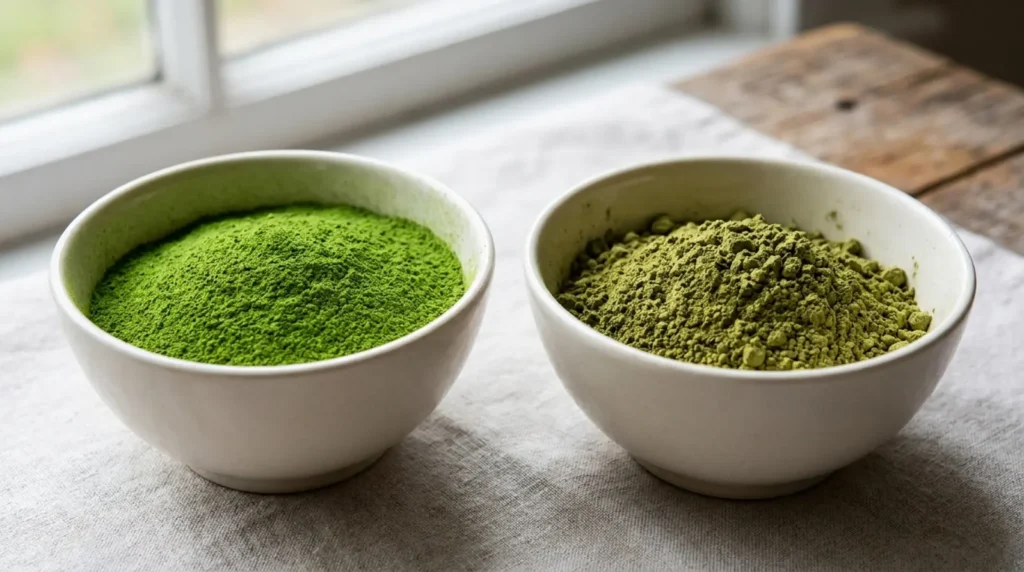
High quality matcha is shade-grown, stone-milled, sourced from a named Japanese region, and harvested within the past year. You can confirm all four in under 60 seconds using sight, touch, smell, and taste.
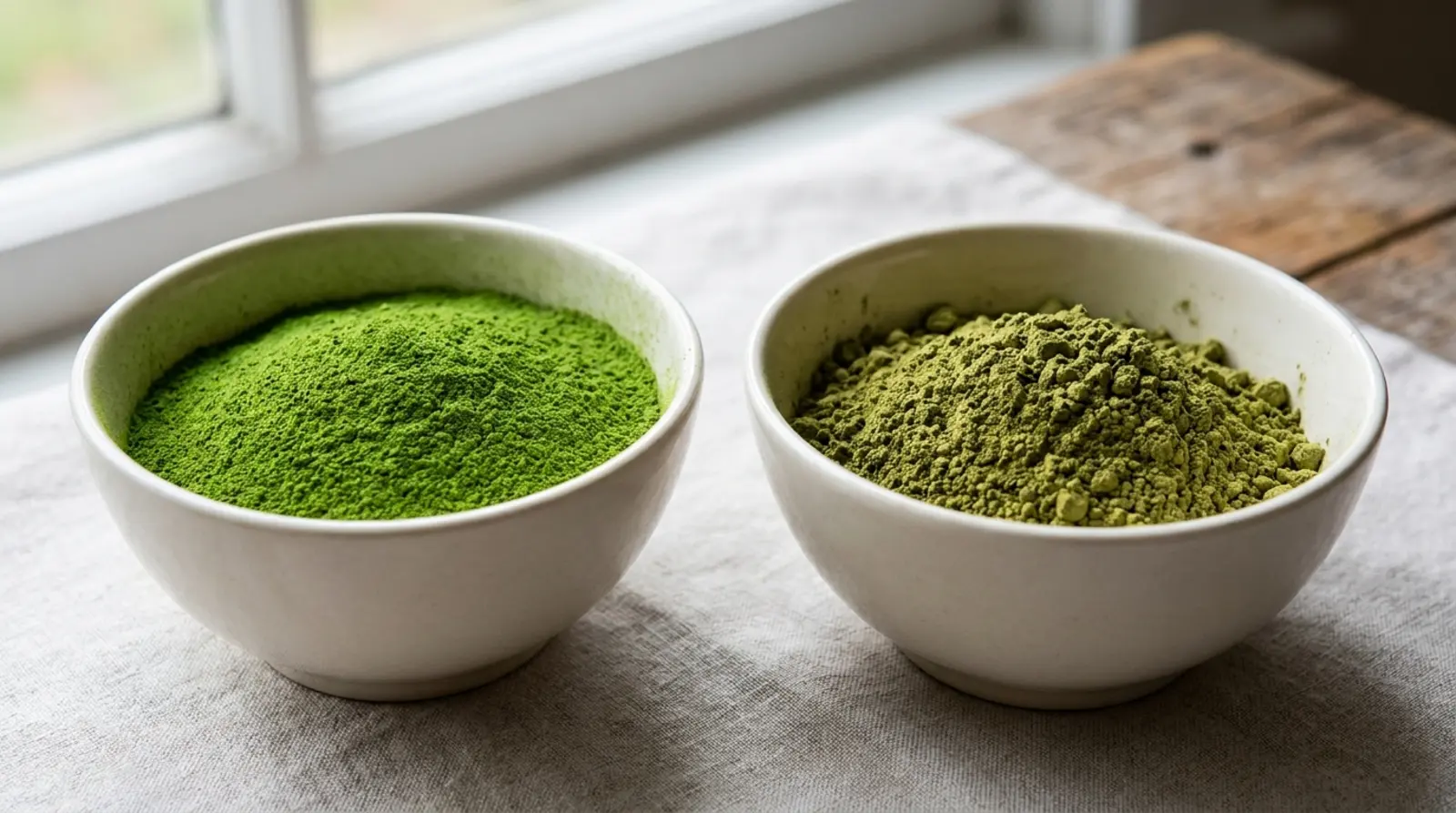
The color gap is the fastest tell: vibrant emerald on the left, lifeless olive on the right.
Most “matcha” on store shelves is dull, bitter, coarsely ground culinary powder, sold at premium prices and dressed up with words like “ceremonial” and “100% natural.” If you have ever whisked a cup that tasted like fishy, astringent hay, you were not doing it wrong. You were probably handed low-grade tea.
Quality is learnable fast. This guide gives you 8 checks: 4 sensory tests (color, texture, aroma, taste) plus 4 label checks (origin, grade, freshness, price). Run all 8 in under 60 seconds and you get a complete picture. Want the bigger picture first? See the pillar guide to the best matcha.
Want to compare every option yourself? Browse our matcha marketplace — 119+ Japanese brands you can filter by grade, origin, and certification.
What Makes Matcha “High Quality”?
High quality matcha is shade-grown tea from young, tender leaves, stone-milled into an ultra-fine powder and recently harvested from a reputable Japanese region such as Uji, Nishio, or Kagoshima. Each of those production choices leaves a visible, tangible, smellable, and tastable fingerprint in the finished powder. That is why you can evaluate quality without lab equipment.
Think of the evaluation in two halves. Sensory tests tell you what is in the tin right now: vivid emerald color, baby-powder texture, fresh grassy-sweet aroma, umami-forward taste. Label tests tell you whether the producer earned that quality and can keep it consistent: a named Japanese origin, an honest grade, a recent harvest date, a price that lines up with reality. Strong matcha passes both. Sections below walk through each signal and the red flags that betray inferior powder.
1. Color: Vivid Emerald, Not Olive or Yellow
Color is the highest-signal test you can run, and it works before you ever open the tin. High quality matcha is a vivid, almost electric emerald green. That intensity comes from chlorophyll the plant builds up during several weeks of shade-growing, when leaves are deprived of direct sun and respond by packing in pigment.
Lower-quality matcha gives itself away immediately. Olive, khaki, dull, yellowish, or brownish tones point to older more mature leaves, often from the second or third flush picked in summer rather than the first flush harvested in spring, plus oxidation from age, too much sun during growing, or simply stale stock. A muddy green is never a good sign, regardless of what the label promises.
Why Does Color Signal Quality?
Shade-growing is the mechanism. Covering the tea plants for several weeks before harvest spikes chlorophyll production, which is why first-harvest, well-shaded leaves from regions like Uji (Kyoto) and Nishio (Aichi) yield that signature emerald. Lower grades use more mature, less-shaded leaves picked later in the season. They simply cannot reach the same vivid green.
Practical tip: always judge color in natural daylight, ideally against a white spoon or sheet of paper. Brand photos are routinely color-corrected and saturated to look 1 or 2 shades greener than the actual product, so trust the powder in your hand over the image on the website.
2. Texture: It Should Feel Like Baby Powder
Genuine stone-milled matcha is astonishingly fine (roughly 5 to 10 microns) and feels silky and weightless between your fingers, like baby powder or a pressed eyeshadow. That fineness is not cosmetic. It lets the powder suspend evenly in water, which is the whole point of drinking the whole leaf.
Grainy, sandy, or gritty powder was coarsely milled or machine-ground rather than stone-milled. Coarse matcha clumps, sinks, and refuses to whisk into a smooth suspension, leaving a chalky cup with sediment at the bottom.
What Is the Sift Test?
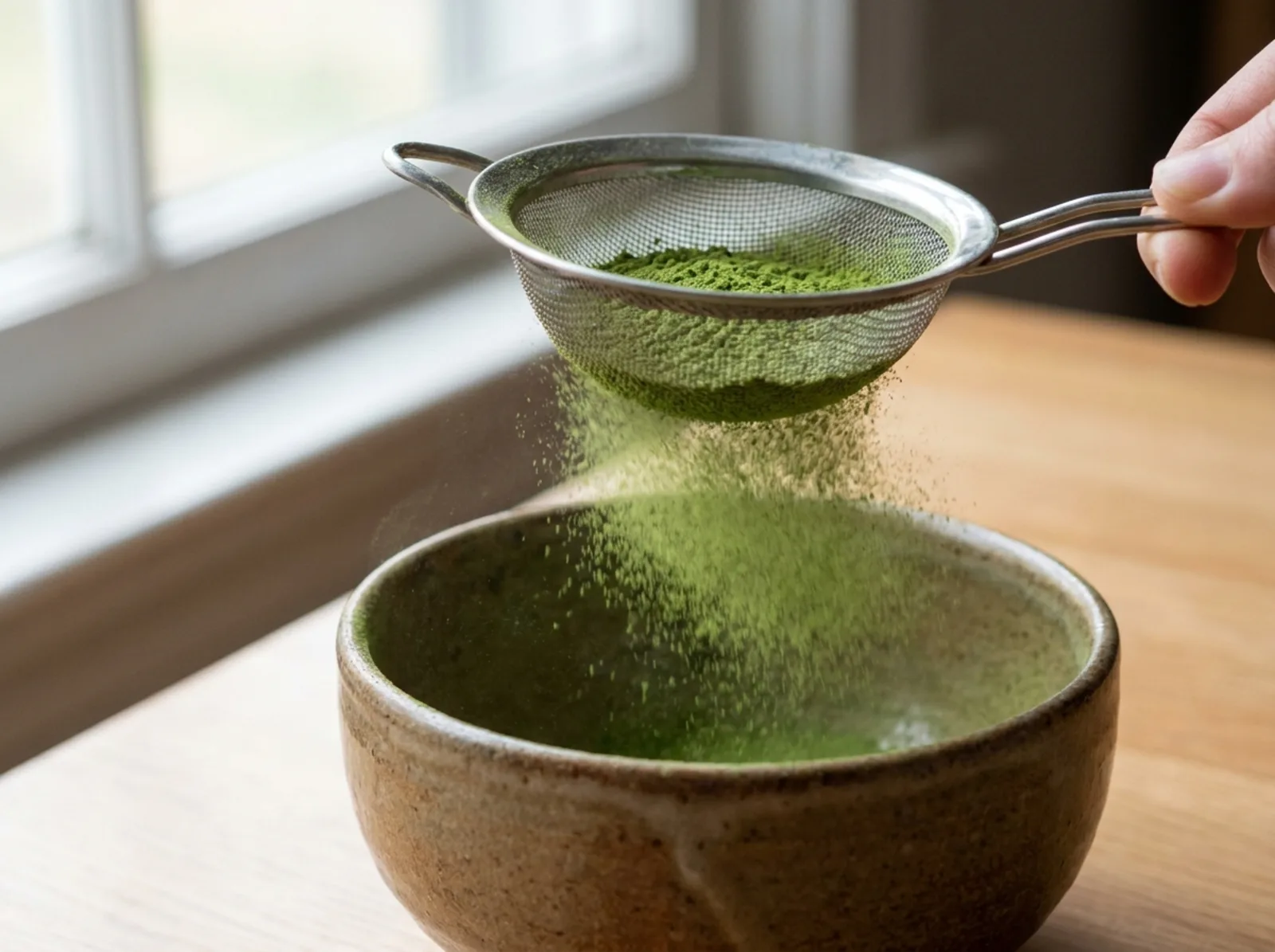
Stone-milled powder falls like a soft cloud, leaving almost nothing in the mesh.
Quality matcha sifts effortlessly through a fine strainer, falling like a soft cloud with almost nothing left behind. Gritty powder catches in the mesh and leaves coarse residue you have to push through. Fineness also dictates how well the powder whisks up; the right matcha whisk, a bamboo chasen of 80 to 100 prongs, makes a fine powder bloom into a thick froth in 15 to 20 seconds of brisk zig-zag whisking, but no tool rescues a coarse grind.
3. Aroma: Fresh, Grassy, Sweet
Open the tin and breathe in. High quality matcha smells fresh, vegetal, and grassy-sweet, often with a subtle marine or umami note that hints at the savory cup ahead. The aroma should feel alive and bright.
The red flags are unmistakable: hay-like, musty, fishy, or flatly nonexistent smell signals stale or oxidized tea. Matcha that smells of nothing has lost its volatile aromatics to time and air.
Why Smell Matcha Before You Buy?
Aroma is also a freshness gauge. The bright grassy scent fades within weeks once a tin is opened and the powder meets oxygen. A strong, fresh aroma tells you the matcha is high quality and recently packed. If a retailer offers a sample or open tester, use your nose first: it is the single fastest of the 8 quality reads.
4. Taste: Umami With Natural Sweetness
The mouthfeel test is the payoff. High quality matcha is smooth, creamy, and umami-rich, with a lingering natural sweetness and only gentle astringency. It should coat the palate and finish clean, leaving you wanting another sip rather than reaching for sugar or milk to cover it.
Inferior matcha announces itself on the tongue: harsh biting bitterness, a chalky or sour finish, or flat cardboard-like flavor with no depth. Those are the hallmarks of mature leaves, poor processing, or age.
L-theanine and umami
There is real chemistry behind the sweetness. The roughly 20 to 30 days of shading before harvest raise levels of L-theanine, the amino acid responsible for matcha’s sweet, savory, brothy character, while simultaneously lowering the harsh catechins that drive bitterness. The best tencha is shaded under tana canopies that block 90 percent or more of sunlight. More shade and younger leaves mean more umami and less bite.
Bitterness is not always the matcha’s fault
Before condemning a tin, check your preparation. Water near boiling, or too much powder for the volume, pulls out bitterness from even good matcha; aim for water around 70 to 80°C (158 to 176°F) and about 2 grams of powder to 60 ml of water. The key difference is forgiveness: high quality matcha stays pleasant across small preparation mistakes, while low-grade powder turns acrid the moment anything is slightly off.
5. Origin: Where the Leaves Were Grown
Authentic Japanese matcha comes from a short list of 4 revered growing regions, and origin is one of the most reliable label signals you have. The names to look for: Uji (Kyoto), Nishio (Aichi), Kyoto more broadly, and Kagoshima. Uji in Kyoto Prefecture is the historic gold standard and the birthplace of Japanese tea culture. Nishio sits in Aichi Prefecture, and Kagoshima Prefecture, in the far south, has become a source of excellent-value matcha with consistent quality.
The red flags are about omission. Matcha with no stated country of origin, or tea quietly sourced from non-Japanese regions and sold as premium Japanese product, should make you cautious. Transparency about where the leaves grew is a marker of a producer with nothing to hide.
Named Region vs. Vague Blends: Which Matters?
A trustworthy tin names a specific region or even a specific farm: “Uji, Kyoto Prefecture” or “Nishio, Aichi Prefecture” rather than a bare “Product of Japan.” Vague phrasing such as “Japanese-style,” “Asian green tea,” or simply silence on origin often hides a blend or a non-Japanese source, frequently from China or Vietnam sold at a Japanese markup. Producers who name a town and a harvest year tend to be more transparent than those that state only a country. The guide on where to buy matcha covers transparent, origin-stated sellers worth trying.
6. Grade: Ceremonial, Latte, or Culinary
Grade and quality are correlated, but here is the honest truth most brand-owned guides skip: grade terms are marketing, not a regulated standard. No legal body certifies that a tin labeled “ceremonial” meets a defined bar, so the word alone proves nothing. Context and the sensory tests above matter far more.
The terms still carry meaning when used in good faith. Ceremonial grade matcha is made from the first harvest, the spring first flush picked around April and May, and the youngest, most tender top 2 to 3 leaves of each shoot, intended to be drunk simply with hot water. It represents the highest raw quality. Latte grades are built to shine through milk. Culinary grades are made for baking and cooking. For the full breakdown of all 3 tiers and how they differ, see the explainer on matcha grades.
How Do You Match Grade to Your Use?
Buying smart means matching grade to intent. Do not pay ceremonial prices of $1 to $2 per gram for a latte you are going to mask with oat milk and vanilla. A good latte grade costs less and will taste better in that cup. Reserve the ceremonial tins for the 1 or 2 cups a day you drink matcha straight, where you can actually taste the difference.
7. Freshness and Storage: Quality Degrades Fast
Even perfect matcha decays, and it decays quickly. The powder oxidizes fast once it meets air, light, and warmth, so freshness is non-negotiable. Look for a harvest date or a “best by” date on the tin, ideally one that places the harvest within the last 12 months, since most matcha is at its peak for 6 to 12 months after milling. A producer confident in their freshness tells you when the tea was picked.
Once it is yours, store matcha airtight and cold (the refrigerator, around 4°C, works well) and keep it away from light, air, heat, and strong odors, which the powder absorbs readily. Once a tin is open, aim to finish it within 1 to 2 months while the aroma is still bright. Red flags are easy to spot: no date on the packaging, clear or transparent containers that let light degrade the powder, and loose bulk bags that cannot be resealed.
Packaging tells you who cares
The container is a quiet quality signal. The best matcha ships in resealable, opaque 20 to 40 gram tins (better still, nitrogen-flushed packaging that displaces oxygen) from a producer who understands how fragile matcha is and has invested in protecting it. Cheap clear pouches with no reseal mechanism suggest the opposite.
8. Price: What Quality Actually Costs
Price is a useful sanity check, even though it is not proof on its own. Real ceremonial matcha generally runs roughly $1 to $2 or more per gram, which works out to about $30 to $60 for a standard 30-gram tin. A tin labeled “ceremonial” priced far below that, say a 30-gram tin at $10, is a red flag. Genuine first-harvest, stone-milled tea simply cannot be produced that cheaply.
The reverse trap is equally real: price alone does not guarantee quality, because slick marketing inflates the price of mediocre powder constantly. A high price tag is necessary but not sufficient. Always cross-check it against the other 5 signals: color, texture, aroma, origin, and freshness.
Where Are the Value Sweet Spots?
You do not have to pay top-tier ceremonial prices to drink well. Matcha from Kagoshima Prefecture and honest latte grades consistently deliver real quality at a friendlier cost, often near the lower $1-per-gram end, especially for everyday lattes. That is where most buyers find the best balance.
Label Red Flags at a Glance
When a tin trips any of these wires, slow down:
| Red flag | What it suggests |
|---|---|
| No stated origin | No country, region, or producer named |
| No harvest or best-by date | Producer is hiding stale stock |
| “Ceremonial” at a bargain price | First-harvest grade is not cheap to produce |
| Vague language (“Japanese-style,” “matcha blend”) | Often covers a non-Japanese source |
| Clear or transparent packaging | Light degrades the powder fast |
| “100% natural” with no sourcing detail | Marketing phrase standing in for actual transparency |
Good brands are transparent about origin, harvest, and grade. Vagueness is the tell.
Quick Quality Checklist
Screenshot this and take it shopping:
- Vivid emerald green, not olive or yellow
- Baby-powder fine at 5 to 10 microns, no grit
- Fresh grassy-sweet aroma
- Umami with natural sweetness, only gentle astringency
- Named Japanese origin (Uji in Kyoto, Nishio in Aichi, or Kagoshima)
- Stated harvest or best-by date within about 12 months
- Opaque, resealable, dated 20 to 40 gram tin
- Grade matched to use; about $1 to $2 per gram for ceremonial
Hit most of these and you are holding genuinely high quality matcha.
The 60-Second Verdict
Run all 8 checks above on any tin before you buy. The 4 sensory tests: vivid emerald color, 5-to-10-micron baby-powder texture, grassy-sweet aroma, umami taste. The 4 label tests: a named origin like Uji or Nishio, an honest grade, a harvest date within 12 months, and a $1-to-$2-per-gram price that reflects real production costs. High quality matcha clears all 8 bars. Low-quality powder fails at least one visibly. When you are ready to buy, start with the guide on where to buy matcha and review the tiers in the matcha grades explainer.
The Matcha Buyer’s Guide Hub: Choose the Right Matcha Without the Guesswork